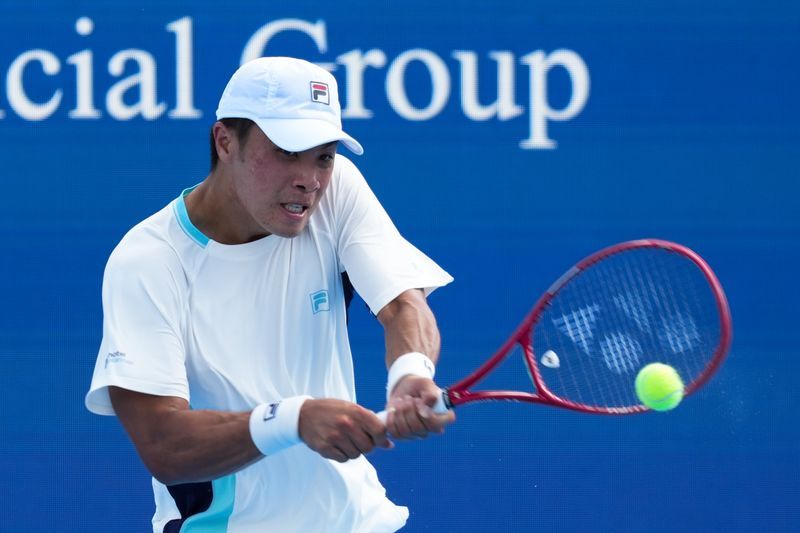
Brandon Nakashima delivered a commanding performance at the Cincinnati Open on Friday, overcoming a set deficit and a service break in the final set to eliminate fellow American Taylor Fritz 7-6(9) 4-6 6-3. The 25-year-old's third-set recovery proved decisive, showcasing the resilience that has defined his recent tournament run and positioning him as a serious contender on the North American hard court circuit.
Nakashima's victory marks a significant milestone in his career trajectory, as he has now secured spots in the semifinals at consecutive Masters 1000 events following his deep run in Montreal the previous week. This consecutive appearance at the sport's elite tier of tournaments demonstrates a consistency at the highest level that suggests the American is transitioning from promising prospect to established competitor. His trajectory through August has redefined expectations around his capabilities during one of tennis's most demanding stretches of the calendar.
The opening set epitomised the calibre of competition between the two Americans, with both players demonstrating exceptional serving prowess. Neither competitor gave ground easily on their own deliveries, forcing the set into a tiebreaker where precision and composure became paramount. Nakashima ultimately prevailed in the tiebreak through superior play at critical junctures, converting his fifth set point when Fritz's return went marginally long. This opening victory provided Nakashima with a psychological advantage, though Fritz remained dangerous throughout.
Fritz responded emphatically in the second set, employing aggressive return-of-serve tactics that disrupted Nakashima's rhythm. Breaking his opponent early, Fritz capitalised on his aggressive positioning and closed the set with an ace, forcing the match into a decisive third frame. The pattern reflected a common dynamic in American tennis currently, with both players possessing the weapons to impose their will through sustained pressure and tactical nous.
The final set became the arena where Nakashima's superior mental fortitude emerged most clearly. Despite falling behind 3-2 when Fritz converted an early break of serve, Nakashima demonstrated remarkable composure in recovery situations. Facing 30-0 down at a critical juncture, Nakashima clawed back to convert his second break point and level the match at 3-3. This sequence proved pivotal, as the momentum shift proved irreversible for Fritz.
With the match delicately balanced at 3-3, Nakashima seized control through superior execution and defensive positioning. He won the final three games of the match as Fritz's error count mounted and his confidence visibly eroded. The 27th seed's ability to maintain composure while capitalising on opponent mistakes reflects a maturity beyond his years and experience level. This closing sequence represented the fruits of his recent intensive tournament schedule, where repetition at the highest level sharpens instinctive decision-making.
This victory extended Nakashima's remarkable recent form into the upper reaches of the sport's ranking system. His record against Fritz coming into this match stood at a modest 1-4, making the straight-sets nature of his final-set dominance even more impressive. The psychological weight of overcoming an unfavourable head-to-head record while recovering from adversity within the match underscores the mental components underpinning his recent ascendancy.
Nakashima's performance also reinforced his standing as a top-10 threat, with this win representing his fourth victory over top-10 ranked opponents during the 2024 season. This metric provides objective evidence of his elevation to a new competitive tier. The frequency of such victories suggests that Nakashima has not merely enjoyed a hot streak but rather has developed the tactical awareness and shot-making consistency required to compete with tennis's elite performers on consistent basis.
Looking ahead to the semifinals, Nakashima will face either Italian 10th seed Lorenzo Musetti or fellow American Frances Tiafoe. Regardless of his opponent, Nakashima enters as the favoured player given his recent form and the visible confidence radiating from his movement and decision-making. A potential all-American semifinal against Tiafoe would represent the depth of emerging talent within the United States men's tennis contingent.
For Malaysian and Southeast Asian tennis enthusiasts, Nakashima's rise carries broader significance regarding the evolving competitive landscape leading into the U.S. Open, commencing later in August. The hard courts of the Americas remain the proving ground where young American players traditionally establish themselves at the highest level. Nakashima's performance suggests the next generation of American tennis is prepared to mount genuine challenges at Grand Slam tournaments, potentially reshaping the competitive hierarchy heading into autumn's elite events.
The timing of Nakashima's breakthrough run assumes particular importance given that major tournaments increasingly favour players who can sustain intensity across multiple matches within compressed timeframes. His consecutive Masters semifinals demonstrate an ability to manage the physical and mental demands that distinguish elite performers from capable competitors. As the circuit moves toward the season's biggest stages, Nakashima's upward trajectory suggests American tennis may be entering a period of renewed competitiveness at the highest level.

