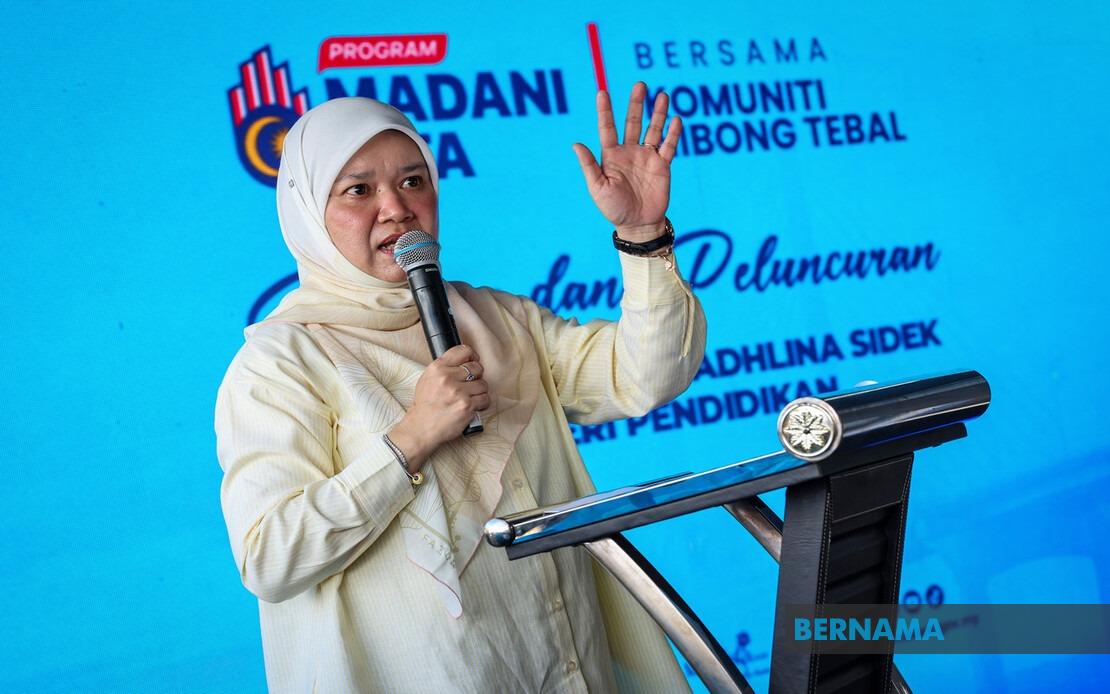
Education Minister Fadhlina Sidek has praised the NADI Mahir initiative as a meaningful intervention that addresses a persistent concern for Malaysian households—the upfront cost of school uniforms. Speaking in Nibong Tebal, Fadhlina noted that the instalment purchase scheme is demonstrating tangible benefits for families navigating tight budgets while trying to meet back-to-school expenses. The programme represents a practical policy response to a challenge that affects working-class and middle-income parents across the country, particularly during the school calendar's transition periods when multiple uniform sets must be purchased simultaneously.
Beyond its direct assistance to parents, the NADI Mahir initiative embodies a broader strategic philosophy: using social programmes to simultaneously address consumer needs and foster entrepreneurial activity. The school uniforms sold through the scheme are manufactured by 120 former trainees of the NADI Mahir Jahit sewing programme, individuals who completed skills development courses offered through NADI's Pintar Services platform. This structural design ensures that economic activity generated by the initiative flows back to local producers rather than flowing out to larger commercial entities, creating what the minister characterised as genuine income opportunities for community members who have invested time in developing marketable skills.
Fadhlina, who serves as Member of Parliament for Nibong Tebal, offered her constituency as evidence of the initiative's grassroots relevance. Her remarks came during the officiating of the MADANI Kita programme in the constituency, indicating a government push to showcase social programme implementation at the local level. The presence of Ministry of Communications (Telecommunications Infrastructure) deputy secretary-general Mano Verabathran and Malaysian Communications and Multimedia Commission State Affairs chief officer Bukhari Yahya reflected the multi-agency coordination required to deliver such initiatives, suggesting that education-focused programmes increasingly intersect with digital infrastructure and connectivity considerations.
The NADI ecosystem extends well beyond uniform procurement. According to Fadhlina, the National Information Dissemination Centre has deployed a diverse portfolio of interventions targeting different demographic segments and social challenges. The NADI Tuisyen Rakyat programme, focused on academic support, has attracted participation from over 42,000 students nationwide, with Nibong Tebal recording more than 73 enrolled participants. The programme's effectiveness is demonstrated by the 65 outstanding students it produced during the 2025 Sijil Pelajaran Malaysia examination cycle, suggesting that subsidised tutoring initiatives can meaningfully improve examination outcomes when properly targeted.
Beyond academics, NADI has ventured into youth engagement through esports programming. The NADI E-Sukan platform positions competitive gaming as a legitimate avenue for identifying talent, building confidence, and developing collaborative skills among young Malaysians. This reflects a modernisation of youth development thinking, acknowledging that digital natives increasingly congregate in online gaming environments and that these spaces offer pedagogical value when appropriately structured. Nibong Tebal's achievements in this space—winning the national NADI E-Sukan MADANI Mobile Legends title and securing runner-up finishes at state level in esports and cooking competitions—illustrate that interest in such programmes extends across diverse communities.
The integration of artificial intelligence exposure into NADI's programming framework signals an attempt to future-proof skills development. The 1 NADI 1 Prompt Engineer initiative, which has attracted 11 participants in Nibong Tebal, addresses a strategic concern facing Malaysia's technology sector: whether the local talent pipeline can develop sufficient expertise in emerging AI domains. Early exposure to prompt engineering and generative AI capabilities among youth populations could prove consequential if sustained and scaled across more constituencies, potentially addressing skills gaps that might otherwise constrain Malaysia's digital economy transformation.
The NADI Mahir school uniform scheme also merits examination as a policy innovation addressing systemic inequity. Access to education in Malaysia is nominally universal, yet hidden costs frequently create barriers for disadvantaged families. By enabling instalment payment arrangements, the programme disaggregates a substantial upfront expense into manageable periodic payments, improving accessibility without requiring direct cash transfers that might be administratively complex or politically contentious. This approach resonates with international development thinking around removing friction from access to essential services.
From an entrepreneurship perspective, the 120 NADI Mahir Jahit alumni operating within the uniform supply chain represent more than simple programme participants—they constitute a formalised cohort integrated into an institutional supply network. This structural integration, where training graduates gain guaranteed market access through government procurement logic, differs substantially from conventional skills training that leaves graduates to compete in saturated labour markets. The model suggests that effective entrepreneurship support requires pairing skills development with demand generation, a lesson relevant for Malaysia's broader SME ecosystem.
For Malaysian policymakers, the NADI Mahir initiative illustrates how social programmes can serve multiple policy objectives simultaneously. The scheme addresses parental financial stress, supports small-scale manufacturing and entrepreneurship, generates employment for training programme graduates, and maintains education system functionality by ensuring uniform availability. This multiplicity of benefits maximises the return on public investment and builds stakeholder coalitions supporting continued programme funding—parents benefit from affordability, entrepreneurs benefit from market access, and the government demonstrates poverty-reduction credentials.
The timing of Fadhlina's remarks—during August, typically the school calendar transition period—underscores the programme's relevance to immediate household concerns. Malaysian families facing the September school intake would be actively shopping for uniforms, making the availability of instalment options materially consequential for their decision-making. The prominence given to NADI initiatives in official communications suggests the government perceives these programmes as meaningful electoral deliverables, particularly within constituencies represented by senior ministers.
Looking forward, the question for NADI's expansion involves scalability and sustainability. While 120 seamstresses currently produce uniforms and the programme reaches tens of thousands of students through tutoring schemes, broader rollout would require proportional increases in training capacity, distribution infrastructure, and financing arrangements. Whether NADI can maintain programme quality and entrepreneurial integrity while expanding significantly remains an unresolved challenge, particularly in Malaysia's competitive business environment where informal sector operators might undercut formalised NADI producer networks.

