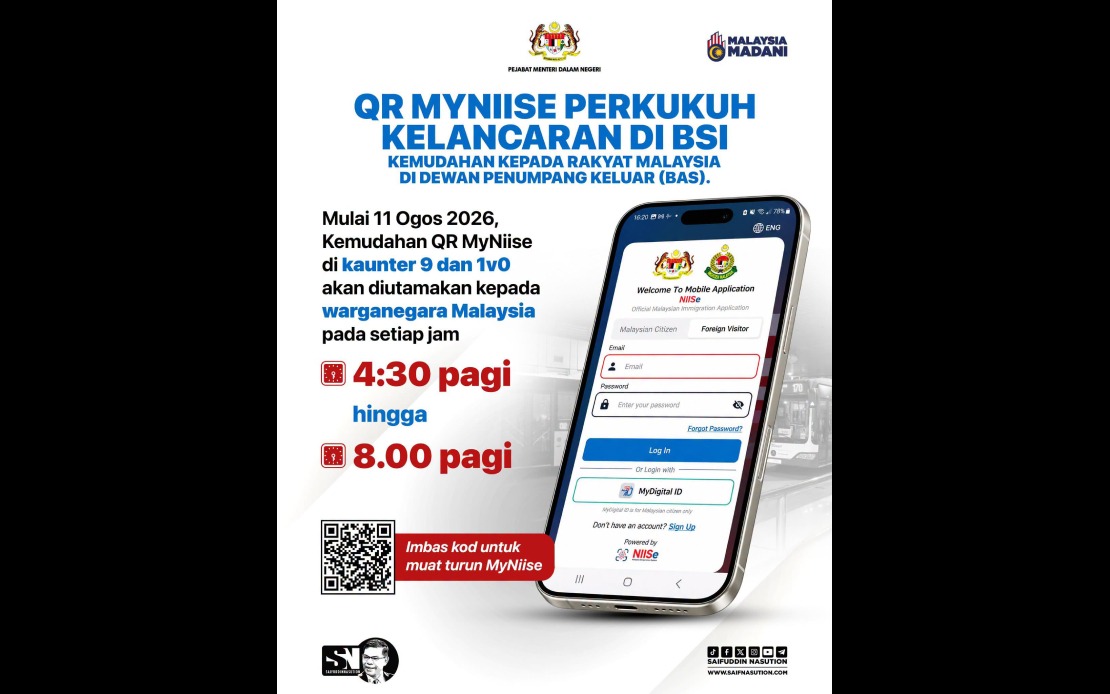
Malaysia's Home Minister Datuk Seri Saifuddin Nasution Ismail has announced a new fast-track immigration clearance system for travellers crossing into Singapore via Bangunan Sultan Iskandar (BSI), leveraging the government's National Integrated Immigration System (MyNIISe) QR code technology. Beginning immediately, passengers utilising the MyNIISe QR code will enjoy priority processing at designated counters during the critical morning hours when congestion typically peaks along the busy Causeway route.
The expedited immigration service operates from counters 9 and 10 in the Bus Departure Hall from 4:30 am to 8:00 am, precisely targeting the window when thousands of Malaysian workers, students, and daily commuters attempt to enter Singapore for employment and business. This timing reflects a deliberate policy intervention designed to address long-standing bottlenecks that have characterised the Causeway crossing during these hours, where queues can stretch significantly and delays routinely cascade through the morning departure schedule.
The Home Minister's announcement highlights a critical challenge faced by the estimated hundreds of thousands of Malaysians who traverse the Causeway daily. For many in the southern states, particularly Johor Bahru and surrounding municipalities, the early morning departure window is essential—workers must clear immigration, board buses or drive across the strait, and arrive at Singapore workplaces within strict time windows. The cumulative delays across the crossing have represented a persistent drag on productivity and work attendance, with some commuters reporting journeys that extend significantly beyond reasonable expectations.
MyNIISe represents a cornerstone of the government's broader digital transformation agenda in the immigration sector. The system, accessible through mainstream mobile platforms including Apple App Store, Google Play Store, and Huawei App Gallery, integrates biometric and travel documentation data to enable rapid identification and processing. By enabling pre-registered users to bypass conventional queuing mechanisms, the technology theoretically reduces manual verification requirements and accelerates throughput at immigration counters.
Saifuddin's framing of the initiative underscores the particular hardship experienced by daily commuters who rely on consistent border crossing to maintain employment and income. The minister explicitly acknowledged that the predawn departures and tight scheduling create genuine strain on travellers, many of whom must navigate unpredictable queuing times while managing employer expectations and time-sensitive responsibilities. This recognition signals that the measure responds to documented pain points rather than theoretical inefficiencies.
The priority allocation to counters 9 and 10 during the designated morning window represents a strategic resource deployment intended to maximise throughput without disrupting the broader immigration apparatus. By concentrating the expedited service at specific locations and times, immigration authorities can manage the QR code workflow separately from conventional processing channels, preventing bottlenecks from shifting rather than being resolved. This targeted approach also allows the government to assess the system's operational effectiveness and capacity constraints.
For Malaysia's broader relationship with Singapore, streamlining Causeway crossings carries economic and social significance. Approximately 400,000 Malaysian workers commute daily to Singapore, representing a substantial population with vested interests in border efficiency. Delays at immigration, if sustained or worsening, risk disrupting Singapore's labour supply and potentially prompting employer grievances that could escalate to diplomatic channels. Conversely, improvements to crossing efficiency strengthen bilateral economic integration and demonstrate governmental commitment to cross-border worker welfare.
The MyNIISe system rollout also reflects Malaysia's evolution toward digital governance infrastructure comparable to regional peers. Singapore, Thailand, and Indonesia have all implemented QR-based immigration systems, and Malaysia's adoption positions it within contemporary international standards. However, successful implementation depends on robust backend systems, reliable mobile connectivity at the border, and sustained user adoption—factors requiring ongoing investment and monitoring.
From a practical standpoint, the initiative's success depends on achieving critical mass in MyNIISe adoption among regular Causeway users. Until now, the system's uptake has remained limited, suggesting awareness gaps or user experience barriers requiring attention. The Home Minister's announcement, coupled with tangible benefits in the form of priority clearance, represents a nudge to convert latent interest into active registration. Government agencies may need to conduct targeted outreach campaigns, particularly through employer networks and commuter associations, to accelerate adoption rates.
The measure also implies resource constraints elsewhere in the immigration system. By prioritising QR users, conventional passengers may experience relatively longer processing times, potentially incentivising broader MyNIISe adoption but also creating a two-tier system. This dynamic, while efficient, could generate perceptions of inequity if non-digital users perceive themselves disadvantaged. Transparent communication about the system's design and phased implementation timelines becomes critical to public acceptance.
Beyond the immediate Causeway context, this initiative signals potential expansion across Malaysia's other border crossings and airports. If MyNIISe delivers measurable improvements in processing times and user satisfaction, the model could be replicated at Kuala Lumpur International Airport, Malaysian-Thai borders, and other high-volume crossing points. Such scaling would represent meaningful progress in the government's digitalisation agenda and could substantially reduce overall travel friction for Malaysian citizens and visitors alike.
The announcement arrives amid broader policy discussions about cross-border mobility and economic integration in Southeast Asia. As the region negotiates enhanced free movement agreements and labour arrangements, border infrastructure and procedures remain limiting factors. Malaysia's investment in digital immigration systems positions it as a responsive partner in regional mobility frameworks, though continued success requires sustained funding, technological upgrades, and political commitment across government transitions.

