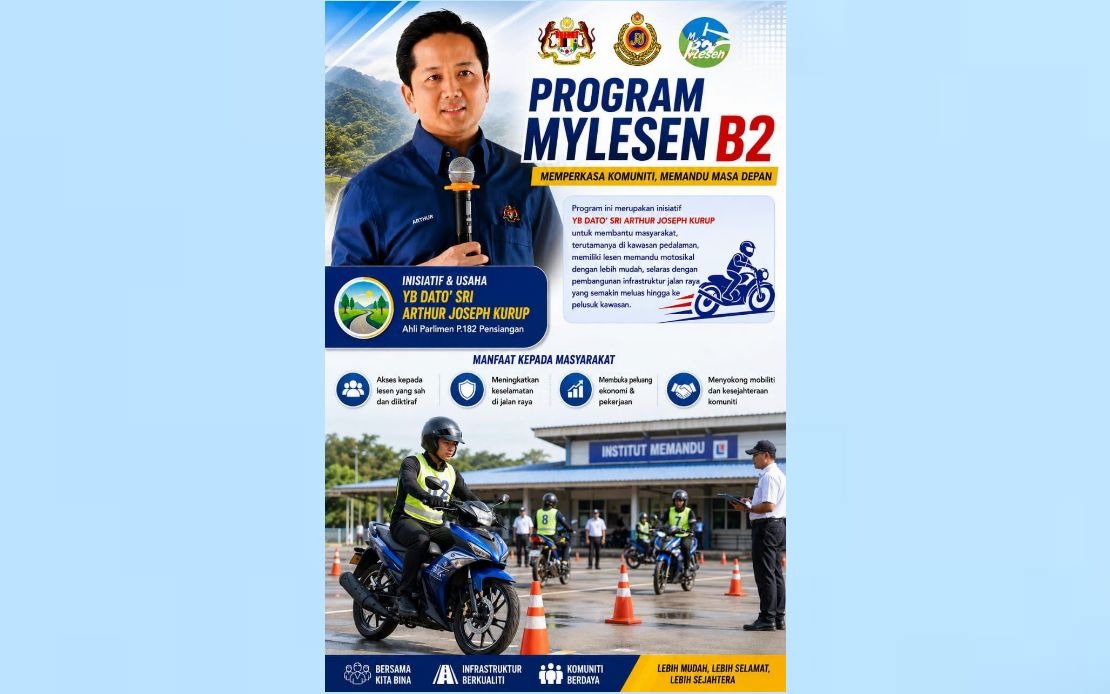
The MyLesen B2 initiative has made its return to Pensiangan in Sabah, continuing efforts to decentralise motorcycle licensing services and bring regulatory compliance within reach of rural communities. This programme represents an important step in addressing the practical barriers that geographic isolation creates for residents seeking to formalise their riding credentials, a challenge particularly acute across Malaysia's rural hinterland and remote constituencies.
According to Pensiangan Member of Parliament Datuk Seri Arthur Joseph Kurup, the mobile licensing scheme is specifically designed to assist rural populations—particularly younger residents—who would otherwise face substantial inconvenience and cost travelling to urban driving centres. The programme eliminates the necessity for potential riders to journey long distances to access formal licensing infrastructure, democratising access to a credential that remains legally essential for motorcycle operation throughout Malaysia.
While the MyLesen B2 programme brings services to communities, participation remains subject to the same rigorous standards applied elsewhere. Applicants must complete mandatory training courses and successfully pass prescribed examinations before receiving their licence. This dual commitment to accessibility and standards ensures that the relaxation of geographic barriers does not compromise the knowledge and safety awareness required of riders operating on Malaysian roads.
The initiative explicitly targets individuals aged 16 to 63 years old, with particular emphasis on first-time licence holders who lack formal riding credentials. By focusing on this demographic, the programme addresses a significant compliance gap where rural residents may have operated motorcycles—common transport in less densely populated areas—without legally valid documentation. Regularising this situation through structured training and testing serves broader road safety objectives while providing residents with legitimate documentation.
Beyond the immediate benefit of legal compliance, Datuk Seri Arthur Joseph Kurup, who simultaneously serves as Malaysia's Natural Resources and Environmental Sustainability Minister, has highlighted the economic dimensions of motorcycle licence possession. A valid licence functionally opens employment opportunities across sectors that require documented riding credentials, from delivery services to agricultural and forestry operations common in rural Sabah. For young residents particularly, the licence represents more than regulatory compliance—it serves as economic enablement in labour markets where mobility determines opportunity.
The permanent validity of the obtained licence, contingent only on compliance with ongoing regulatory requirements, creates long-term utility justifying the immediate effort of training and examination. Unlike temporary or provisional arrangements, residents who successfully complete the MyLesen B2 programme receive credentials with indefinite lifespan, making the investment in participation economically rational across extended personal timescales. This permanence particularly benefits younger participants who may anticipate decades of potential motorcycle use.
The programme addresses an often-overlooked dimension of road safety in Malaysian policy: formal licensing infrastructure in rural areas directly influences compliance rates and accident prevention. When licensing services remain geographically concentrated in urban centres, rural residents face genuine practical impediments to formalisation. This structural barrier can paradoxically drive informal or unlicensed riding, the opposite of intended safety outcomes. By deploying services to underserved regions, MyLesen B2 aligns regulatory infrastructure with geographic population distribution.
Registration for Pensiangan residents occurs through two accessible channels: the Pensiangan Parliamentary Service Centre and the Sook State Assemblyman's Service Centre. This dual-access arrangement ensures that participation options accommodate residents distributed across the constituency, preventing concentration of registration facilities in any single location that might create secondary geographic barriers. The placement within established parliamentary and state assembly service infrastructure leverages existing community touchpoints.
The return of MyLesen B2 to Pensiangan reflects broader policy recognition across Malaysian governance that rural regions require specially tailored service delivery models. Standard urban-centric infrastructure often implicitly assumes populations within proximate reach of centralised facilities—an assumption breaking down across Sabah's distributed geography. Mobile programmes like MyLesen B2 function as corrective interventions, adapting service architecture to demographic reality rather than requiring demographic adaptation to infrastructure.
For Southeast Asian observers, the MyLesen B2 model offers instructive precedent in addressing regulatory compliance challenges across geographically dispersed populations. Rural motorcycling—dominant transport across much of the region—requires safety-conscious licensing approaches that neither abandon compliance standards nor impose insurmountable geographic friction on access. Malaysia's practical approach through mobile licensing infrastructure suggests scalable policy solutions applicable across similar regional contexts where rural populations operate motorcycles central to local economies and transport systems.
The programme's emphasis on road safety awareness and traffic law comprehension represents preventive investment rather than mere bureaucratic box-ticking. Riders in rural areas often operate in challenging conditions—poorly marked roads, varying surface conditions, minimal traffic infrastructure—requiring perhaps heightened rather than relaxed safety consciousness. By ensuring that all riders, regardless of geographic location, undergo standardised training addressing these specific risk environments, MyLesen B2 bridges potential safety gaps that economic geography might otherwise create.

