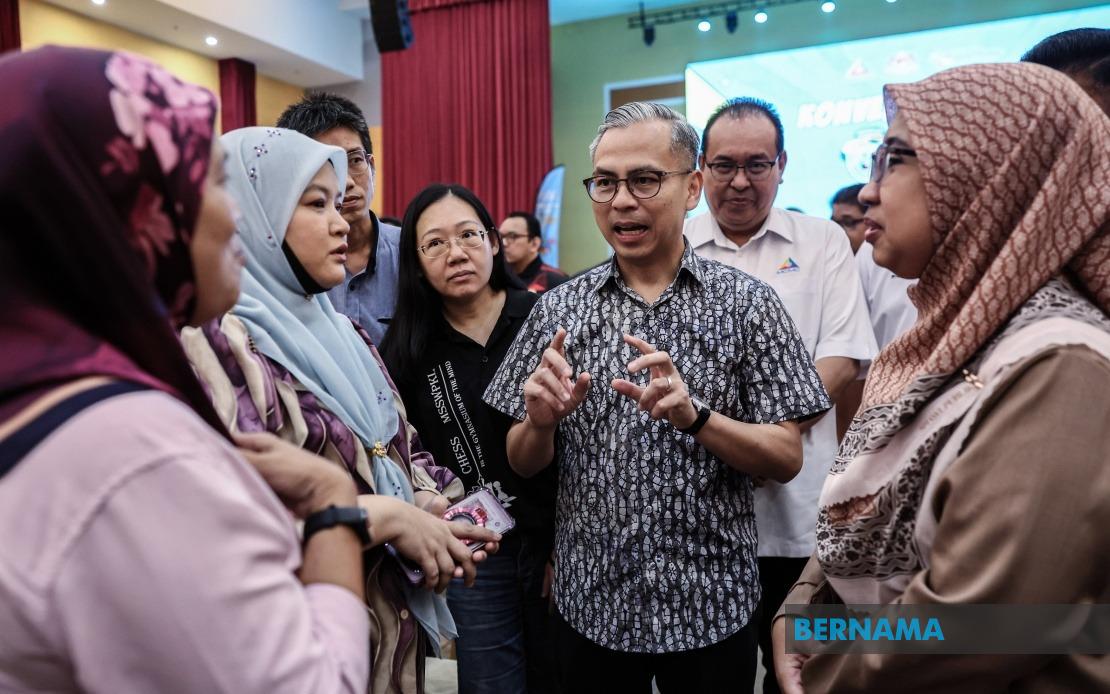
The government has moved to clarify the purpose and administration of MyKhas, the special allocation scheme that has drawn scrutiny regarding how funds are distributed among parliamentary constituencies. Communications Minister Datuk Seri Fahmi Fadzil stressed that MyKhas operates as a mechanism to serve residents and voters within specific constituencies, rather than functioning as a direct financial benefit available to elected representatives. This distinction reflects the administration's broader stance that public resources should ultimately benefit the electorate rather than individual politicians.
Fahmi's remarks, delivered at a press conference following his opening of the 2026 Safe Internet PIBG Convention in Cheras, underscore Prime Minister Datuk Seri Anwar Ibrahim's position that government allocations remain public trusts intended for community welfare. The MyKhas fund sits formally within the Malaysia Plan and Budget documents as a special provision falling under the Prime Minister's authority, establishing a clear hierarchical control mechanism over disbursement decisions. This administrative structure distinguishes MyKhas from traditional constituency development funds that might be accessed more directly by MPs themselves.
As the MADANI Government spokesman, Fahmi emphasised that the scheme's design prevents individual MPs from claiming allocations for personal use or discretionary spending. He stated that even as a senior government figure, he remains unable to access MyKhas funds for himself, reinforcing the principle that the allocation serves strictly public interest objectives. This contrasts with historical perceptions in Malaysian politics, where constituency-level resources have sometimes been viewed as extensions of an elected representative's personal political machinery.
The Prime Minister's office retains sole discretion over how MyKhas funds flow to constituencies, determining whether resources address infrastructure needs such as school improvements, religious institution maintenance, or drainage rehabilitation projects. This centralised approach allows the government to maintain oversight of fund allocation patterns and prevents potential misuse or partisan advantage at the constituency level. The mechanism appears designed to balance constituent service delivery with government accountability structures.
Fahmi addressed a significant concern regarding the distribution of assistance in opposition-held states, a contentious issue that has previously sparked charges of political discrimination in resource allocation. Residents in constituencies controlled by opposition parties may submit applications through the Implementation Coordination Unit under the Prime Minister's Department, creating an alternative pathway that bypasses the local MP's office. This arrangement theoretically ensures that opposition constituents can access government support without depending on opposition MPs to advocate on their behalf.
Anwar reiterated the previous day that parliamentary constituency allocations do not represent exclusive political property belonging to elected representatives. Rather, these funds function as tools for delivering public goods and enhancing living standards across all areas regardless of partisan representation. The Prime Minister indicated flexibility in how allocations reach communities, whether through direct disbursement to schools, religious institutions, places of worship, or public infrastructure such as drainage systems requiring repair.
This clarification carries implications for Malaysian political practice, where the relationship between elected representatives and resource distribution has historically remained ambiguous. By formally establishing that MPs serve as constituency advocates rather than fund custodians, the government attempts to redefine expectations surrounding constituency development. The approach requires constituents to view their elected representatives differently—as intermediaries who can facilitate applications and identify community needs rather than as gatekeepers controlling resource access.
The centralised MyKhas model also reflects broader trends in Southeast Asian governance where national governments have progressively tightened control over local spending decisions. Malaysia's approach resembles similar centralisation efforts across the region, where national treasuries increasingly supervise local disbursement to ensure alignment with broader development priorities. Such systems offer advantages in preventing wasteful or corrupt spending at local levels, though they simultaneously reduce the autonomy that local representatives traditionally exercised over their constituencies.
For Malaysian voters, particularly those in opposition-held areas, the clarification suggests that government services remain theoretically accessible regardless of their constituency's electoral allegiance. The Implementation Coordination Unit pathway provides a mechanism, albeit one that may feel less direct than working through an allied MP. Whether this system functions equitably in practice remains subject to ongoing political scrutiny, as opposition parties and civil society organisations have frequently alleged that resources flow disproportionately to government-controlled constituencies.
The MyKhas framework ultimately represents an attempt to depersonalise politics by framing government spending as technical administration rather than political patronage. Whether residents perceive this distinction meaningfully differs from their lived experience accessing services and support through their MPs remains an open question. The effectiveness of this reframing will likely depend on consistent implementation across all constituencies and transparent communication regarding disbursement criteria and approval processes.

