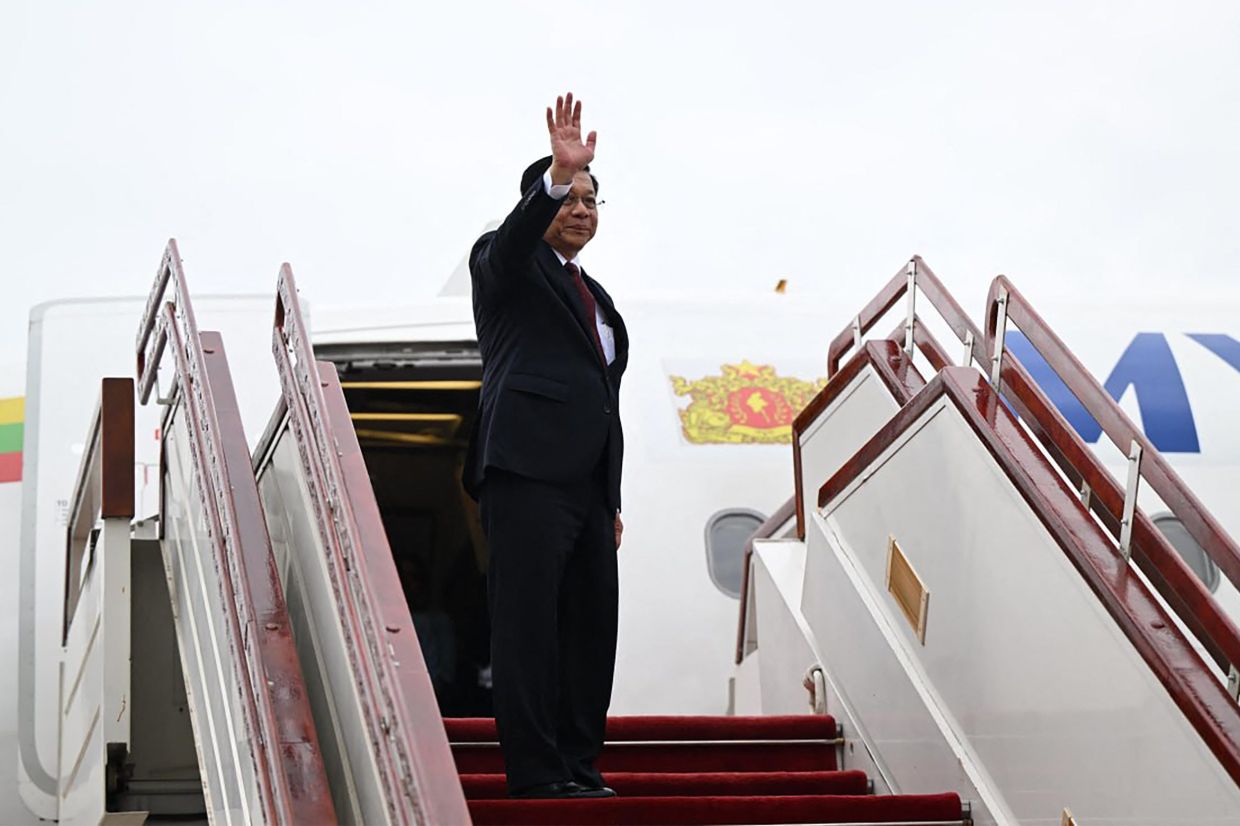
Myanmar's military-backed leader Min Aung Hlaing left for Russia on Monday to hold talks with President Vladimir Putin, according to an announcement from the Myanmar presidency. The journey represents the first visit to Moscow by the former junta chief since assuming the civilian presidency earlier this year, underscoring Myanmar's strategic pivot towards one of its few remaining international allies at a time when most Western nations have isolated the country.
Russia has emerged as a crucial diplomatic lifeline for Myanmar's ruling military establishment. When the armed forces toppled the democratically elected government led by Aung San Suu Kyi in February 2021, most countries in the Western world condemned the takeover and imposed sanctions. Russia, however, stood alongside Myanmar, providing consistent diplomatic support even as the country descended into civil conflict. This backing has deepened Myanmar's reliance on Moscow at a critical juncture when international pressure and economic hardship threaten the stability of the military-led administration.
The conflict triggered by the coup has proven catastrophic for Myanmar's population. More than 100,000 people have been killed in the ensuing civil war, according to conflict monitoring organisations. The violence has displaced millions of civilians, destroyed critical infrastructure, and created a humanitarian crisis that has drawn warnings from the United Nations and international human rights bodies. Despite the mounting toll, the military government has shown no sign of reversing course or engaging meaningfully with democratic opposition groups.
Min Aung Hlaing's path to the presidency has been widely questioned by democracy advocates and Western governments. In April, he was installed as president through elections that were carefully orchestrated by the military junta. International observers and human rights organisations dismissed the electoral process as fundamentally flawed and unrepresentative, with critics arguing the outcome was predetermined. The move attempted to give the military's rule a facade of legitimacy while maintaining absolute control over state institutions and decision-making.
The Myanmar presidency framed the Moscow visit as an opportunity to strengthen bilateral relations and pursue deeper cooperation in strategic areas. In an official statement, authorities emphasised that the talks would focus on consolidating "longstanding friendly and close relations between Myanmar and Russia" while expanding "strategic cooperation" particularly in security and economic sectors. These areas reflect Myanmar's pressing needs: international isolation has crippled its economy, while the civil war demands sophisticated military capabilities to suppress armed resistance movements.
Myanmar's military apparatus has become increasingly dependent on Russian weaponry and support. The country operates Russian-made fighter jets that have been deployed extensively against rebel factions across the nation. However, military aviation operations have drawn serious allegations from conflict monitors who contend that civilians have been deliberately or recklessly targeted in strikes. Some international organisations have characterised these attacks as potential war crimes, though the military government rejects such accusations and maintains that operations target legitimate military objectives.
The military partnership between the two nations has expanded significantly in recent months. In February, Myanmar and Russia formalised a five-year military cooperation agreement, though the government provided minimal details about the arrangement's specific provisions and implications. The accord likely encompasses weapons transfers, training programmes, and intelligence sharing, strengthening Myanmar's capacity to sustain military operations against an increasingly organised opposition.
During his Moscow visit, Min Aung Hlaing will conduct a series of high-level engagements beyond his meeting with Putin. His schedule includes appointments with Russia's prime minister and the speaker of the State Duma, the lower chamber of Russia's parliament. Additionally, he will participate in a Myanmar-Russia economic forum, where officials from both countries are expected to discuss trade opportunities and investment possibilities. These engagements signal Russia's willingness to provide diplomatic recognition and economic engagement despite Myanmar's international pariah status.
Min Aung Hlaing's international travel since assuming the presidency has followed a deliberate diplomatic strategy aimed at rehabilitating Myanmar's international image and securing material support from sympathetic governments. Beyond his Moscow journey, he has undertaken official visits to China, India, and Thailand. China, like Russia, maintained diplomatic ties with the junta throughout the transition and continues to engage with Myanmar's military leadership. India and Thailand, as regional neighbours, maintain pragmatic relationships with Myanmar despite reservations about the military government. These collective engagements reflect the Myanmar leadership's calculation that engagement with Asian powers offers the most promising path to overcoming international isolation and sustaining the regime.
For Southeast Asian observers and policymakers, Myanmar's deepening alignment with Russia carries significant implications. The relationship signals that Myanmar, a strategically important nation in the heart of Southeast Asia, is becoming more tightly integrated into Russian geopolitical interests. This development occurs as Russia seeks to expand its influence in Asia following its invasion of Ukraine and subsequent estrangement from Western nations. Myanmar's vulnerability and dependence on Russian support make it an attractive partner for Moscow, even as the relationship reinforces the military junta's grip on power and complicates prospects for democratic transition in a nation that once showed promise as a reforming democracy.

