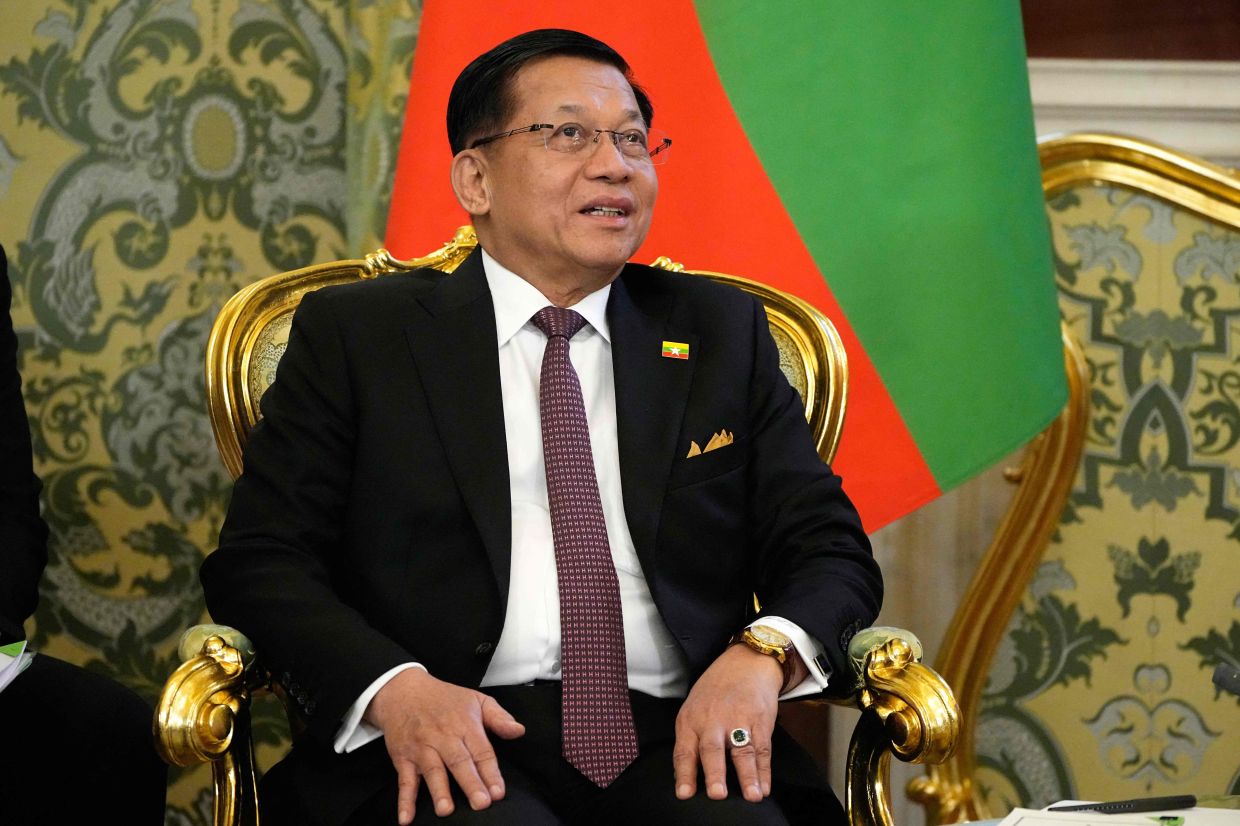
Myanmar's military leader Min Aung Hlaing is set to undertake an official visit to Cambodia in early September, marking the latest stop in what observers characterise as a systematic campaign to rebuild Myanmar's international standing and consolidate his political position at home. Cambodia's Senate has confirmed the visit, with senior palace officials already scouting venues to receive the Myanmar leader and facilitate diplomatic engagements aimed at deepening bilateral ties between the two Southeast Asian neighbours.
The confirmed visit represents a continuation of an aggressive foreign policy agenda that has seen Min Aung Hlaing travel extensively across Asia since his appointment as president in April 2023. Within months of assuming the civilian presidency—a position he secured through a military-controlled electoral process that international observers and democracy advocates widely dismissed as illegitimate—he has already journeyed to India, China, Laos, Thailand and Russia. Each voyage appears strategically calculated to project an image of normal diplomatic engagement and international acceptance, effectively positioning him as a legitimate head of state rather than a military ruler overseeing a junta.
Cambodia's official justification for hosting Min Aung Hlaing emphasises strengthening bilateral cooperation and reaffirming regional friendship. Senate spokesperson Chea Thyrith underscored that the engagement serves mutual interests, framing the encounter as a natural expression of neighbourly relations within Southeast Asia. This diplomatic language reflects Cambodia's own complex relationship with international scrutiny; having navigated decades of domestic challenges and international criticism, Phnom Penh has positioned itself as pragmatic on Myanmar's crisis, maintaining engagement while avoiding confrontation with regional partners.
Yet beneath these cordial formulations lies a far more contested reality that extends well beyond standard state visit protocols. Human rights organisations, democracy advocates and international observers have consistently criticised Min Aung Hlaing's foreign travels as a strategic manoeuvre to secure global legitimacy for what they characterise as an illegitimate military regime. The February 2021 coup that ousted civilian leader Aung San Suu Kyi remains a defining event in Myanmar's contemporary politics; her continued detention and the widespread arrest of activists, journalists and political opponents have generated international condemnation and practical consequences, including Asean's unprecedented decision to exclude Myanmar from leadership-level summit meetings.
The scale of repression under Min Aung Hlaing's rule is substantial and documented. Thousands of human rights activists, democracy advocates and ordinary citizens have been detained through military courts and other extra-judicial processes. The suppression extends beyond political opponents to encompass journalists, civil society workers and ordinary people exercising basic freedoms of expression and assembly. These realities sit uncomfortably alongside the pageantry of state visits and bilateral cooperation agreements, creating a fundamental tension between Myanmar's international diplomatic performance and its domestic governance record.
Cambodian analysts acknowledge both dimensions of the visit's significance. Kin Phea, president of the International Relations Institute of Cambodia, noted that Min Aung Hlaing's Cambodia visit forms part of a broader pattern designed to enhance his legitimacy and consolidate his presidential authority, paralleling the function of his previous regional travels. Simultaneously, Phea suggested that Cambodia itself has constructive reasons for engagement, pointing to its 2022 tenure as Asean chair and continued efforts to facilitate dialogue on Myanmar's crisis. From this perspective, the visit represents not merely Min Aung Hlaing's attempt to gain recognition, but Cambodia's continuing investment in dialogue as a tool for regional stability.
However, Phea introduced an important caveat regarding the actual impact of such bilateral engagements on Myanmar's international standing within the region. The Asean Five-Point Consensus, established in 2021 as a framework for addressing Myanmar's political crisis, constitutes the formal basis for determining whether Myanmar might eventually return to full participation in Asean leadership meetings. This consensus—which calls for dialogue, cessation of violence and humanitarian access—has become the benchmark against which Myanmar's progress is measured. Critically, Phea emphasised that no individual country, including Cambodia, possesses unilateral authority to determine Myanmar's compliance with these conditions or to facilitate its return to Asean summits.
This structural limitation underscores a deeper reality about Myanmar's isolation: diplomatic courtesy and bilateral state visits, while personally beneficial to Min Aung Hlaing and symbolically important, do not automatically translate into the kind of regional rehabilitation that would restore Myanmar to its previous standing within Asean. The military leader's international tour generates photographs of official ceremonies and handshakes, yet these cannot substitute for substantive changes in Myanmar's domestic governance, adherence to democratic principles or implementation of the Asean consensus framework.
For Malaysian readers and other Southeast Asian observers, Myanmar's diplomatic manoeuvres carry particular significance. The region has invested considerable diplomatic capital in managing the Myanmar crisis, with Asean's principle of non-interference creating friction between traditional practices and mounting humanitarian and governance concerns. Cambodia's willingness to receive Min Aung Hlaing reflects a particular approach to regional engagement—one emphasising dialogue and patient diplomacy rather than isolation or confrontation. Yet this approach faces fundamental limits when confronted with the question of whether engagement without conditions ultimately strengthens or enables the very behaviour the international community seeks to discourage.
The Cambodia visit also illuminates divisions within Asean itself regarding how to approach Myanmar. While some members maintain robust engagement with Min Aung Hlaing's administration, others voice stronger concerns about legitimacy and human rights. This internal plurality creates space for bilateral diplomacy like Cambodia's upcoming hosting, yet simultaneously constrains any individual member's capacity to shift regional consensus or unilaterally determine Myanmar's status.
Looking forward, Min Aung Hlaing's continued diplomatic travels will likely persist regardless of Cambodia's hosting or international opinion. The strategic value to Myanmar's military leadership lies in projecting normalcy and international acceptance, even as ground realities within Myanmar remain contested and repressive. Cambodia's role, meanwhile, reflects both genuine regional interests in stability and the practical limitations facing any single Asean member attempting to facilitate resolution of Myanmar's multifaceted crisis through bilateral engagement alone.

