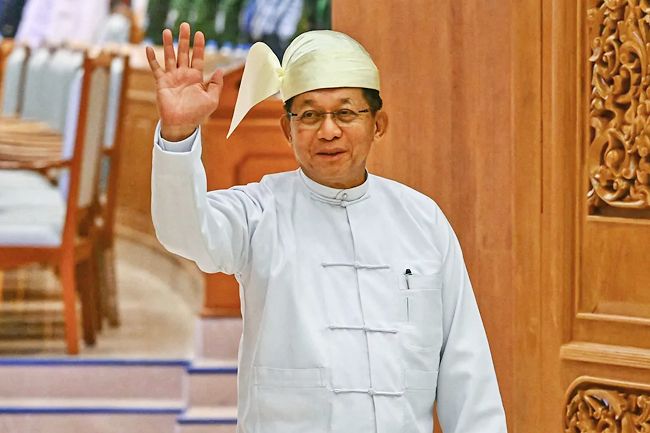
Myanmar's military leader Min Aung Hlaing will travel to Bangkok on August 6 and 7 for talks with Thai Prime Minister Anutin Charnvirakul, Thailand's foreign minister Sihasak Phuangketkeow announced on Tuesday following regional consultations in Manila. The scheduled bilateral engagement underscores Thailand's increasingly assertive role in attempting to reverse Myanmar's diplomatic isolation within the Association of Southeast Asian Nations, a position that has generated considerable friction among the bloc's ten member states.
Sihasak's confirmation of the meeting came after what he characterized as frank discussions among Southeast Asian foreign ministers on navigating Myanmar's reintegration. Those talks reflected ongoing tensions within ASEAN over how to engage with the country following the February 2021 military coup that toppled Aung San Suu Kyi's democratically elected administration. Although Myanmar technically retains ASEAN membership, the junta has faced formal exclusion from the organization's principal gatherings, a symbolic sanction that has highlighted the bloc's struggle to enforce consensus on Myanmar policy.
Thailand's prominent advocacy for Myanmar's rehabilitation within ASEAN carries particular weight given its strategic geography and humanitarian burden. The neighboring nation shares an extensive border with Myanmar and currently hosts millions of refugees fleeing the military's crackdowns and the broader internal conflict that has devastated the country since the coup. Bangkok's economic and security interests in stabilizing the region, combined with its significant ethnic and cultural ties across the border, have positioned Thailand as the primary architect of the reintegration effort. However, this approach has exposed deep fissures among ASEAN members, with some nations resisting what they view as premature normalization with an undemocratic regime.
Thailand's diplomatic strategy toward Myanmar operates on what Sihasak termed a "dual-track approach," acknowledging both bilateral and multilateral dimensions of engagement. He emphasized that Bangkok intends to address pressing bilateral matters directly with Myanmar, particularly trafficking of persons, transnational organized crime, and drug trafficking—issues that directly affect Thai security and public safety. These tangible concerns provide Thailand with leverage to pursue incremental progress on practical governance issues while simultaneously managing ASEAN's broader Myanmar policy.
Crucially, Sihasak stressed that Thailand's bilateral engagement does not constitute abandonment of ASEAN's established five-point peace plan, which has served as the bloc's formal framework for addressing Myanmar's crisis. This clarification was necessary given skepticism from other member states that bilateral Thai-Myanmar relations might supersede the collective ASEAN position. The foreign minister's explicit reaffirmation suggests underlying tensions about whether Thailand is unilaterally pursuing a separate diplomatic track that could undermine coordinated regional action.
The Bangkok meeting also reflects Thailand's attempt to establish more realistic benchmarks for measuring progress on Myanmar's compliance with ASEAN expectations. Sihasak posed specific questions about what constitutes meaningful advancement: Would allowing ASEAN's special envoy access to detained former leader Aung San Suu Kyi constitute progress? Could reductions in border violence indicate positive movement? These questions represent a deliberate recalibration of ASEAN's demands, moving away from categorical positions toward graduated acknowledgment of incremental improvements. This pragmatic reassessment suggests Thailand believes that all-or-nothing approaches have failed and that Myanmar's transformation will require a prolonged engagement process.
Sihasak's acknowledgment that progress "will come incrementally" and "is not going to happen overnight" reflects a fundamental shift in how Thailand approaches Myanmar's reintegration. Rather than insisting on sweeping democratic reforms or complete adherence to ASEAN's peace plan as preconditions, Bangkok appears willing to accept piecemeal changes as building blocks toward eventual fuller integration. This strategy prioritizes stability and bilateral cooperation over enforcing ideological consistency, a position that appeals to other countries prioritizing pragmatism but troubles those committed to democracy advocacy.
Thailand's strategy also contemplates facilitated dialogue between Myanmar's military government and armed ethnic groups concentrated along the Thai-Myanmar border. Sihasak suggested Bangkok could serve as a mediator between the junta and these organizations, potentially creating space for negotiations that remain blocked domestically. This approach treats the ethnic conflicts not merely as symptoms of Myanmar's political dysfunction but as distinct negotiating tracks where Thailand possesses geographical advantage and diplomatic credibility. Successful intercommunal dialogue could reduce border instability while simultaneously demonstrating progress that justifies further ASEAN engagement with the junta.
The broader context of Myanmar's recent elections adds another dimension to Thailand's reintegration efforts. Although widely criticized as lacking legitimacy by international observers, the heavily controlled polls that resulted in Min Aung Hlaing becoming president could theoretically create openings for negotiations with both ethnic armed organizations and democratic opposition groups. Thailand interprets these elections as potential catalysts for dialogue rather than regarding them as simply reinforcing authoritarian rule, viewing them as tactical opportunities to pursue the bilateral and multilateral engagement Bangkok envisions.
Simultaneously, other ASEAN members are reconsidering the mechanisms for regional Myanmar policy. Philippine Foreign Minister Theresa Lazaro revealed that ASEAN is deliberating appointment of a permanent, long-term special envoy to Myanmar, acknowledging that the current system of yearly rotating envoys has proven ineffective. This institutional reform reflects broader recognition that Myanmar's crisis demands sustained diplomatic attention rather than episodic engagement. A permanent envoy would provide continuity and institutional memory, potentially strengthening ASEAN's collective leverage while also enabling more sophisticated diplomacy than the rotating system permits.
The August visit represents a critical juncture in Thailand's reintegration strategy, testing whether bilateral engagement can generate the incremental progress that might eventually satisfy both Thailand's pragmatic interests and broader ASEAN concerns about Myanmar. The outcome will signal whether Thailand's dual-track approach can bridge divisions within ASEAN or whether it exacerbates tensions between members prioritizing engagement and those demanding stronger conditions for Myanmar's normalization. For Malaysia and other ASEAN states, the Bangkok talks will provide crucial indicators of whether Myanmar's eventual reintegration is proceeding and what precedent this sets for how the bloc handles future political crises among member states.

