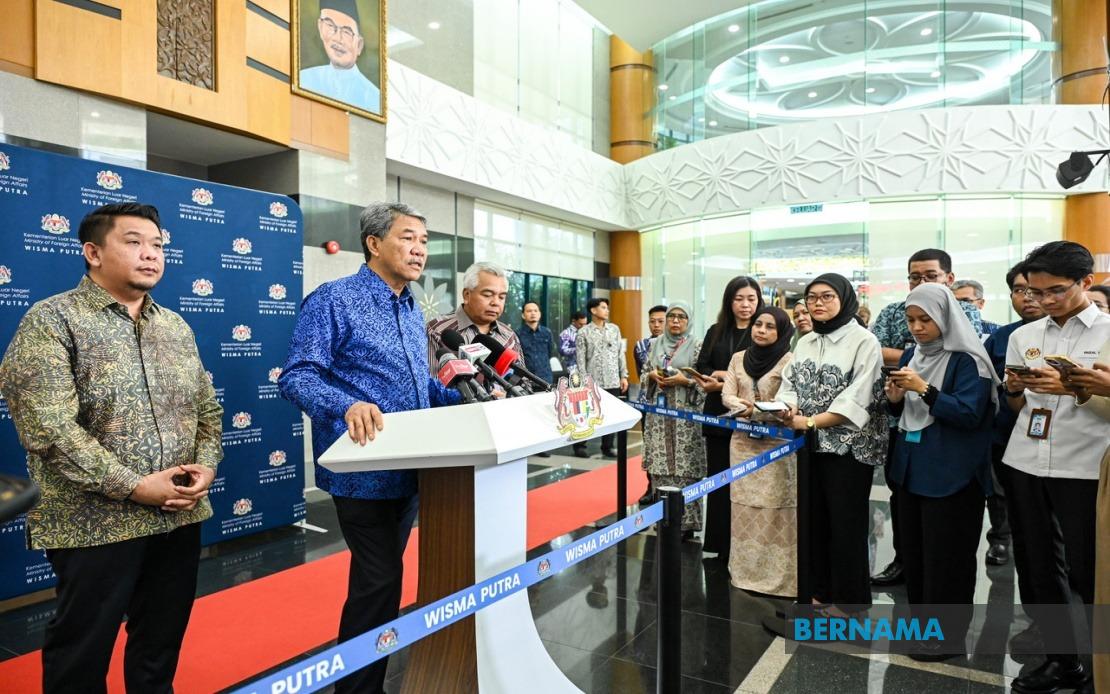
Myanmar has signalled its willingness to repatriate 5,000 refugees through maritime routes, according to Malaysia's Foreign Minister Datuk Seri Mohamad Hasan, who made the announcement following diplomatic discussions with Myanmar's newly appointed Foreign Minister Tin Maung Swe. The statement, delivered at a press conference after Malaysia's observance of the 59th ASEAN Day celebration in Putrajaya on Monday, represents a potential step forward in managing one of Southeast Asia's most intractable displacement crises, though substantial uncertainties remain about implementation and the welfare of returnees.
During his meeting with Tin Maung Swe, Mohamad Hasan indicated that Myanmar authorities confirmed their readiness to undertake the repatriation operation using maritime transport. However, the Malaysian minister immediately qualified this development by emphasising that the primary concern must centre on ensuring adequate protection for those being returned. He posed critical questions about whether sea-based repatriation would genuinely provide safe passage and what conditions awaited the refugees upon arrival in Myanmar, underscoring the complex humanitarian considerations that underpin such operations.
Malaysia has already completed the identification process for all 5,000 individuals targeted for repatriation, representing a significant administrative accomplishment in itself. While no concrete timeline has been established for when the repatriation would commence, Mohamad Hasan stressed that accelerating the process should nonetheless remain a priority for both nations. This measured approach reflects the tension between Malaysia's desire to reduce the burden on its own resources while simultaneously ensuring that vulnerable populations are not returned to circumstances of danger or uncertainty.
A crucial dimension of the Malaysian government's position involves repositioning the broader refugee discourse beyond its traditional Rohingya-centric framing. Mohamad Hasan explicitly noted that Myanmar's displacement crisis encompasses diverse ethnic minorities, including substantial populations of Chin and Karen refugees who have also fled to neighbouring countries. This expanded perspective is particularly important for Malaysia, which hosts significant numbers of non-Rohingya Myanmar refugees whose circumstances and needs often receive less international attention and diplomatic prioritisation.
Within the ASEAN framework, Malaysia is advocating for a unified regional approach to Myanmar's refugee challenge rather than allowing individual member states to pursue fragmented national solutions. The bloc views this humanitarian issue as fundamentally connected to Myanmar's broader political instability and structural governance challenges. ASEAN's collective response mechanism therefore becomes essential to ensuring that repatriation efforts do not inadvertently perpetuate the underlying causes of displacement or place returnees in vulnerable positions.
The Five-Point Consensus, agreed upon by ASEAN and Myanmar's military leadership in 2021, remains at the centre of the regional bloc's engagement strategy with Myanmar. This framework, which addresses ceasefire implementation, humanitarian access, dialogue among all parties, and ASEAN's monitoring role, provides the ostensible foundation for addressing the broader Myanmar crisis. Mohamad Hasan reiterated that this mechanism must remain the binding principle guiding ASEAN's response, emphasising that all member states and Myanmar's leadership formally endorsed these commitments.
The minister's insistence that any modifications to the Five-Point Consensus must return to the negotiating table reflects deep concerns within ASEAN about unilateral initiatives undermining the bloc's collective authority. By anchoring Malaysia's refugee diplomacy within this consensus framework, Mohamad Hasan seeks to ensure that bilateral repatriation discussions do not become a parallel track that sidelines broader ASEAN mechanisms. This positioning protects the bloc's credibility as a unified actor while preventing individual member states from being presented with fait accompli decisions on Myanmar policy.
For Malaysia, hosting approximately 177,000 registered refugees and asylum seekers from Myanmar, the repatriation of 5,000 individuals would provide modest relief from immense humanitarian and resource pressures. However, the scale of the broader challenge remains daunting, with many refugees unable or unwilling to return given ongoing instability following Myanmar's 2021 military coup. The willingness of Myanmar's government to engage on repatriation logistics does not necessarily signal resolution of the political crisis that originally forced displacement.
The emphasis on maritime repatriation rather than land-based routes raises questions about costs, logistics complexity, and whether port-based operations might actually complicate rather than facilitate the process. Ships require adequate berthing facilities, health screening protocols, and coordination with multiple government agencies across both nations. Malaysia's insistence on safety considerations likely reflects awareness that previous repatriation attempts in the region have occasionally encountered operational difficulties and allegations of inadequate care during transport.
The timing of these discussions, occurring after the appointment of a new Myanmar Foreign Minister, may indicate subtle shifts in how Myanmar's junta approaches international engagement on sensitive humanitarian matters. Whether this represents genuine policy evolution or tactical adjustment designed to improve Myanmar's diplomatic standing internationally remains unclear. ASEAN observers will be closely monitoring whether Myanmar's professed readiness to repatriate translates into concrete, timely action.
Malaysia's diplomatic strategy appears calculated to secure humanitarian progress while maintaining the institutional coherence of ASEAN's Myanmar policy framework. By anchoring refugee repatriation discussions within the Five-Point Consensus and emphasising regional collective action, Mohamad Hasan positions Malaysia as both a responsible host nation managing refugee flows and a principled ASEAN member committed to maintaining bloc unity on Myanmar issues. This balancing act will prove essential as the repatriation process moves from rhetorical commitment toward operational implementation.

