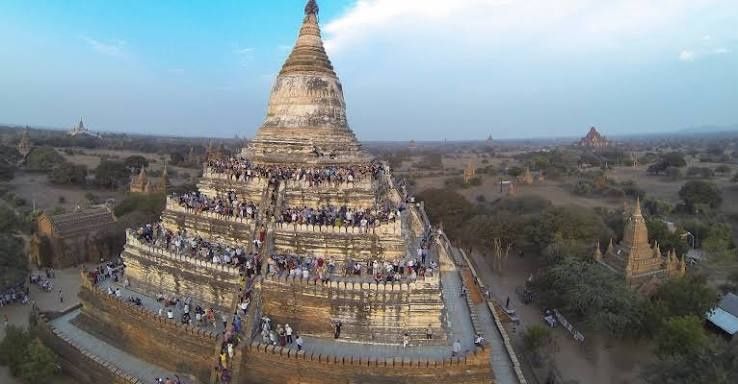
Myanmar's military-backed administration is pursuing an ambitious tourism recovery strategy, betting that a resurgence of visitors to the nation's famed Buddhist temples, colonial architecture and pilgrimage sites will signal economic normalisation and help legitimise the government following this year's elections. The initiative represents one of the regime's first tangible efforts to demonstrate that parts of the country are reopening for international business and leisure travel, a symbolic move designed to attract both foreign currency and investor confidence after years of international isolation triggered by the 2021 coup.
The authorities have set an ambitious target of welcoming 1.8 million international visitors by year's end, nearly double the 973,263 who arrived in 2025. Achieving this goal would require a dramatic acceleration in the second half of the year, particularly given that only 448,205 visitors had entered the country through May, representing just a modest five per cent increase compared to the same period last year. Officials are focusing heavily on easing visa procedures and cultivating direct connections with travellers from neighbouring China and Thailand, recognising that regional markets represent the most accessible route to recovering lost tourism revenue in the near term.
Designated attractions including the temples of Bagan, the serene Inle Lake, the sacred Golden Rock Pagoda, and the major cities of Yangon and Mandalay continue to anchor Myanmar's tourism positioning, according to Aung Aye Han, the director general of the Directorate of Hotels and Tourism. These sites have historically formed the backbone of the country's appeal as a frontier destination, drawing international visitors attracted by centuries-old religious monuments and relatively unspoiled natural landscapes. The government's strategy emphasises what it describes as a "trust-building" approach, recognising that the security concerns and reputational damage from recent years require deliberate confidence-restoration efforts.
Chinese nationals represent the largest share of Myanmar's international air arrivals, with numbers climbing 12 per cent during the first five months of this year, followed by Thai visitors, whose arrivals increased by seven per cent. This pattern reflects both geographical proximity and the relative ease of land crossing, as well as the visa-on-arrival programmes now extended to citizens of China, India, Japan and South Korea. Citizens of Russia and most Southeast Asian nations already enjoy visa-free entry, and officials have indicated that further liberalisation of entry requirements will be calibrated based on demand patterns from individual countries. However, any further easing of border controls remains contingent on government assessment of market conditions.
The scale of Myanmar's tourism challenge becomes apparent when compared to regional benchmarks. Even if the government achieves its 1.8 million target, arrivals would remain substantially below the approximately 4.7 million visitors who entered the country in 2015, during Myanmar's initial opening to the world following decades of military isolation. Thailand, one of Myanmar's closest economic partners, attracted roughly 33 million tourists last year and continues to target similar numbers, highlighting the vast gap between Myanmar's current trajectory and its regional competitors. This disparity underscores both the distance Myanmar must travel to rebuild its tourism sector and the formidable challenge of reconstructing international confidence in the country's stability.
President Min Aung Hlaing's administration has attempted to facilitate this recovery through a sustained regional diplomatic campaign since his April swearing-in. State visits to China and India, combined with efforts to normalise relations with Southeast Asian neighbours, reflect recognition that tourism recovery is inseparable from broader geopolitical rehabilitation. Thailand has begun responding to these overtures, with Foreign Minister Sihasak Phuangketkeow visiting Myanmar in April, signalling willingness to re-engage. More tellingly, popular Thai travel influencers, including content creators Farose and Bas from the Go Went Go channel, have recently filmed content in Yangon, exposing the city to regional audiences after years when it largely vanished from Southeast Asian travel social media and itineraries.
The signals of returning interest extend beyond immediate neighbours. Tour operators report increasing enquiries from Europe, the United States and India, despite the persistence of limited international flight connectivity. Thet Lwin Toh, managing director of Myanmar Voyages International Tourism Co., attributes this renewed curiosity partly to Myanmar's historical positioning as an undiscovered frontier destination, prized for colonial-era architecture, ancient religious sites and relatively untouched landscapes. This suggests that international appetite for Myanmar extends well beyond the neighbouring markets on which government strategy currently concentrates, potentially offering broader opportunity if security conditions stabilise further.
Luxury accommodation providers are reporting early signs of recovery. Occupancy rates at high-end hotels in Yangon have risen approximately 10 per cent since the election, according to May Myat Mon Win, general manager of Chatrium Hotel Royal Lake and adviser to the Myanmar Tourism Federation. However, the composition of visitors differs markedly from pre-coup patterns: business travellers, religious pilgrimage groups and individuals exploring investment opportunities now constitute the primary clientele, rather than leisure tourists. This mix reflects both the cautious international environment and the government's own prioritisation of visitors with economic significance, including those evaluating potential business ventures.
Japanese interest presents particular promise, with officials anticipating a significant increase in arrivals driven primarily by business and investment considerations rather than conventional tourism. This reorientation toward purpose-driven travel—pilgrims seeking religious experiences, investors conducting due diligence, and business professionals—represents a practical acknowledgment that Myanmar cannot immediately recover its pre-coup leisure tourism model. Building that confidence will require time, improved security conditions and sustained diplomatic normalisation across the region.
Western governments have maintained cautious stances despite marginal increases in arrivals from traditionally risk-averse markets. The United States State Department continues to advise against travel due to armed conflict and civil unrest, yet official figures show arrivals from America rose 17 per cent through May. Individual travellers such as Liam Martinez, a 34-year-old Texan, report relying on alternative information sources, including YouTube travel content, to form their own risk assessments in contradiction to official warnings. These independent visitors, though currently small in number, may represent the vanguard of broader Western tourism recovery if security conditions continue to improve and travel media begins actively promoting Myanmar again.
The government's tourism offensive also reflects strategic importance beyond immediate revenue generation. International travel recovery serves as a barometer of Myanmar's broader re-integration into the global economy and regional order. Success in attracting even modest increases in foreign visitors would provide the regime with tangible evidence of economic progress, helping to offset concerns about civil conflict and international isolation. However, substantial growth depends on factors beyond government control: continued security improvements, resolution of armed conflict, sustained diplomatic progress with regional partners, and international willingness to move beyond security concerns. Myanmar's tourism trajectory will ultimately reveal whether the military government can deliver on its implicit promise of restored stability and economic opportunity.
The challenge of reaching 1.8 million visitors by year-end remains formidable given current arrival rates, requiring approximately 900,000 visitors in the final seven months—a pace substantially exceeding the year-to-date average. Meeting or approaching this target would require significant acceleration in international flight capacity, heightened marketing effectiveness, and demonstrable security improvements across key tourist regions. For Malaysia and other Southeast Asian nations, Myanmar's tourism recovery carries implications for regional travel patterns, hotel occupancy rates and investment flows, making the success or failure of this initiative relevant to broader Southeast Asian economic dynamics.

