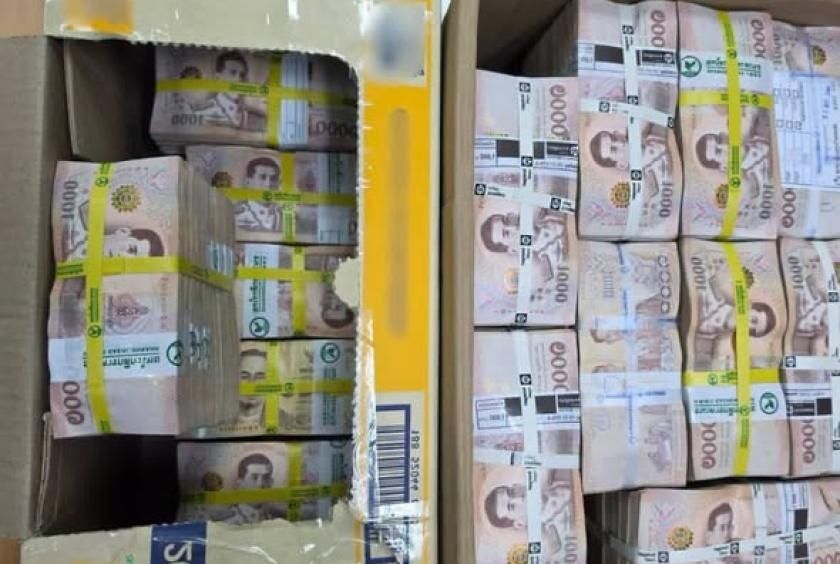
A Myanmar citizen faces serious charges in Thailand after customs officers uncovered one of the larger undeclared currency shipments at a major land crossing in recent months. The 31-year-old driver was intercepted at the Mae Sai Friendship Bridge checkpoint while attempting to transport more than 23 million baht—equivalent to approximately US$689,077—into Myanmar without proper declaration, sparking a fresh investigation into what officials suspect is part of a larger smuggling network.
The interception occurred when Thai customs personnel conducted a standard inspection of a vehicle displaying Myanmar registration plates crossing the Friendship Bridge at Mae Sai, the main commercial gateway between the two nations in Chiang Rai province. This checkpoint handles thousands of vehicles daily, making it a critical juncture for monitoring cross-border movement of goods and currency. The discovery reveals how determined smugglers continue to exploit this heavily-trafficked route despite increased vigilance by regional authorities.
Inside the vehicle, inspectors methodically searched through two cartons ostensibly containing dried fish and potatoes—commodities that typically move freely across the border as legitimate trade goods. Concealed within these everyday foodstuffs were meticulously organised bundles of 1,000-baht banknotes, each wrapped in plastic and packed to avoid detection by conventional screening. The first carton alone contained approximately 17 million baht, while the second held an additional 6.023 million baht, totalling 23.023 million baht when combined.
The scale of this seizure underscores the persistent challenge facing Southeast Asian nations in controlling illicit financial flows across porous land borders. The region has long struggled with currency smuggling, which can facilitate money laundering, financing of illegal activities, and circumvention of capital controls. Thailand, in particular, maintains strict regulations governing the export of its national currency, and moving such quantities without authorisation constitutes a serious breach of financial law that carries substantial penalties.
Thai customs authorities have characterised the alleged offence as violating multiple provisions of the Customs Act and Thailand's foreign exchange control regulations. These laws exist primarily to prevent the destabilisation of currencies through unauthorised export, to combat organised crime financing, and to maintain economic stability. The fact that the driver was attempting to move currency into Myanmar rather than extracting Thai baht suggests possible connections to significant financial operations on the other side of the border, though details remain scarce.
The suspect is currently in custody at Mae Sai Police Station pending formal charges and further investigation. Thai authorities have indicated they are actively pursuing leads to identify additional individuals potentially involved in organising or coordinating this smuggling attempt. Law enforcement sources have not disclosed whether this driver was acting independently or as part of an established trafficking operation, though the sophistication of the concealment method and the substantial sum involved suggest some degree of planning and logistical coordination.
The timing and nature of this seizure reflect broader regional concerns about cross-border criminal activity. The Thai-Myanmar border, stretching over 2,400 kilometres, remains one of Asia's most active zones for smuggling operations. While drugs have traditionally dominated headlines, money laundering and currency trafficking have increasingly attracted law enforcement attention as investigators recognise the financial networks enabling larger criminal enterprises. Myanmar's own currency instability and ongoing economic turbulence since 2021 has created significant demand for foreign exchange, potentially driving such smuggling operations.
For Malaysian readers and regional observers, this arrest serves as a reminder of how interconnected Southeast Asian criminal networks have become. Thai authorities' success in intercepting this shipment depends partly on coordination with customs agencies across the region, including those in Malaysia and other ASEAN nations. The methods employed—hiding currency in food packaging, using civilian vehicles, targeting busy border crossings—represent tactics criminals employ throughout the region, suggesting that similar operations may be occurring across other frontiers, including those affecting Malaysia.
The investigation's continuation also highlights the resource-intensive nature of modern border security. Screening thousands of daily crossings while identifying contraband requires both technological investment and trained personnel willing to conduct meticulous inspections under challenging conditions. Success in this case will depend on whether Thai investigators can identify supply chains, financial intermediaries, and recipients of such shipments, potentially dismantling networks rather than merely removing individual couriers from circulation.
As regional economies increasingly integrate through trade and tourism, managing the legitimate flow of goods and people while preventing criminal exploitation has become a central security challenge for ASEAN governments. Thailand's proactive approach at Mae Sai demonstrates commitment to enforcing financial controls, though questions remain about the ultimate origins and intended use of the smuggled currency. The investigation's outcome may provide valuable intelligence about cross-border financial crime networks operating throughout the wider region.

