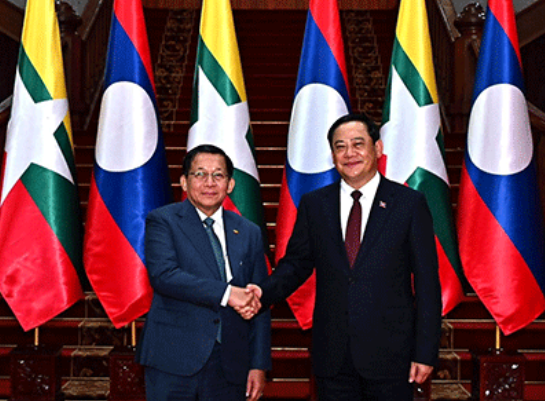
Myanmar's President Min Aung Hlaing has concluded a significant diplomatic mission to Laos, using a three-day state visit to underscore the two neighbouring nations' determination to elevate their partnership across political, economic and security dimensions. The high-profile engagement, which took place from July 3 to 5, represented far more than ceremonial pageantry; it reflected a deliberate effort by both Vientiane and Naypyidaw to position their relationship as a cornerstone of regional stability and prosperity during a period of considerable geopolitical flux in Southeast Asia.
The visit carried substantial symbolic weight, marking the 70th anniversary of formal diplomatic relations between Laos and Myanmar and serving as President Min Aung Hlaing's inaugural major foreign foray following his assumption of office. That Vientiane was selected as the first stop for such high-level bilateral engagement underscores the particular importance Myanmar places on its relationship with its western neighbour. Accompanied by his wife and a substantial delegation, the Myanmar leader received a full state reception at Vientiane's Presidential Palace, where President Thongloun Sisoulith extended a warm welcome that demonstrated Laos's reciprocal commitment to strengthening ties.
The substantive discussions between the two presidents ranged across the entire spectrum of bilateral cooperation. President Thongloun offered formal congratulations on Myanmar's recent electoral processes and the formation of its new government, expressing confidence in the nation's trajectory under President Min Aung Hlaing's stewardship. This gesture carried particular resonance given the international scrutiny surrounding Myanmar's political developments and suggested Laos's desire to maintain close working relationships regardless of external pressures or controversies. The reciprocal acknowledgment from the Myanmar leader, who praised Laos and its people for their steadfast support, reinforced a narrative of mutual respect and non-interference that characterises the two nations' diplomatic approach.
Beyond presidential-level engagement, the visit encompassed meetings with Prime Minister Sonexay Siphandone and National Assembly President Xaysomphone Phomvihane, creating multiple institutional touchpoints for cooperation. This multi-layered approach ensures that bilateral initiatives gain traction across the executive, legislative and administrative arms of government, thereby enhancing implementation prospects. Prime Minister Sonexay's emphasis on consolidating longstanding friendship reflected an understanding that such relationships require continuous nurturing and cannot be taken for granted in an era of shifting regional alignments.
Particularly noteworthy was the agreement to strengthen parliamentary cooperation between the two nations' legislatures. National Assembly President Xaysomphone pledged that Laos's legislative body would actively monitor implementation of bilateral agreements and provide necessary legislative support, a commitment that addresses a persistent weakness in many regional partnerships where agreements are signed but inadequately operationalised. The Myanmar President's reciprocal call for both parliaments to encourage their governments to effectively implement accords, particularly in trade and investment, suggests recognition that parliamentary scrutiny can drive governmental accountability and faster results.
The formal outcomes of the visit included two significant cooperation documents that reflect both nations' priorities. A Memorandum of Understanding on tourism cooperation between Laos's Ministry of Culture and Tourism and Myanmar's Ministry of Hotels, Tourism and Culture opens avenues for enhanced visitor flows, cultural exchanges and revenue generation for both nations. The second MOU establishing "friendship city" relations between Vientiane and Naypyidaw provides an institutional framework for city-to-city diplomacy, grassroots exchanges and people-to-people engagement that often prove more durable than top-level political rhetoric.
The two nations identified an impressive array of sectors for expanded collaboration, ranging from traditional areas such as defence and security to contemporary challenges including cross-border air pollution. This breadth reflects the neighbouring nations' interconnectedness; what happens in one country inevitably affects the other, necessitating coordinated approaches to shared challenges. The commitment to enhanced border security coordination and information sharing holds particular relevance given the porous nature of the Myanmar-Laos border and the security threats emanating from transnational organised crime networks and armed groups operating in border regions.
Regional multilateral frameworks featured prominently in discussions, with both leaders agreeing to strengthen collaboration within Asean, the United Nations, and the Mekong-Lancang Cooperation framework. For Malaysian and other Southeast Asian observers, this commitment deserves careful attention. The Laos-Myanmar partnership contributes to cohesion within the broader regional architecture that underpins Asean. When smaller Southeast Asian nations forge closer relationships, particularly those grounded in mutual trust and practical cooperation, they collectively strengthen the bloc's capacity to navigate great power competition and maintain centrality in regional affairs.
The Mekong-Lancang Cooperation framework merits particular consideration, as it represents China's preferred mechanism for regional engagement and development initiatives. Myanmar and Laos's recommitment to this framework, alongside their bilateral partnership, suggests both nations view cooperation through multiple channels—including but not limited to Chinese-sponsored initiatives—as essential to their development strategies. This multi-vector approach reflects pragmatic statecraft, allowing these nations to benefit from various partnerships while retaining autonomy.
Cultural and symbolic dimensions of the visit reinforced the spiritual and historical foundations of the bilateral relationship. President Min Aung Hlaing's wreath-laying at the Unknown Soldier Monument in Vientiane and his participation in a Baci ceremony—a traditional Lao blessing ritual—represented acknowledgment of shared values and historical experiences. These gestures carry weight beyond ceremonial niceties; they signal respect for Lao culture and traditions to both elite and popular audiences. The planned visits to Luang Prabang and its temples and UNESCO World Heritage sites further embedded cultural exchange within the official itinerary.
The handover of snake antivenom serum to the Lao Ministry of Health, while seemingly minor, reflects practical humanitarian cooperation and demonstrates attention to public health challenges that affect ordinary citizens. Such initiatives, multiplied across various sectors, gradually build institutional relationships and trust at technical levels that sustain bilateral ties even when political winds shift.
For Southeast Asia and Malaysia specifically, the Laos-Myanmar visit illustrates important principles about maintaining regional stability. Both nations, despite their individual challenges and complexities, have invested in deepening their relationship through deliberate diplomatic engagement, institutional cooperation and people-to-people exchanges. This model, replicated across the region, strengthens the overall architecture of ASEAN-based regionalism that provides the platform for Malaysia and other member states to pursue their national interests while maintaining collective security and prosperity. The emphasis on parliamentary cooperation, legislative oversight of agreements and multi-sectoral engagement offers a template that regional partners might consider when deepening their own bilateral relationships, creating a more robust and credible framework for regional cooperation.

