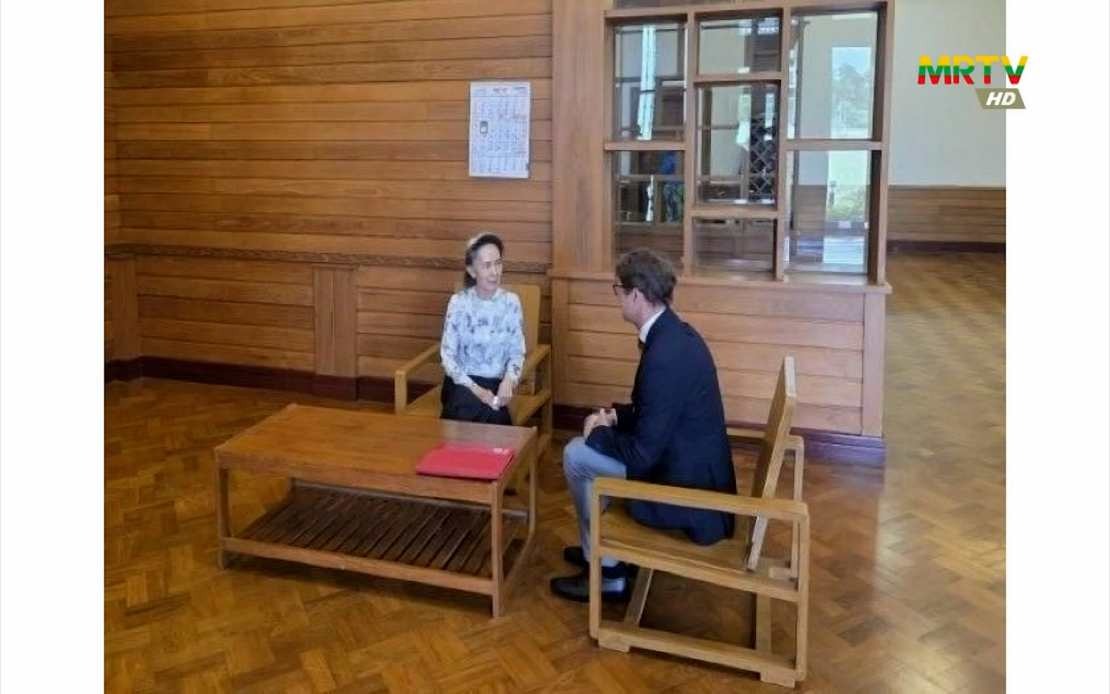
Myanmar's military-backed administration has permitted an International Committee of the Red Cross representative to meet with detained former leader Aung San Suu Kyi, marking a significant diplomatic breakthrough after more than three years of limited international access to the nation's most prominent political prisoner. Government spokeswoman Khine Khine Soe announced on Monday that Suu Kyi received Arnaud de Baecque, the ICRC's Resident Representative to Myanmar, at an undisclosed location in Naypyitaw, the capital. The carefully controlled encounter, documented through photographs released by the government, represents the first publicly confirmed meeting between Suu Kyi and an international official since her detention began following the February 2021 military coup.
The images provided by authorities offer limited but tantalising insights into Suu Kyi's current circumstances. In photographs showing her meeting with de Baecque, the 81-year-old appears in traditional Burmese dress within a minimally furnished room containing only basic wooden furniture. Another photograph depicts her cutting a birthday cake, with the inscription "Happy Birthday Aunty Suu 19.6.2026" visible on its surface. The background reveals modest furnishings including a clothes rack and storage boxes, suggesting residential quarters rather than a prison facility. However, independent verification of the photographs' authenticity, location, and timing remains impossible, as Reuters could not confirm the details through external sources.
Suu Kyi's prolonged detention without substantial international oversight has become a central point of contention between Myanmar's military rulers and the regional community. Since the coup swept away the civilian government she led, her exact whereabouts and health status have been shrouded in official secrecy. The Nobel Peace Prize laureate has endured a series of trials conducted largely behind closed doors, resulting in multiple convictions that accumulated to a 33-year sentence. The sentence was subsequently reduced to 27 years, then further cut by one-sixth in April, leaving an outstanding obligation of 18 years according to members of her legal team. Throughout her detention, Suu Kyi's associates have consistently characterised the charges—ranging from corruption and election fraud to violations of state secrecy legislation—as politically motivated mechanisms designed to eliminate her from public life.
The international community's concerns about Suu Kyi's wellbeing have intensified following years of opacity regarding her health and condition. Her son, Kim Aris, disclosed to Reuters in December that he maintains virtually no direct contact with his mother, receiving only irregular secondhand information about alleged heart, bone, and dental problems. This communication vacuum has fuelled widespread anxiety among international observers, democracy advocates, and neighbouring nations about whether Suu Kyi might suffer serious deterioration or death while confined. Southeast Asian governments have increasingly vocalized these concerns through diplomatic channels, with Thailand's Foreign Minister Sihasak Phuangketkeow recently calling for verifiable access to allow confirmation of the military's repeated claims that Suu Kyi enjoys good health.
The timing of this Red Cross meeting follows a period of intensified regional diplomatic pressure on Myanmar's government. In late April, Myanmar conducted a military-engineered election that formally installed former junta leader Min Aung Hlaing as president, consolidating military control over state institutions. Around the same time, authorities announced that Suu Kyi had been transferred to house arrest, ostensibly improving her conditions, though independent confirmation remains elusive. When ASEAN foreign ministers convened in Bangkok last month, the bloc explicitly prioritised gaining access to Suu Kyi to independently verify the junta's assertions regarding her health. The Philippines formally requested permission for an ASEAN special envoy to visit her, a request that the military administration has thus far declined.
For Malaysian readers and observers across Southeast Asia, Suu Kyi's predicament represents far more than the circumstances of a single political prisoner. Her detention symbolizes the broader regional struggle between military authoritarianism and democratic aspirations that continues to shape Southeast Asian geopolitics. Myanmar's neighbours, including Malaysia, have a vested interest in understanding the true situation within Myanmar, as instability and human rights abuses can generate refugee flows, economic disruption, and regional tension. The military junta's grudging permission for this Red Cross meeting suggests possible responsiveness to sustained regional and international pressure, though the carefully controlled nature of the encounter indicates the government remains determined to manage its narrative.
The Red Cross's diplomatic role in this situation reflects the organization's broader mandate as a neutral humanitarian actor capable of accessing restricted environments. The ICRC maintains working relationships with governments worldwide and serves as one of the few international bodies to which repressive regimes occasionally grant access. However, the ICRC itself has not publicly confirmed details of the meeting or commented on Suu Kyi's health status, maintaining the confidentiality that characterises its operations. This silence, while consistent with the organization's protocols, also means that international observers cannot independently verify whether this meeting represents a genuine improvement in access or merely a carefully orchestrated publicity exercise.
Suu Kyi's detention has profoundly destabilized Myanmar's political landscape and complicated Myanmar's relationships with ASEAN neighbours. As the daughter of independence hero General Aung San and Myanmar's most internationally recognized political figure, Suu Kyi commands deep affection among large segments of the population despite the military's efforts to delegitimize her through judicial proceedings. Her years under house arrest during the previous junta period—when she delivered celebrated speeches to supporters gathered beyond the gates of her Yangon residence on Inya Lake—transformed her into a global symbol of democratic resistance. The current military regime clearly recognizes her enduring symbolic power, which explains both the severity of her punishment and the evident desire to control all information regarding her treatment.
The government's release of photographs showing Suu Kyi appears designed to counter accumulating international criticism while maintaining strict limits on independent verification. By producing images of her in relatively normal circumstances—meeting with a Red Cross official, celebrating her birthday—the military seeks to demonstrate that she receives humane treatment. Yet the controlled dissemination of these specific images, combined with the absence of any statement from the ICRC or from Suu Kyi herself, underscores the fundamental information asymmetry that has characterized her detention. International observers and regional governments must accept the military administration's framing of events while lacking means to independently confirm Suu Kyi's actual health, mental state, or conditions of confinement.
The path forward for Suu Kyi's situation remains uncertain. While this Red Cross meeting represents acknowledgment of international pressure and perhaps a marginal expansion of access, it does not suggest imminent release or fundamental changes to her detention status. Myanmar's military rulers have demonstrated considerable stubbornness regarding political prisoners and remain largely insulated from economic or diplomatic pressure sufficient to force policy shifts. ASEAN's consensus-based diplomacy has proven insufficient to compel meaningful change, though individual member states continue advocating for improved access and transparency. For Malaysia and other regional nations, Suu Kyi's case continues symbolizing the tensions between respecting national sovereignty and promoting human rights standards—a balance that remains deeply contested across Southeast Asia.

