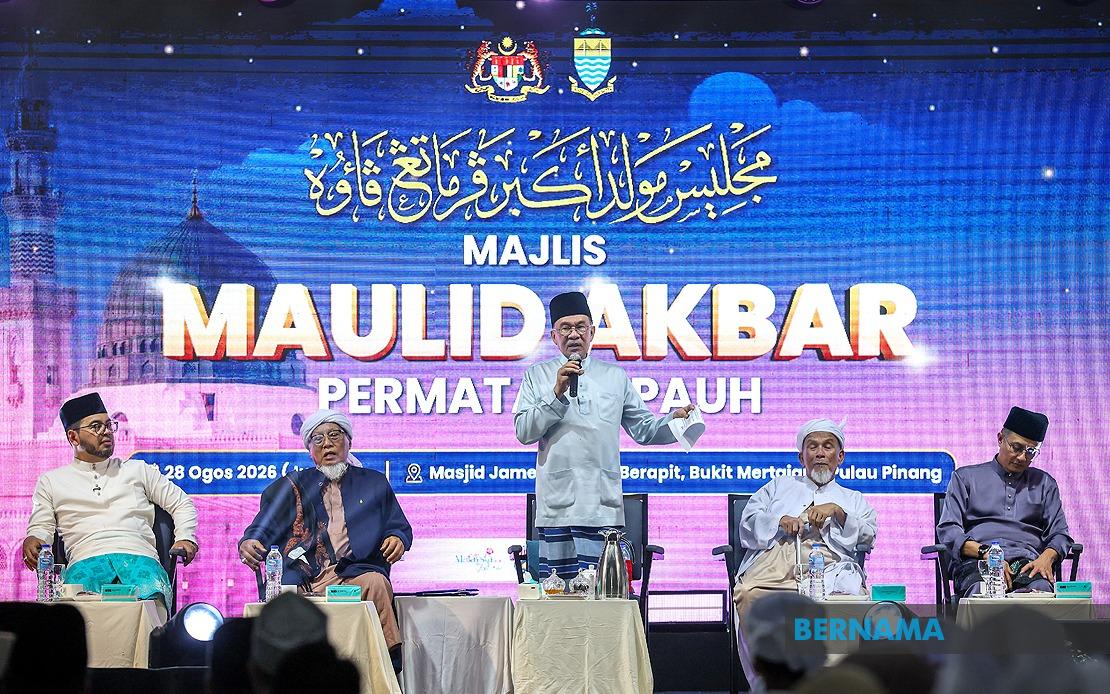
Prime Minister Datuk Seri Anwar Ibrahim has called upon Malaysia's Muslim community to establish themselves as moral exemplars within society, emphasising that genuine respect emerges through consistent demonstration of ethical conduct in everyday affairs. Speaking at a Maulid Akbar ceremony held in conjunction with National Day celebrations at Masjid Tengah in Bukit Mertajam, Anwar stressed that Muslims must distinguish themselves through diligence, trustworthiness, and an unwavering commitment to honest dealings, positioning moral character as the foundation upon which social standing should rest.
The Prime Minister articulated a straightforward philosophy of leadership and community influence. Rather than relying on titles, formal authority, or economic status to command respect, he argued that Muslims can earn genuine admiration by exhibiting the tangible qualities of hard work, personal integrity, and honesty in their interactions. Anwar emphasised that when members of society observe Muslims conducting themselves with transparency, fulfilling their commitments, and rejecting corrupt practices, such conduct naturally generates the esteem and trust that positions demand. This perspective reflects a broader philosophy about the relationship between individual character and collective standing within a diverse nation.
The address carried particular significance given Malaysia's ongoing efforts to rebuild public trust in institutions and leadership following periods marked by high-profile corruption cases and governance challenges. By positioning personal moral conduct as the cornerstone of societal respect, Anwar appears to be advancing a message that extends beyond religious communities to touch upon the broader national project of restoring institutional credibility. The explicit rejection of corruption and theft, coupled with emphasis on promise-keeping, directly addresses concerns that have plagued public discourse in recent years.
Central to Anwar's message was the assertion that Islam fundamentally embodies principles of compassion, kindness, and universal welfare. He argued that Muslims bear a responsibility to exemplify these teachings through their actions toward all members of society, irrespective of religious affiliation or ethnic background. This inclusive framing suggests an attempt to position Islamic values as compatible with, and indeed supportive of, Malaysia's multiethnic social fabric. By emphasising that Muslims must safeguard the wellbeing of entire communities and foster harmonious relationships across different groups, Anwar appeared to be reinforcing narratives of religious cooperation rather than division.
The Prime Minister introduced the concept of achieving balance across multiple dimensions of human development and national progress. Rather than compartmentalising spiritual, intellectual, moral, and material advancement, Anwar advocated for simultaneous cultivation of faith, knowledge, character development, physical wellbeing, and economic prosperity. This holistic approach reflects the Malaysia MADANI framework that has become central to his administration's governance agenda, suggesting that authentic national development cannot be reduced to policy implementation, GDP growth statistics, or technological capability alone.
Anwar employed a metaphorical framework to articulate this vision of balanced progress, describing the imperative to simultaneously reach toward the sky while remaining rooted in the earth. This imagery encapsulates the tension between pursuing modernisation and prosperity while preserving foundational values and moral principles. For Malaysian policymakers and citizens navigating rapid technological change and economic transformation, the metaphor carries resonance with broader questions about cultural preservation amid development. The earth-bound roots represent faith, character, and morality, suggesting these elements provide the stability necessary to sustain growth that might otherwise become untethered from meaningful purpose.
The Minister in the Prime Minister's Department (Religious Affairs), Dr Zulkifli Hasan, attended the ceremony, indicating government commitment to the themes Anwar articulated. This ministerial presence underscores that calls for enhanced moral leadership among Muslims constitute not merely spiritual exhortation but elements of official policy discourse and national governance philosophy. The attendance of the religious affairs minister lends institutional weight to what might otherwise be understood as private reflection or community-directed counsel.
Anwar extended his call beyond individual conduct to encompass intellectual and institutional dimensions of religious life. He highlighted the importance of seeking wisdom and guidance from Islamic scholars and theologians, positioning such engagement as essential to Muslims fulfilling their broader role in society. Simultaneously, he emphasised the necessity of fostering constructive dialogue between religious scholars and political leaders, framing such exchange as beneficial to both communities. This dual emphasis suggests recognition that Muslim moral leadership operates through multiple channels—individual daily conduct, scholarly guidance, and formal institutional engagement.
The Prime Minister's articulation of how Malaysia MADANI must function operationally reinforced these philosophical commitments. He insisted that the national development agenda cannot successfully pursue economic expansion and technological mastery while neglecting the moral and value-based foundations that should inform such progress. This statement challenges conventional development paradigms that prioritise quantifiable economic and technological metrics above other considerations. For Southeast Asian countries grappling with the social and cultural consequences of rapid modernisation, Anwar's framing offers a counterpoint to purely technocratic approaches to national advancement.
The speech reflects broader tensions within Malaysian society regarding the relationship between Islamic identity and national development, particularly regarding how Muslim communities can effectively contribute to a plural society. By grounding Muslim leadership in demonstrable moral conduct rather than assertions of religious superiority or institutional dominance, Anwar appears to be advancing a framework that positions ethical behaviour as the legitimate basis for influence and respect. This approach potentially offers pathways beyond more confrontational models of religious and ethnic identity politics that have characterised some periods of Malaysian history.
The emphasis on integrity and rejection of wrongdoing carries particular weight given persistent public concerns about governance standards and official accountability. By directing calls for moral conduct explicitly toward Muslim communities while framing such conduct as essential to earning respect and maintaining social cohesion, Anwar may be attempting to cultivate grassroots commitment to higher ethical standards across society. The message suggests that institutional reforms and policy changes, while necessary, must be accompanied by cultural shifts in how individuals conduct themselves within their respective communities and roles.
Looking forward, the articulated vision presents both idealistic aspirations and practical challenges. While the philosophical framework emphasising moral leadership and balanced development enjoys broad appeal, translating such principles into concrete institutional practices and sustained individual conduct remains substantially more complex. For Malaysians and Southeast Asian observers, the speech raises fundamental questions about how societies can authentically cultivate ethical cultures while managing competing demands of economic competitiveness, technological advancement, and social diversity in an increasingly globalised context.

