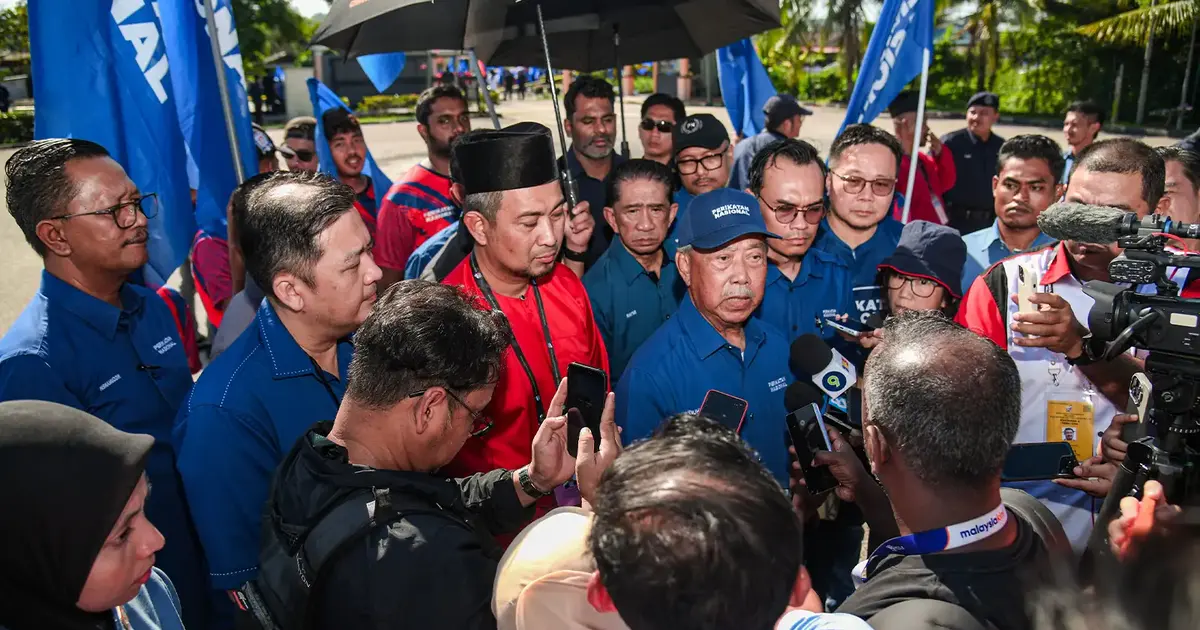
Perikatan Nasional's prospects for securing state-level political leadership remain viable, according to coalition president Muhyiddin Yassin, who outlined the grouping's strategic positioning across Malaysia's peninsular and East Malaysian territories. The Bersatu chief's optimism reflects calculations centred not merely on the coalition's existing parliamentary strength but on the coalition's ability to forge working arrangements with political actors currently positioned outside its formal membership structure.
The composition of Perikatan Nasional has undergone substantial shifts since its initial formation, with membership comprising principally Bersatu, the Malaysian Islamic Party (PAS), and the Pan-Malaysian Islamic Party component. This three-part structure has provided the coalition with varying degrees of influence across different state legislatures, though results have been inconsistent, with some states seeing the coalition capture executive control whilst others witnessed less favourable electoral outcomes. Muhyiddin's latest statements appear designed to project organizational confidence heading into potential forthcoming state elections and to counter perceptions that the coalition faces terminal fragmentation.
Crucially, Muhyiddin identified Muda—the youth-focused political movement established by former Bersatu member Muhammad Azmin Ali—as representing a potential avenue for expanded legislative support. Muda has cultivated a distinct political profile distinct from larger coalition partners, positioning itself as an alternative voice whilst maintaining pragmatic openness to collaboration with various political formations depending on state-level circumstances. The explicit acknowledgment that external parties could supplement coalition strength demonstrates flexibility in coalition-building strategy, moving beyond the notion of rigid bloc voting that has historically characterised Malaysian coalition politics.
The strategic significance of additional parliamentary partners extends beyond mere numerical advantage. State governments in Malaysia operate within frameworks requiring majority support in state legislative assemblies, with coalition-building often determined not by national party strength but by the specific composition of individual state parliaments. This reality has forced Perikatan Nasional to develop sophisticated state-by-state strategies rather than relying upon a uniform nationwide approach. Muhyiddin's framing implicitly acknowledges this tactical necessity whilst positioning the coalition as sufficiently adaptable to secure necessary support across varying state political landscapes.
Muhyiddin's confidence reflects calculations regarding the coalition's organizational capacity and established networks across state legislatures. Perikatan Nasional maintains substantial legislative representation in several crucial states where party machinery remains functional and grassroots mobilization capabilities remain intact. These regional strongholds provide foundation blocks upon which additional partnerships could be constructed, allowing the coalition to leverage existing organizational strength whilst supplementing it through targeted alliances with compatible political entities like Muda.
However, the coalition faces considerable structural challenges that complicate Muhyiddin's optimistic projections. Internal tensions between Bersatu and PAS have surfaced periodically, reflecting differing ideological orientations and competitive interests for Malay-Muslim voter support. These underlying strains could constrain the coalition's capacity to present united electoral campaigns or maintain unified legislative blocs once elected. Moreover, Perikatan Nasional's overall parliamentary footprint has contracted substantially since 2020, necessitating proportionately greater reliance upon external partner support to achieve state-level majorities in contexts where the coalition previously commanded stronger independent positions.
The mention of potential allies beyond formal coalition structure also reflects demographic and generational factors influencing Malaysian electoral politics. Muda's base comprises younger voters increasingly sceptical of traditional party structures, representing an emerging electoral constituency that established coalitions must address through partnership rather than absorption. By identifying Muda specifically, Muhyiddin signals awareness that future political success requires engagement with newer political formations and voter constituencies that resist incorporation into conventional coalitional frameworks. This recognition indicates strategic sophistication regarding contemporary Malaysian political dynamics.
State-level political outcomes in Malaysia have increasingly diverged from national-level electoral results, with several states selecting administrations controlled by coalitions different from those dominant at federal level. This pattern underscores the genuine independence of state electoral contests from national political tides and the possibilities available to coalitions willing to construct state-specific partnerships. Perikatan Nasional's potential pathway to state government leadership thus depends substantially on its capacity to identify willing partners and to construct functional legislative coalitions regardless of national political configurations.
Muhyiddin's public expressions of confidence regarding state government formation capabilities serve multiple strategic purposes simultaneously. Internally, such statements reassure coalition members that organizational viability remains intact despite periodic setbacks and internal difficulties. Externally, projections of confidence may influence calculations by potential external partners regarding the coalition's trajectory and the wisdom of collaborative arrangements. In Malaysian politics, where coalitional partners often assess alliances partly through perceptions of momentum and capacity, Muhyiddin's statements help shape narratives regarding Perikatan Nasional's political health and forward prospects.

