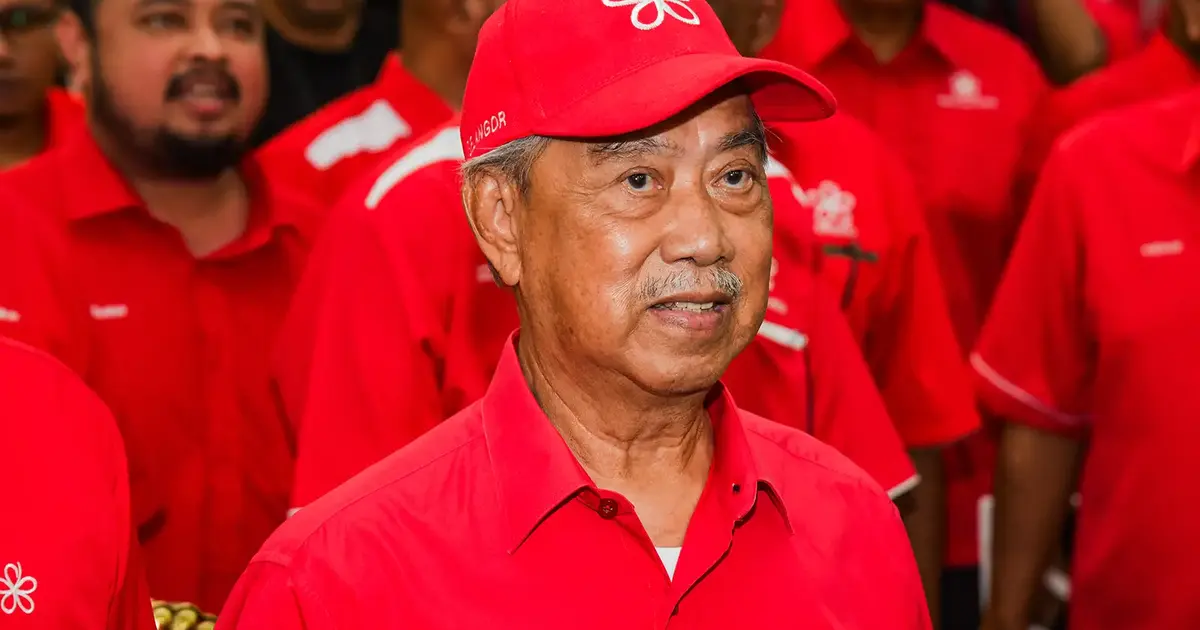
Bersatu president Muhyiddin Yassin has signalled fresh confidence that his party can make inroads with non-Malay voters without relying on partnership with PAS, addressing a persistent electoral vulnerability that has constrained the party's coalition-building options in recent years.
Muhyiddin's assertion reflects a strategic reassessment within Bersatu following the party's underwhelming performance among non-Muslim and non-Malay communities in previous electoral cycles. The party has historically struggled to move beyond its core demographic base, a limitation that complicated its positioning within Malaysia's fractious coalition politics and limited its appeal to multiracial voter blocs essential for commanding parliamentary majorities.
The Bersatu chief attributed the party's earlier difficulty in winning non-Malay support directly to public perception of PAS, his former ally in the Perikatan Nasional coalition. According to Muhyiddin's analysis, many non-Malay voters harboured reservations about associating with a political force they viewed as practising an exclusionary brand of politics, creating a perception problem that extended to Bersatu through its close association with the Islamic party.
This observation touches on a fundamental challenge in Malaysian politics: the complicated interplay between Islamic-oriented parties and multiracial appeal. PAS, as a religiously-focused political force, has consistently maintained a substantial bloc of Malay-Muslim support but has faced persistent difficulty attracting votes from Chinese, Indian, and other non-Malay communities. When Bersatu aligned closely with PAS, particularly during the Perikatan Nasional administration, the party inherited some of these electoral liabilities despite its own less explicitly religious positioning.
Muhyiddin's confidence appears grounded in a strategic reorientation. By positioning Bersatu as capable of independent appeal across Malaysia's diverse electorate, the party leader suggests a pathway toward broader coalition possibilities and reduced dependence on any single partner. This flexibility could prove valuable as Malaysian political configurations continue evolving, particularly if Bersatu seeks to rebuild relationships with other major players or construct new alliance structures.
The statement also implies internal party calculations about Bersatu's future trajectory. Rather than remaining locked into coalition arrangements that may constrain its growth, the party appears to be exploring how it might appeal directly to communities previously alienated by its political partnerships. This repositioning requires careful messaging that distinguishes Bersatu's approach from that of its former allies while maintaining core support among its existing voter base.
For Malaysian politics more broadly, Muhyiddin's remarks highlight the ongoing tension between coalition-building necessities and electoral appeal. Parties seeking to govern must often form partnerships that balance ideological differences with practical political mathematics. Yet such alliances frequently carry costs: association with certain partners can limit a party's ability to expand its constituency. Bersatu's proposed path of autonomous non-Malay outreach suggests the party is willing to accept greater strategic independence in exchange for reduced electoral constraints.
The viability of this approach remains uncertain. Bersatu would need to develop policy platforms and messaging resonating with non-Malay communities while maintaining its existing support network. This balancing act has proven difficult for many Malaysian political parties, particularly those with historical roots in ethnically or religiously defined constituencies. Successfully executing such a repositioning requires sustained effort, credible policy commitments, and demonstrated willingness to champion non-Malay interests within government or parliament.
Muhyiddin's confidence also occurs within the context of Malaysia's broader political fragmentation. With multiple coalitions competing for parliamentary seats and influence, parties demonstrating flexibility in alliance formation and broader electoral appeal gain strategic advantages. If Bersatu can genuinely expand its non-Malay support base, it enhances its negotiating position within future government formations and increases its relevance across diverse electoral landscapes.
The timing of these statements may carry significance as well. Malaysian political parties frequently adjust their messaging and strategic positioning in anticipation of elections or major political realignments. Bersatu's emphasis on independent non-Malay appeal could reflect preparations for upcoming electoral challenges or opportunities to reshape coalition arrangements at state or federal levels.
However, translating confidence into electoral performance presents formidable challenges. Non-Malay voters, particularly urban and educated constituencies, have demonstrated sophistication in evaluating party track records, policy proposals, and coalition associations. Simply distancing from PAS rhetorically may prove insufficient; Bersatu would need to offer substantive policy differentiation and demonstrate genuine commitment to non-Malay concerns through concrete actions and resource allocation.
The party's success in this endeavour could reshape Malaysian coalition politics by creating new alliance possibilities and reducing the dominance of rigid ethnic and religious coalition structures. Conversely, if Bersatu's outreach efforts fail to gain meaningful traction, the party may find itself constrained to familiar partnership patterns, suggesting that electoral realities impose stronger constraints than political leaders' aspirational statements acknowledge.

