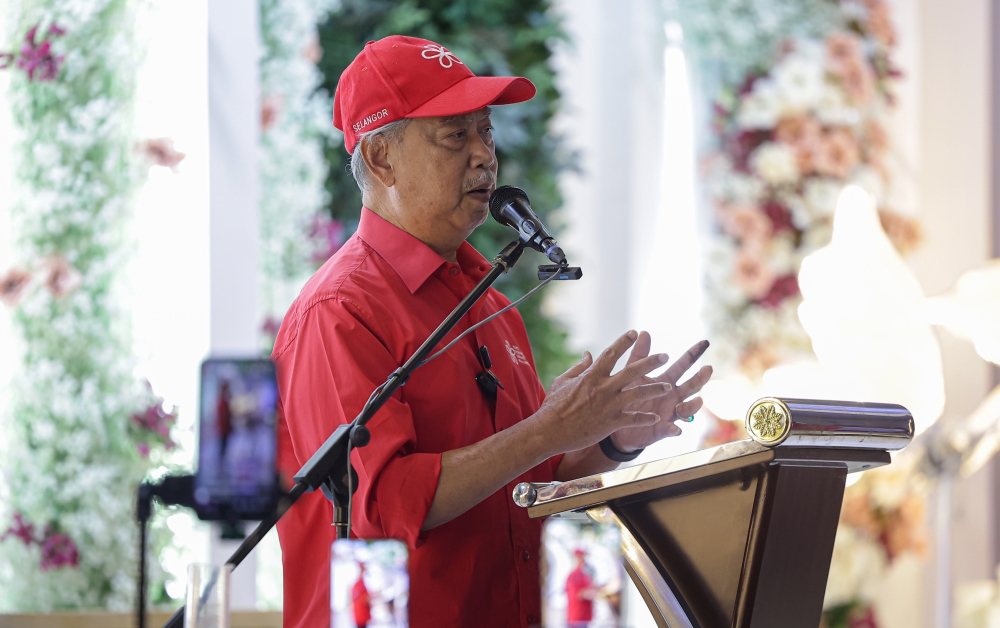
Tan Sri Muhyiddin Yassin has staked a distinctive claim for Parti Pribumi Bersatu Malaysia, asserting that his party now represents the sole principled Opposition voice within Parliament as Malaysia's political architecture continues to fragment and realign. Speaking in Kuala Lumpur on July 18, the former Prime Minister contended that Bersatu occupies unique standing in the legislative chamber, distinguishing itself from other political entities through what he characterized as consistent adherence to Opposition principles. His assertion reflects broader turbulence within Malaysian politics, where traditional coalition boundaries have dissolved and erstwhile allies have reconfigured their alliances in ways that complicate conventional Opposition-Government classifications.
Muhyiddin's positioning of Bersatu represents a calculated effort to carve out political territory for his party as the Malaysian political sphere exhibits unprecedented fluidity. Over recent years, the nation has witnessed successive realignments that have fundamentally altered the composition and character of political blocs. The emergence of Perikatan Nasional, internal conflicts within established coalitions, and shifting cross-party accommodations have created a landscape where traditional dichotomies between Government and Opposition no longer cleanly categorize parliamentary dynamics. Bersatu's assertion of exclusive Opposition credentials must be understood within this context of systemic political reconfiguration.
The Malaysian Parliament's current composition reflects decades of complex electoral mathematics and coalition-building, elements that Muhyiddin's argument seeks to distill into a clearer narrative. By claiming sole authentic Opposition status, Bersatu attempts to establish itself as the principled custodian of parliamentary scrutiny, implicitly suggesting that other political entities have compromised their Opposition function through various accommodations with Government structures or through ambiguous positioning that muddles clear political accountability. This framing carries implications for how Malaysian voters might understand their legislative representation and the mechanisms through which parliamentary oversight functions.
The significance of Muhyiddin's claim extends beyond symbolic positioning into substantive questions about parliamentary governance and democratic accountability. In a functioning Westminster-derived system such as Malaysia's, a robust Opposition serves essential functions: scrutinizing executive decisions, articulating alternative policy frameworks, and providing voters with genuine electoral choice between competing visions. Muhyiddin's contention that Bersatu alone fulfils this role suggests that other Opposition-aligned parties have either entered into arrangements that compromise their scrutiny function or have adopted positions so ambiguous that they fail to provide meaningful counterbalance to Government initiatives.
The political realignment that has characterized Malaysian politics in recent years stems partly from institutional factors and partly from personality-driven competition. The defection of certain leaders and blocs between coalitions, the rise of new political vehicles, and the shifting calculus of State-level politics have collectively created a Parliament that resists easy categorization. Muhyiddin's effort to establish Bersatu as the unambiguous Opposition force represents an attempt to impose clarity upon this complexity, marketing his party to voters as the reliable guardian of oppositional function rather than as one voice among several competing for Opposition credentials.
For Malaysian voters and observers, Muhyiddin's assertion raises important questions about how Opposition identity is determined and what criteria distinguish genuine parliamentary scrutiny from mere rhetorical positioning. Does Opposition status derive from formal coalition membership, from consistent voting patterns against Government initiatives, from the willingness to enter coalitions with other parties, or from some combination of these and other factors? The fluidity of Malaysian politics has created situations where answering these questions has become genuinely complex, allowing various actors to make competing claims about their Opposition bona fides.
The timing of Muhyiddin's statement reflects broader dynamics within Malaysian politics as various parties position themselves ahead of future electoral contests and as the current parliamentary configuration continues to evolve. State-level elections, internal party developments, and shifting inter-party relationships create an environment where political narratives become subject to rapid revision. By staking Bersatu's claim to exclusive Opposition status now, Muhyiddin seeks to establish a durable political identity that can survive future realignments and provide consistent messaging to the party's supporters and potential voters.
Bersatu's own history complicates the assertion of principled Opposition consistency. The party emerged from internal conflicts within the United Malays National Organisation and has itself undergone several significant strategic pivots, from Government participation to Opposition positioning and beyond. These shifts have required considerable explanation and reframing from party leadership, suggesting that political circumstances and party interests have substantially influenced Bersatu's positioning rather than unchanging principle. Muhyiddin's current framing must thus be understood as seeking to establish a new stable identity after a period of significant flux.
The regional dimensions of this Malaysian political development warrant consideration for Southeast Asian observers. As other nations in the region experience their own coalition fragmentation and realignment, Malaysia's experience demonstrates both the complexities that emerge when established parties and coalitions fragment and the rhetorical strategies through which political actors attempt to establish clarity and identity. Muhyiddin's claim that Bersatu represents Parliament's authentic Opposition voice exemplifies how political actors navigate ambiguous circumstances by constructing narratives that advance their interests while portraying them as principled positions.
Looking forward, the credibility and durability of Bersatu's Opposition identity will depend substantially on consistent parliamentary behaviour, policy articulation, and electoral performance. Muhyiddin's assertion represents a declaration of intent rather than an established reality, requiring ongoing demonstration through voting patterns, legislative initiatives, and engagement with voters. Whether Bersatu can sustain this positioning amid the perpetual realignments that characterize contemporary Malaysian politics remains an open question that will unfold through subsequent elections, parliamentary sessions, and political developments. The assertion itself reflects both Bersatu's ambitions and the broader uncertainty that characterises Malaysia's political trajectory.

