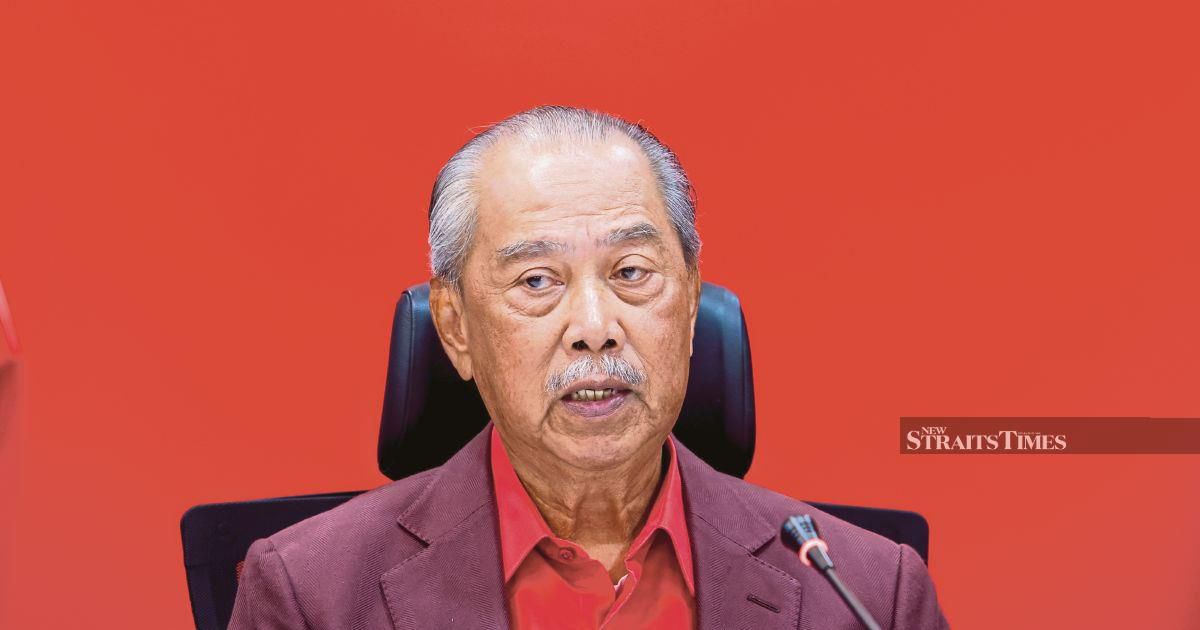
Bersatu president Tan Sri Muhyiddin Yassin has levelled serious allegations that Umno is engineering a conspiracy to destabilise the unity government formed between his party and Pakatan Harapan. The accusation marks an escalation in tensions within the ruling coalition and underscores deepening rifts between component parties that have sought to present a united front since their merger following the 2022 general election.
Muhyiddin's assertion carries significant weight given his direct experience with political engineering. His earlier administration collapsed in August 2021 when Umno withdrew support, a sequence of events that fundamentally altered Malaysia's political landscape and paved the way for the formation of the current unity government. By drawing parallels between past and present machinations, the Bersatu leader is signalling what he perceives as a pattern of destabilising behaviour from the country's largest Malay-Muslim party.
The timing of these allegations is particularly noteworthy given the coalition's ongoing challenges in maintaining parliamentary cohesion and advancing its legislative agenda. Malaysia's political structure, with its finely balanced parliament, has historically made governments vulnerable to defections and shifting alliances. The unity government, comprising ideologically diverse partners ranging from Umno to the more progressive elements of Pakatan Harapan, has repeatedly faced questions about its longevity and internal stability.
Umno's position within the coalition has remained complex and contested. The party, which dominated Malaysian politics for seven decades, found itself in opposition following the 2022 election before eventually joining the unity arrangement. This participation represented a significant shift for Umno, yet underlying tensions about the coalition's direction, policy priorities, and power-sharing arrangements have periodically surfaced. Muhyiddin's allegations suggest these tensions are intensifying beyond the realm of typical policy disagreement.
The Bersatu president's claims also reflect broader strategic calculations within Malaysian politics. With another general election likely within the next two years, positioning for competitive advantage has intensified among coalition partners. Umno, seeking to rehabilitate its electoral standing after previous defeats, may be reassessing its coalitional commitments. From Bersatu's perspective, any weakening of the unity government could prove catastrophic, given the party's modest parliamentary representation and dependence on larger coalition partners for ministerial positions and political relevance.
Muhyiddin's invocation of his government's collapse serves a rhetorical purpose beyond immediate partisan scoring. It reminds coalition members and the Malaysian public of the consequences when ruling alliances fracture. That August 2021 episode, which came amid the Covid-19 pandemic and economic uncertainty, remains vivid in collective memory. His comparison implicitly warns that repeating such destabilisation would damage the nation's governance and economic stability, potentially resonating with voters fatigued by political instability.
The allegations also highlight vulnerabilities in how Malaysia's coalition governments have functioned in recent years. Unlike established democratic systems where coalitions often emerge from electoral outcomes with clearly negotiated terms, Malaysian coalitions have frequently formed retroactively, bringing together parties with incompatible ideologies and competing interests. The unity government, despite its stated commitment to reforms and democratic renewal, embodies these structural weaknesses. Without robust mechanisms for dispute resolution and power-sharing enforcement, suspicion and accusation readily fill the vacuum.
Regional observers watching Malaysian politics will note implications beyond domestic concerns. As Southeast Asia's third-largest economy navigates complex geopolitical positioning between major powers, political instability at home undermines Malaysia's strategic credibility internationally. Investors scrutinise governance stability closely, and repeated threats to government longevity create uncertainty that ripples through financial markets and impacts business confidence throughout the region.
For Malaysian citizens, these allegations underscore the precariousness of recent political arrangements. The unity government was presented as a stabilising force offering relief from the tumultuous period following the 2020 Sheraton Move that precipitated Muhyiddin's government itself. That successive administrations face accusations of destabilisation plots suggests that foundational issues about how Malaysian politics organises power, manages competition, and balances multiple actors remain unresolved despite reform rhetoric and coalition agreements.
The credibility of Muhyiddin's specific claims requires scrutiny. Umno has not publicly confirmed the alleged conspiracy, and distinguishing between normal political manoeuvring and orchestrated destabilisation can prove challenging. However, the fact that such accusations now emanate from the coalition's own ranks, rather than opposition benches, indicates genuine anxiety about internal cohesion. Whether these concerns translate into actual attempts at government collapse, or represent pre-emptive positioning ahead of electoral realignment, will become clearer in coming months as coalition dynamics continue evolving.

