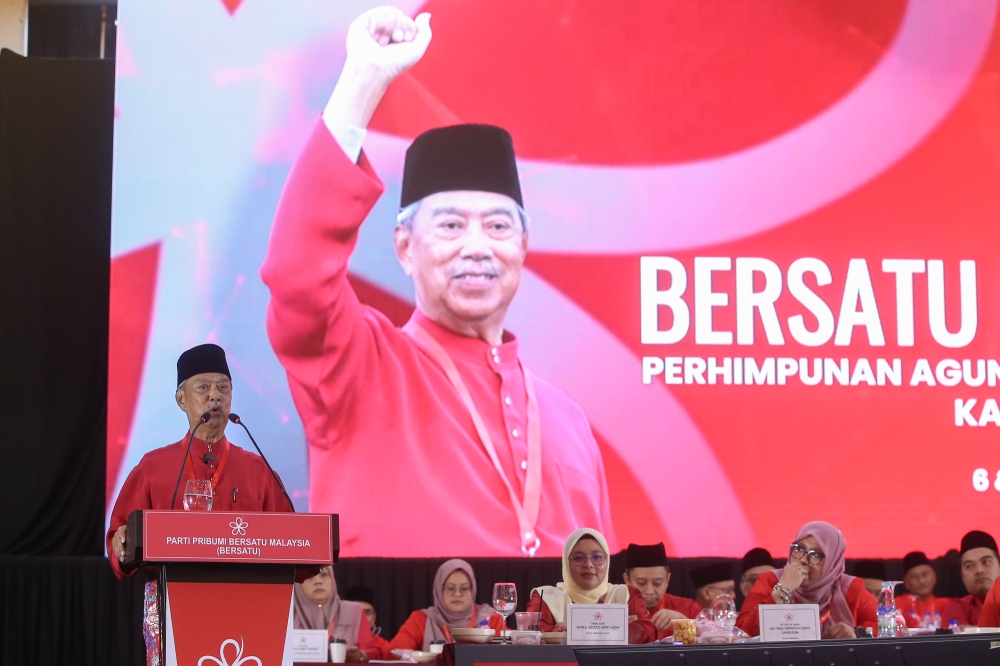
Parti Pribumi Bersatu Malaysia president Tan Sri Muhyiddin Yassin has levelled serious accusations against his Perikatan Nasional allies, asserting that the coalition has effectively sidelined his party from meaningful participation in governance. Speaking in Kuala Lumpur on July 17, Muhyiddin articulated grievances that reflect deepening tensions within Malaysia's political landscape, where multiple coalitions compete for influence and legitimacy among Malay-Muslim voters.
The Bersatu leader's critique extends beyond questions of internal coalition management to challenge the broader claim that Perikatan represents authentic Malay unity. By suggesting that the alliance with Umno—which has historically positioned itself as the guardian of Malay-Muslim interests—lacks the credentials to embody genuine community representation, Muhyiddin raises fundamental questions about the coherence and ideological consistency of the coalition structure. This positioning carries significant implications for how voters assess which political formation genuinely advances Malay community interests.
Muhyiddin's statements must be understood within the complex dynamics of Malaysian coalition politics, where partnerships frequently form and fracture based on electoral calculations and personal ambitions rather than ideological alignment. Bersatu, established relatively recently as a political vehicle, has struggled to establish itself as an independent force while navigating relationships with more established parties. The party's inclusion in Perikatan represented an attempt to build critical mass, yet Muhyiddin's complaints suggest this arrangement has not delivered the influence or autonomy his party anticipated.
The accusation that Perikatan has marginalised Bersatu reflects tensions that have periodically surfaced in Malaysian coalition politics. When parties with complementary electoral bases combine forces, questions invariably arise about power-sharing, resource allocation, and decision-making authority. Muhyiddin appears to be articulating frustrations that Bersatu has assumed the role of junior partner without the corresponding voice in strategic decisions that such arrangements typically entail.
Moreover, Muhyiddin's characterisation of the Umno partnership as failing to constitute genuine Malay unity deserves closer examination. Umno has traditionally claimed to represent Malay interests through its institutional relationships with the monarchy and civil service, yet it has also faced criticism for prioritising elite interests over grassroots community concerns. By questioning whether an Umno-led formation can authentically represent Malay aspirations, Muhyiddin implicitly argues that alternative political arrangements might better serve this constituency.
For Malaysian voters evaluating their electoral choices, these claims introduce important considerations about coalition authenticity and internal governance. If Perikatan genuinely marginalises one of its component parties, this raises questions about how such a coalition would manage diverse interests once in government. Democratic structures require mechanisms for negotiating differences and ensuring that all participants retain meaningful agency—principles Muhyiddin appears to suggest Perikatan has violated.
The timing of Muhyiddin's intervention reflects broader patterns in Malaysian politics, where statements from party leaders frequently serve dual purposes: addressing immediate factional concerns while positioning their parties for future electoral contests. By publicly articulating grievances about marginalisation, Muhyiddin simultaneously signals to party members that he is defending their interests and communicates to potential supporters that Bersatu remains an independent political actor despite coalition membership.
In the context of Southeast Asian politics more broadly, the Malaysian coalition dynamics illustrate challenges that confront multi-ethnic democracies managing competing communal claims. When political partnerships attempt to aggregate support across different constituencies, internal tensions often emerge over resource distribution and policy priorities. Muhyiddin's criticism highlights how these tensions can become publicly visible, potentially destabilising coalition stability if underlying grievances remain unaddressed.
For regional observers, Muhyiddin's statements also underscore the ongoing fragmentation within Malay-Muslim political representation in Malaysia. Rather than a unified bloc supporting single coalitions, this constituency increasingly divides its support among multiple competing formations—each claiming to represent authentic community interests. This fragmentation complicates governance prospects for any single coalition seeking majority support, as demonstrated by Malaysia's political volatility over recent years.
Looking forward, Muhyiddin's grievances will likely influence discussions about coalition restructuring or realignment. Political parties frequently recalibrate partnerships when existing arrangements fail to deliver anticipated benefits or status. If Bersatu determines that Perikatan marginalises its influence to unacceptable degrees, the party might explore alternative coalitional arrangements, further reshaping Malaysia's already complex political architecture.
The implications for Malaysian governance extend beyond coalition management to questions about democratic accountability and power-sharing within political alliances. If major coalitions contain frustrated component parties lacking meaningful decision-making influence, this creates conditions for instability and potential defection. Resolving such tensions requires explicit agreements about resource distribution, policy implementation authority, and mechanisms for dispute resolution—institutional foundations that Muhyiddin's complaints suggest may be inadequate within current Perikatan structures.
Ultimately, Muhyiddin's challenge to Perikatan's authenticity as a vehicle for Malay-Muslim interests reflects deeper uncertainties about which political formations can credibly claim to represent this constituency in contemporary Malaysia. As voters increasingly question whether established parties genuinely advance their interests, they may gravitate toward alternatives that promise more transparent governance and equitable internal power-sharing—standards against which Muhyiddin appears to be implicitly measuring Perikatan's performance.

