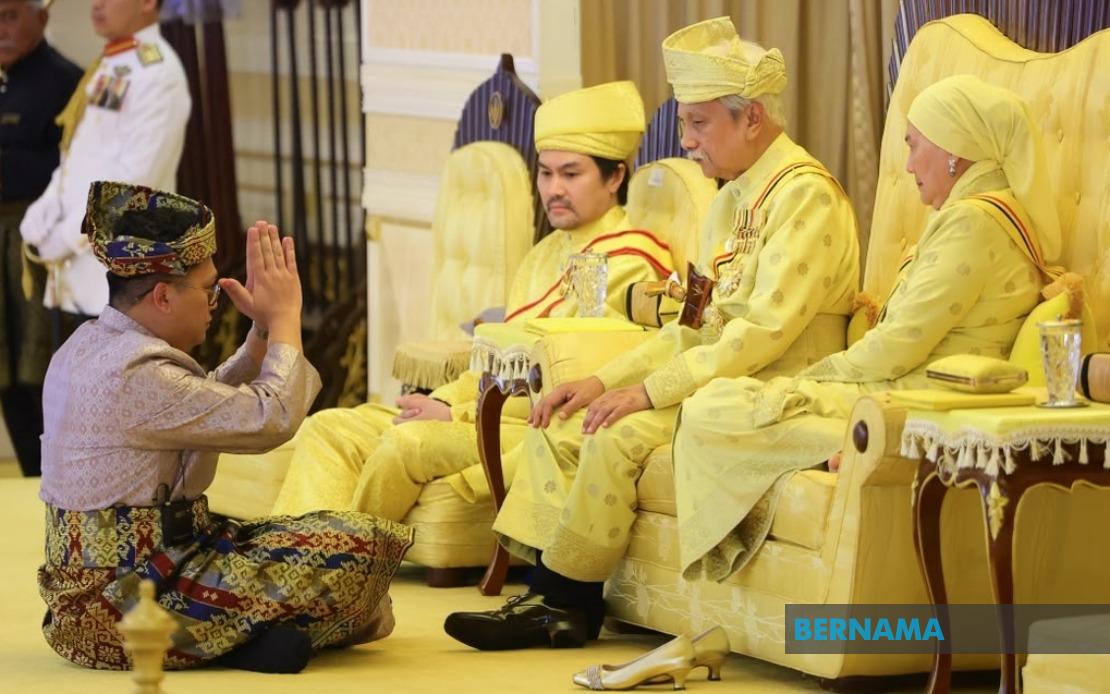
The Yang Dipertuan Besar of Negeri Sembilan, Tuanku Muhriz Tuanku Munawir, has officially conferred the position of 11th Undang of Luak Sungei Ujong upon Muhammad Faris Johari through a formal ceremony held at Istana Besar Seri Menanti on June 27. The installation saw the conferment of the title Datuk Klana Petra upon the newly appointed Undang, marking a significant moment in the state's hereditary leadership structure and customary governance framework.
The installation process adhered to traditional protocols centred on the Minangkabau administrative system unique to Negeri Sembilan. The ceremony commenced with the Orang Empat Istana, custodians of palace protocol, formally seeking the ruler's permission to proceed with the investiture. This ritualistic step underscores the constitutional relationship between the state's customary leadership and the monarchy, reflecting the intricate balance between hereditary Undang authority and the sovereign's ceremonial oversight that characterises Negeri Sembilan's governance arrangements.
Following the protocol's completion, Muhammad Faris publicly pledged his loyalty to Tuanku Muhriz, cementing the personal covenant expected between an Undang and the state's ruler. This declaration transcends mere ceremonial formality, establishing the foundational trust upon which the Undang will exercise their administrative responsibilities across their luak, or feudal district. The oath reinforced the hierarchical yet consultative nature of Negeri Sembilan's distinctive governance model, which relies on collaborative decision-making between the Yang Dipertuan Besar and the collective Undang council.
In his address during the ceremony, Tuanku Muhriz stressed the paramount importance of upholding the pledges made with sincerity, integrity and robust accountability. The ruler specifically reminded the assembled chieftains and Orang Kaya to maintain unwavering loyalty toward the institution of the Yang Dipertuan Besar and cultivate close, respectful engagement with the palace. These remarks reflect broader concerns within Negeri Sembilan's establishment about preserving institutional coherence amid evolving modern governance demands and generational transitions within the Undang families.
The ruler's address incorporated emphasis on the foundational role of mutual respect, trust and consensus in sustaining Malaysia's constitutional monarchy framework. By linking these principles to the protection of customary traditions and the state's overall prosperity, Tuanku Muhriz articulated a vision wherein modern governance and traditional institutions need not conflict but rather reinforce one another. This perspective holds particular relevance for Malaysian federalism, where states like Negeri Sembilan navigate the intersection between Islamic law, customary Minangkabau practices and federal constitutional requirements.
Tuanku Muhriz also called upon the broader population to collaborate with the customary leadership in discharging official duties whilst preserving and advancing Adat Perpatih, the matrilineal customary law system historically practised throughout Negeri Sembilan. This appeal acknowledges that customary governance systems require active societal participation to remain viable and culturally meaningful. The preservation of Adat Perpatih has gained renewed attention as younger generations increasingly migrate to urban centres and become less familiar with traditional administrative structures, making conscious efforts to maintain these inherited systems essential for their continuation.
Muhammad Faris Johari, at 28 years old, represents a younger generation of Undang leadership in Negeri Sembilan. Born on October 30, 1997, he brings contemporary professional credentials to the historically hereditary position, having obtained a bachelor's degree in accountancy from Universiti Teknologi MARA and achieving professional qualification through the Association of Chartered Certified Accountants programme in 2022. His background reflects how modern Undang appointees increasingly combine traditional hereditary claims with formal education and professional expertise, potentially enabling more sophisticated engagement with contemporary administrative and financial challenges facing their districts.
The appointment carries significance beyond ceremonial dimensions, as Undang positions entail substantial responsibilities in land administration, dispute resolution within their luak and representation within Negeri Sembilan's Dewan Negeri. An Undang's effectiveness in these domains can directly impact livelihood outcomes for communities within their district, from agricultural land matters to resource allocation disputes. Muhammad Faris's professional accounting background may position him to engage more effectively with state-level financial matters and development initiatives affecting Sungei Ujong.
The ceremony's attendance reflected the formal nature of the installation, with prominent attendance from Tunku Ampuan Besar Tuanku Aishah Rohani Tengku Besar Mahmud, Tunku Besar Seri Menanti Tunku Ali Redhauddin Tuanku Muhriz and Tunku Panglima Besar Tunku Zain Al-'Abidin, establishing the event's significance within the broader royal household. Menteri Besar Datuk Seri Aminuddin Harun and heads of state government departments also witnessed the proceedings, signalling the Negeri Sembilan state administration's commitment to maintaining functional relationships between the constitutional government and the customary leadership structure.
The same day witnessed the planned installation of the 22nd Undang of Luak Rembau, indicating a broader transition period within Negeri Sembilan's customary leadership. Such concurrent installations suggest potential generational succession patterns across multiple luak simultaneously, potentially reshaping the dynamics within the collective council of Undang that advises the Yang Dipertuan Besar on matters of state governance and customary law.
Negeri Sembilan's unique constitutional arrangement, grounded in the Minangkabau system, renders it distinct among Malaysian states and merits consideration as Southeast Asia's only matrilineal feudal governance structure still operationalised within a modern nation-state framework. The installation of new Undang represents continuity of this distinctive heritage whilst simultaneously raising questions about how traditional systems adapt to contemporary demands including land scarcity, urbanisation and evolving notions of administrative accountability. Muhammad Faris's appointment will provide insights into whether younger, professionally qualified Undang can effectively navigate these intersections while maintaining the customary principles that legitimise their positions within their communities.

