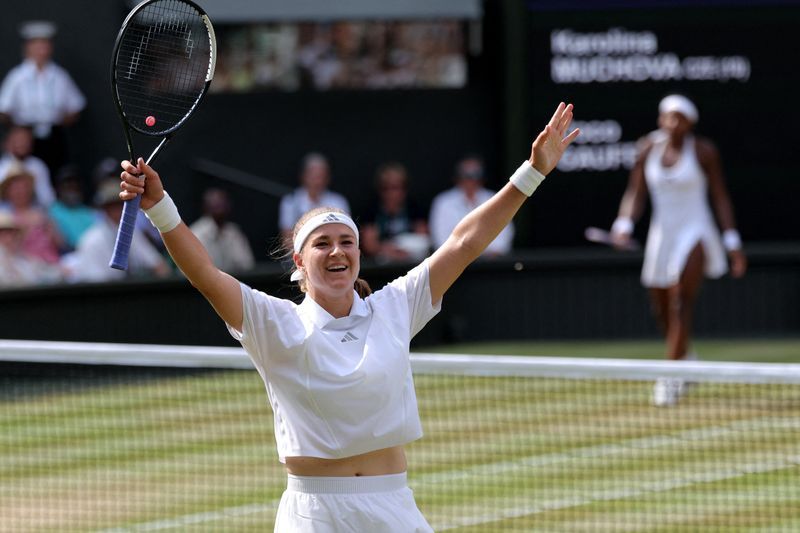
Karolina Muchova authored one of the tournament's most dramatic turnarounds on Centre Court, outlasting Coco Gauff through a gruelling semifinal that swung decisively in the final set's tiebreak. The Czech competitor emerged victorious 6-2 1-6 7-6 (12-10) after two hours and 35 minutes of relentless tennis, forcing the American into a capitulating forehand error that sealed Muchova's passage to Saturday's championship match. The result marks a remarkable achievement for the 28-year-old, who will contest her maiden Grand Slam final and simultaneously keeps alive the prospect of a historic all-Czech women's singles final, depending on the outcome of Thursday's second semifinal between compatriot Linda Noskova and Ukraine's Marta Kostyuk.
Muchova's advance extends an extraordinary streak of Czech success at Wimbledon, with the nation having produced two champions in the past two seasons. Marketa Vondrousova claimed the title in 2023, while Barbora Krejcikova won in 2024, demonstrating the depth of talent emerging from Central Europe's tennis pipeline. A third Czech lifting the Venus Rosewater Dish within four years would cement the country's status as a powerhouse in women's tennis, a distinction that seemed improbable just a generation ago.
Perhaps most peculiar about Muchova's dominance on grass is an irony that would escape casual observers: the semifinalist suffers from a grass allergy severe enough to require pharmaceutical intervention before stepping onto the lawn. She has spoken candidly about the arsenal of medications, inhalers, and eye treatments necessary simply to compete on grass courts, a medical burden that makes her performance at Wimbledon all the more impressive and speaks to her mental fortitude and competitive drive.
Muchova controlled the opening set with assured grasscourt tactics, breaking Gauff in the third and fifth games to establish an early stranglehold. The American's frustration mounted visibly as she surrendered her serve a second time through an unforced error, driving a forehand wildly into the back boards. Muchova's serve proved particularly effective, with a 111 mph ace punctuating her dominance as she claimed the set 6-2 without extended baseline exchanges.
Yet Gauff has cultivated a reputation throughout this year's tournament for escaping precarious situations through sheer determination. The seventh-seeded American had survived four consecutive three-set matches to reach the semifinals, demonstrating a resilience that belied her age and experience level. Following a dismal first set, she marshalled her resources in the second set, finally converting a breakthrough opportunity on her ninth attempt to forge a 3-1 advantage. A subsequent break for 5-1 propelled her mother to celebratory outbursts in the player's box, and Gauff would level the match by claiming the set 6-1, forcing an unexpected decider.
The third set transformed into a compelling examination of each player's capacity to manufacture exceptional shots under pressure. Both competitors unleashed potent forehands and executed impeccable backhands, trading blow for blow in a manner that transcended mere point-winning and became an exhibition of sustained excellence. The tactics shifted from the grinding baseline exchanges that characterised earlier rounds, with each player willing to venture forward and gamble on net play to avoid extended rallies.
The decisive moment arrived when Muchova saved a match point while defending against a Gauff breakpoint opportunity for 5-4. Rather than capitulating, the Czech competitor recovered to force the tiebreak, where superior composure ultimately determined the outcome. Muchova produced a comprehensive display of repertoire throughout the tiebreak's critical moments, executing a spectacular diving volley winner and subsequent lob that left Gauff stranded. She earned the first match point on that sequence but watched the opportunity evaporate before seizing the second when Gauff's forehand into the net conceded defeat.
Muchova's breakthrough to her first Grand Slam final comes after years of consistent performances that suggested major championship success was inevitable. Her versatility across different court surfaces, combined with an imaginative touch and willingness to vary pace and trajectory, positions her as a genuine threat to any opponent despite her unseeded or lower-seeded status at major tournaments. The 10th seed's passage to the final validates the talent that professional observers have long recognised.
For Southeast Asian tennis followers, Muchova's story carries particular resonance given the region's growing emphasis on developing homegrown Grand Slam contenders. The Czech system's production of multiple champions in recent years offers lessons in talent development, training infrastructure, and the mental conditioning required to sustain success at sport's highest echelon. Muchova's journey from dealing with physical limitations to competing at Wimbledon's pinnacle demonstrates that elite tennis success increasingly depends on comprehensive support systems and unwavering psychological commitment rather than raw physicality alone.

