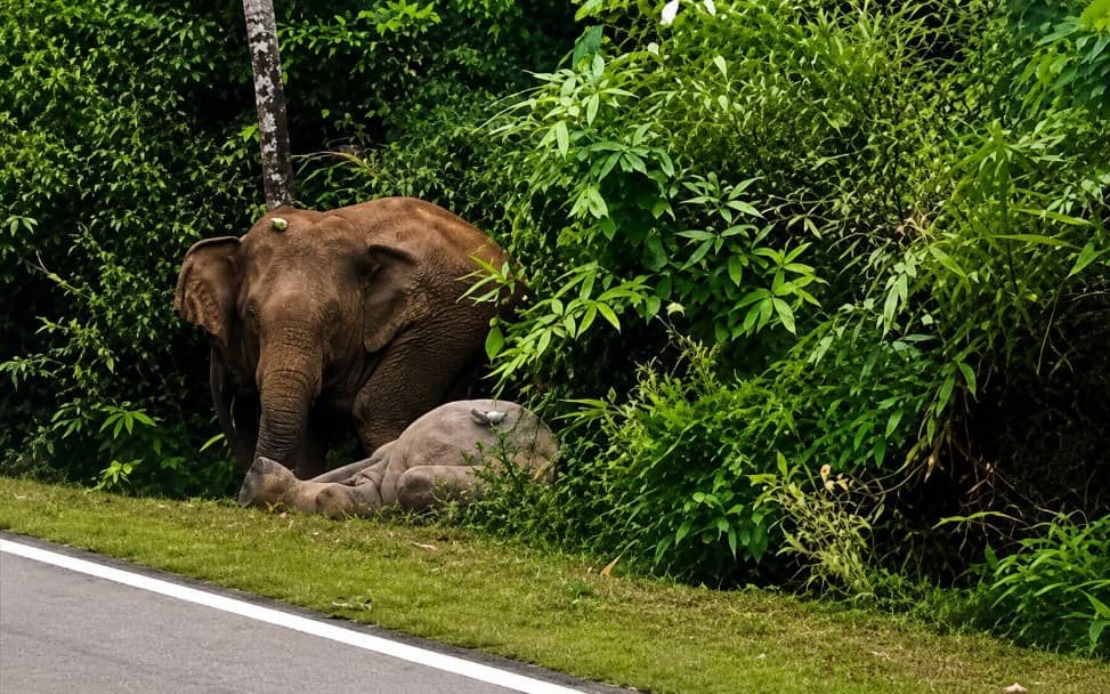
A grieving mother elephant kept vigil over her dead calf for seven hours on a forest road in Mersing early yesterday, in a heartbreaking incident that has reignited concerns about the escalating conflict between humans and wildlife in Malaysia's elephant corridors. The five-year-old female calf was struck by a Perodua Bezza vehicle at 2.28 am along Jalan Felda Nitar, and the mother elephant's refusal to leave the animal's side—captured in videos that quickly spread across social media—drew tragic parallels to the Gerik incident of May 11 last year, when another baby elephant died beneath a container lorry while its mother desperately attempted rescue.
The Johor Department of Wildlife and National Parks received notification of the collision at approximately 8.30 am and dispatched four officers to assess the situation. Upon arrival, investigators confirmed that the deceased calf measured around 150 centimetres in body length, displayed no tusks, and bore front and rear footprints of 11 inches and 14 centimetres respectively, indicating an animal at a vulnerable stage of development. The adult elephant present at the scene, believed to be the mother, remained steadfast beside the small corpse as traffic slowed and officials worked to manage the crisis.
The incident carried immediate consequences for human safety as well. The driver of the Perodua Bezza, a 31-year-old man, sustained leg injuries when his vehicle crashed into the young elephant and subsequently plunged into a five-metre-deep ravine. The Fire and Rescue Department responded to extract the trapped motorist, highlighting how these tragic encounters endanger both animal and human life. Road accidents involving wildlife in peninsula Malaysia's forest zones remain unpredictable and frequently catastrophic for all parties involved.
Official records identified the affected elephant herd as belonging to the Jamaluang-Mersing ID group, part of the broader elephant population that traverses the protected corridors between fragmented forest reserves across the East Coast and Southern regions. Wildlife authorities worked to reunite the bereaved mother elephant with her herd, enlisting personnel from the Johor Elephant Sanctuary's Capture Unit to gently guide the distressed animal back into the forest. Once the mother had been successfully moved away from the roadside, the remains of her calf were interred near the accident site rather than transported elsewhere.
The presence of warning signage in the area—previously installed to alert drivers to elephant crossings—raised questions about road safety protocols and driver awareness. Although authorities had taken precautions to mark the zone as a high-risk wildlife area, the combination of darkness, unfamiliar terrain, and the unpredictable movements of large animals proved sufficient to cause tragedy. The department acknowledged the inherent dangers of the location and issued fresh advisories urging motorists to reduce speed and increase vigilance when passing through elephant corridors, particularly during early morning and evening hours.
Following the incident, Perhilitan announced plans for intensive patrols throughout the night and the following day to monitor the mother elephant's welfare and discourage her from returning to the accident site, where the presence of her dead offspring might trigger dangerous interactions with vehicular traffic. Such bereavement-driven behaviour has been documented in elephant populations worldwide and presents substantial challenges for wildlife managers attempting to prevent further casualties. The psychological impact on wild elephants losing offspring remains poorly understood in the Malaysian context, though anecdotal evidence suggests mothers may linger in areas of loss.
The Mersing tragedy inevitably invoked memories of the Gerik incident, which captured national attention and sparked widespread debate about human-elephant coexistence. In that May incident, a baby elephant became trapped beneath a container lorry, and the mother elephant was photographed and videoed attempting to push the heavy vehicle, actions that many observers interpreted as a mother's desperate bid to free her trapped young. The emotional resonance of that moment transcended the typical wildlife incident and became a symbol of the collision between Malaysia's development trajectory and its remaining wild heritage.
These recurring tragedies underscore the fundamental tension underlying Southeast Asia's conservation challenges. As human settlements expand into forest margins and major roads bisect traditional elephant migration routes, the probability of lethal encounters accelerates. Malaysia's elephant populations, already fragmented into isolated subgroups by habitat loss and development, face mounting pressure from vehicular traffic, agricultural encroachment, and resource competition. The loss of young animals particularly threatens the demographic viability of already-stressed populations.
The incident also illuminates disparities in wildlife protection across Malaysia's states. While some regions have invested in wildlife overpasses, underpasses, and enhanced enforcement of speed restrictions in elephant zones, implementation remains inconsistent. The presence of warning signs in Mersing demonstrated awareness of the risk, yet the accident still occurred, suggesting that signage alone provides insufficient protection. Experts have long advocated for physical barriers and alternative routing infrastructure to separate elephant populations from major roads, though such measures require substantial capital investment and land coordination between multiple stakeholders.
For Malaysian motorists travelling through forested regions, particularly in Perak, Pahang, Johor, and Terengganu, the Mersing and Gerik incidents serve as sobering reminders of wildlife's presence and unpredictability. The darkness and remoteness of forest roads can create false impressions of isolation, yet these corridors remain active highways for wild populations. Drivers unfamiliar with such routes may underestimate the necessity of reduced speeds and heightened alertness, especially during low-visibility hours when nocturnal animals are most active.
The broader implications extend to Malaysia's conservation narrative and international reputation. Global attention to human-wildlife conflict increasingly influences perceptions of Southeast Asian nations' environmental stewardship. Incidents such as the Mersing tragedy, when amplified through social media, attract international commentary that sometimes conflates isolated accidents with systemic failures in wildlife management. While Malaysian authorities have expanded protected areas and launched anti-poaching initiatives, the persistence of road accidents suggests that integration of conservation objectives into transportation and land-use planning remains incomplete.
Looking forward, wildlife experts and conservation organizations are likely to intensify calls for comprehensive corridor management, including wildlife-vehicle barrier systems, elevated detection technology, and coordinated cross-state strategies for elephant population monitoring. The emotional power of images showing bereaved animals has historically galvanized public support for stronger protective measures, and the Mersing incident may provide renewed impetus for policy reform. Whether this tragedy catalyzes meaningful change in how Malaysia balances development with wildlife protection will depend on sustained political commitment and substantial resource allocation to infrastructure improvements in critical wildlife zones.

