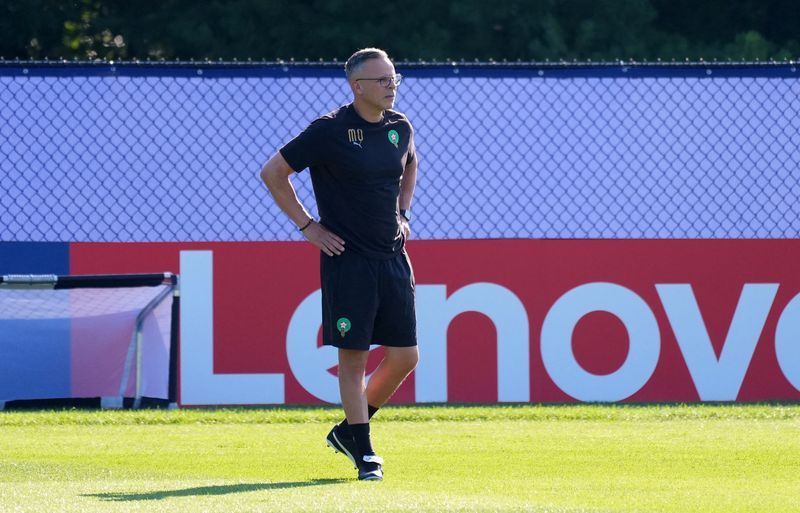
Morocco's ambitions at this World Cup extend far beyond securing passage to the semi-finals, their coach Mohamed Ouahbi made clear on Wednesday, just hours before his team's quarter-final encounter with France. Speaking in Foxborough, Massachusetts, Ouahbi pointedly dismissed suggestions that the North African nation should be content with their performance in the tournament thus far, insisting that his players refuse to view any achievement short of the ultimate prize as anything more than an interim step.
The remarks underscore a fundamental shift in Morocco's mentality from their 2022 campaign in Qatar, when they emerged as an unlikely semi-finalist and captured global attention with their underdog status. Then, reaching that stage felt remarkable enough. Now, returning to the World Cup as a battle-hardened outfit with proven pedigree, Ouahbi's squad operates under entirely different expectations. The coach made this mindset explicit when he told assembled reporters that premature congratulations served no useful purpose. "We will take stock at the end of the tournament," he said, making clear that reflection on their achievements would come only once their World Cup journey had concluded, hopefully with the trophy in hand.
Ouahbi's steely refusal to indulge in self-satisfaction reflects a professional approach increasingly common among tournament contenders. He pointedly rejected what he termed a defeatist mentality, one where teams settling into the latter stages of a World Cup might view anything beyond advancing as a bonus. "No, the bonus is to win the World Cup," Ouahbi declared, articulating a philosophy that has evidently guided Morocco's progress through the tournament. This philosophical stance has practical implications: it keeps players focused on the next objective rather than becoming distracted by congratulatory narratives that may circulate in the media.
Thursday's match against France carries particular historical weight, as it represents a rematch of the 2022 semi-final in Qatar, when the French eliminated Morocco and dashed their hopes of reaching the final. That encounter left a mark on the North African football consciousness, and the opportunity for redemption so soon thereafter adds psychological layers to what is already a formidable challenge. France remains the defending world champion from 2018 and the runner-up from the most recent World Cup, making them among the tournament's most experienced competitors.
The French squad presents an intimidating prospect, boasting arguably the most potent attacking arsenal assembled at any World Cup in recent memory. Kylian Mbappé, the tournament's second-leading scorer with seven goals, leads a forward contingent that includes creative talents such as Ousmane Dembéle, Michael Olise, and Bradley Barcola. This depth in attacking options has proven devastatingly effective throughout the tournament, culminating in their methodical, if unspectacular, 1-0 victory over Paraguay in the round of 16, a match Mbappé decided with a penalty conversion.
Yet Ouahbi approached the discussion of France's formidable attacking prowess with measured confidence rather than trepidation. He avoided the trap of becoming fixated on the opposition's strengths, instead emphasizing that both teams would continue evolving throughout the competition. The coach's framing suggested that dwelling on comparative assets between the two sides represented a futile exercise; instead, Morocco's preparation would focus on execution and competitive intensity. "The key is to play the match without regrets," Ouahbi explained, suggesting that his team's approach would prioritize giving maximum effort rather than second-guessing tactical or strategic choices.
Morocco's path to the quarter-finals demonstrates they represent substantially more than token opposition for the tournament favorites. The Atlas Lions progressed comfortably through their group stage, then eliminated the Netherlands and Canada—nations with their own legitimate World Cup credentials—to confirm their credentials as serious title contenders rather than Cinderella story participants. This sequence of results against accomplished opposition has legitimized Morocco's presence in the latter stages and vindicated the professionalism with which Ouahbi has managed his squad's progression.
The coach articulated this conviction when he spoke about the importance of playing at maximum intensity throughout the forthcoming match. "We have to play at 2,000% and not think what we have done up to now is not bad," Ouahbi said, employing hyperbolic language to emphasize the mental discipline required. This formulation acknowledges the psychological danger inherent in reaching the quarter-finals: complacency can creep in, especially when a team has already exceeded pre-tournament expectations. By explicitly rejecting this temptation, Ouahbi signaled to his players that maintaining focus and intensity represents their primary responsibility.
From a Southeast Asian perspective, Morocco's World Cup campaign resonates with football audiences in the region who have long identified with smaller nations punching above their weight on the global stage. The North African team's demonstrated capacity to compete against established powers like France and eliminate sides such as Canada and the Netherlands offers instructive lessons about the declining gap between traditional football elites and emerging competitors. As Malaysia and its neighboring countries continue developing their football infrastructure and competitive capabilities, the Moroccan example of sustained improvement and tactical discipline provides a template worth studying.
Ouahbi's insistence on maintaining winning standards rather than celebrating intermediate achievements also reflects broader truths about tournament football. Momentum, psychological confidence, and the elimination of complacency often determine outcomes in knockout competition far more than raw talent differential. By keeping his squad mentally engaged with the ultimate objective rather than distracted by plaudits for their group-stage progression, Ouahbi has employed a coaching strategy designed to maintain the psychological sharpness necessary for consecutive victories against increasingly formidable opposition.
The quarter-final against France will test whether Morocco's evolved approach and professional mentality can translate into another memorable result. While France enters as favorites given their tournament pedigree and attacking firepower, Ouahbi has positioned his team to believe that their only acceptable outcome involves advancing further. This refusal to view the quarter-final as a satisfactory endpoint, combined with Morocco's demonstrated competitive capacity, suggests that the North Africans will prove a considerably more formidable obstacle than their underdog status in pre-match betting odds might suggest.

