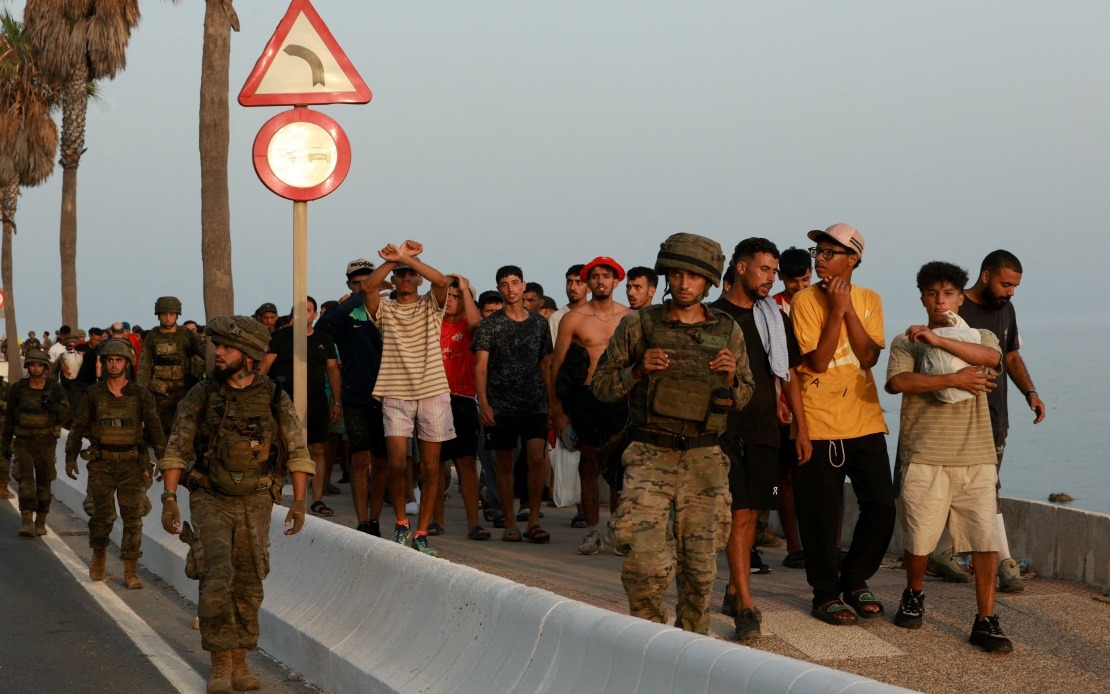
A sudden and dramatic influx of migrants into Ceuta, Spain's North African enclave, has prompted Morocco to point fingers at social media misinformation and criminal trafficking operations as the primary culprits behind the unprecedented crossings. The Moroccan Interior Ministry released a statement characterizing the episode as the result of coordinated deception, where false narratives circulated online combined with organized smuggling networks to propel tens of thousands across the maritime boundary separating Morocco from European territory within just a few days.
The scale of the movement has been staggering. While Spanish authorities estimate between 50,000 and 60,000 migrants reached Ceuta by Friday—equivalent to roughly two-thirds of the territory's entire resident population of approximately 85,000—Morocco's own accounting differs slightly, claiming about 40,000 arrivals in Ceuta itself, with an additional 1,135 individuals attempting to cross into Melilla, another Spanish possession on the Moroccan coast. This discrepancy in figures underscores the chaos and difficulty in documenting such large-scale movements in real time, a common challenge when mass migrations unfold across ungoverned or poorly monitored border zones.
According to Morocco's account, the crisis was substantially triggered by migrants' misinterpretation of a Spanish court judgment. The ruling apparently created widespread belief among would-be migrants that they could successfully enter Europe without facing immediate deportation—a critical psychological and practical factor that shapes migration decision-making. When combined with deliberate misinformation spread through social media platforms, this legal development apparently created a perfect storm of perceived opportunity, compelling individuals and families to attempt the journey despite significant risks.
The human cost of these crossings has been tragic and contested between authorities. Morocco reported 11 deaths, while Spanish officials documented at least 72 fatalities among those attempting to reach Ceuta by sea. This stark divergence in death toll figures reflects broader tensions in how the two nations account for losses and underscores the difficulty in verifying exact casualty figures during chaotic border incidents. Both governments acknowledged ongoing efforts to cross-reference deaths and identify victims, a process complicated by the involvement of migrants from multiple nationalities and the rapid, disorderly nature of the movements.
For Malaysia and other Southeast Asian nations observing these developments, the Ceuta incident carries important implications regarding migration pressures in Europe and the role of social media in shaping mass movements. Southeast Asia itself faces similar pressures from irregular migration and human trafficking networks, making Morocco's experience instructive. The role of misinformation in driving migration decisions—amplified through digital platforms—represents a challenge that transcends geography and demonstrates how false narratives can rapidly mobilize vulnerable populations across borders, often with fatal consequences.
Morocco's attribution of blame to trafficking networks reflects the reality that organized smuggling operations profit substantially from migrants' desperation and confusion. These networks exploit legal gray areas, court rulings they misrepresent, and information asymmetries to convince migrants that irregular crossings are viable or safer than they actually are. By weaponizing a Spanish court decision and spreading false claims about entry possibilities, smugglers created conditions for mass departure, knowing each successful crossing generates profits and builds reputation that attracts further clients.
The coordination between Morocco and Spain to verify deaths and establish identities illustrates how bilateral cooperation, despite underlying tensions over migration, remains essential for managing humanitarian crises. Both nations have significant interests in preventing future such episodes—Morocco in maintaining stability along its northern coast and managing its role in European migration flows, Spain in securing its external borders and managing the humanitarian dimension of irregular migration.
The incident also reveals vulnerabilities in information environments where migrants rely on social media and informal networks rather than official channels for critical decisions. The Spanish court ruling, while legitimate, was apparently distorted in translation and retelling as it circulated through migrant communities and trafficking networks. This information cascade—where a kernel of legal fact becomes transformed into false hope through repeated sharing—demonstrates the urgent need for clearer official communication about migration policies and legal realities, both to deter unfounded migration attempts and to reduce deaths.
For regional observers, the Ceuta crisis underscores how migration pressures, human trafficking operations, and information warfare intersect at borders worldwide. Southeast Asian nations increasingly grapple with similar patterns, particularly regarding irregular maritime migration and the role of trafficking syndicates in spreading false narratives about safe passage or destination country policies. Morocco's public attribution of responsibility to misinformation and trafficking networks, while potentially deflecting some accountability, nonetheless identifies real phenomena that merit serious policy attention across all transit and destination nations managing irregular migration flows.

