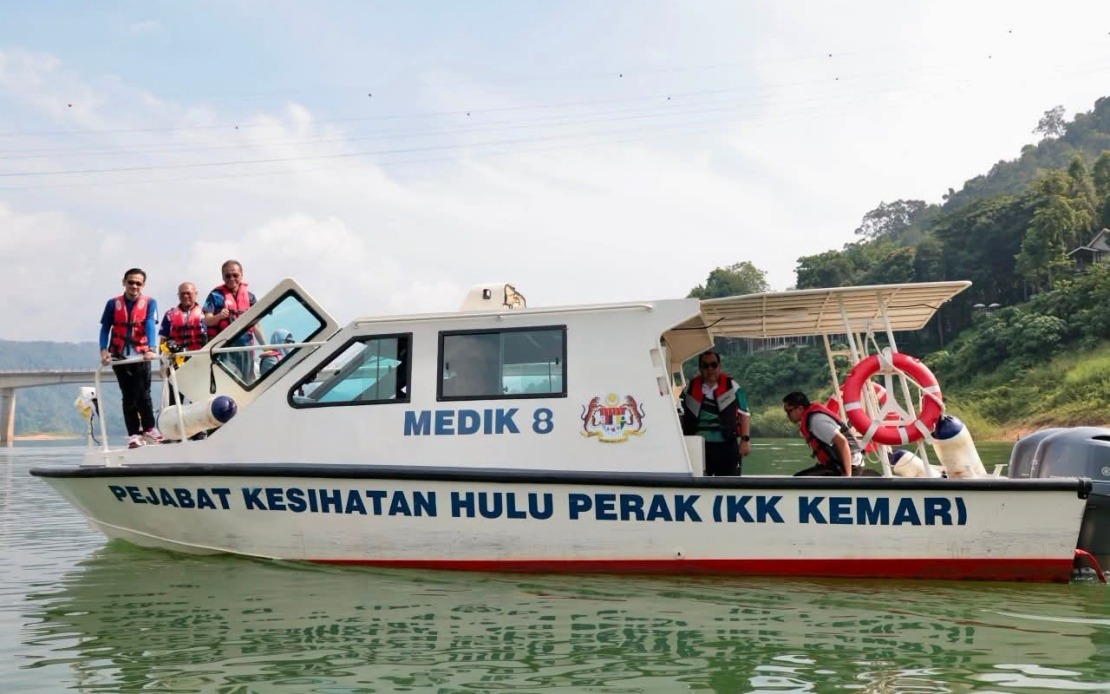
The Ministry of Health has taken a significant step toward bridging the healthcare gap in Peninsular Malaysia's most isolated communities by introducing the Medic Boat 8, a new waterborne medical service aimed at serving the Orang Asli population scattered throughout Hulu Perak's interior. The 12-passenger multipurpose vessel, which carries a price tag of RM350,000, was officially launched at the Belum Rainforest Resort jetty during Health Minister Datuk Seri Dr Dzulkefly Ahmad's working visit to the district, signalling renewed government commitment to ensuring that geographical remoteness does not become a barrier to quality healthcare delivery.
The deployment addresses a longstanding challenge faced by more than 4,500 Orang Asli residents living in the Kemar Resettlement Scheme, a vast area where waterways represent the only viable transport infrastructure linking communities to essential services. For these populations, traditional road-based emergency response systems prove inadequate and often dangerously slow. The introduction of Medic Boat 8 expands the MOH's existing flotilla from six vessels to seven, significantly enhancing the ministry's capacity to respond to medical emergencies and deliver routine healthcare interventions across the network of rivers that crisscross this interior region.
Dr Dzulkefly emphasised that the boat service exemplifies the Malaysia MADANI agenda's core principle that healthcare accessibility must transcend geographical and infrastructural obstacles. While the acquisition of sophisticated government assets matters, he acknowledged that their true value lies entirely in the hands of dedicated personnel willing to operate them under challenging conditions. This candid assessment underscores a reality often overlooked in policy discussions: expensive equipment becomes meaningless without motivated staff capable of navigating river currents, unpredictable weather patterns, and the physical and emotional demands of providing care in remote settings.
The boat's deployment represents a calculated response to the specific transport realities of the region. Orang Asli communities in Hulu Perak depend almost entirely on waterway navigation, meaning that conventional ambulance services and road-based medical evacuations cannot function effectively. By establishing a dedicated boat-based medical response system, the MOH creates a parallel emergency infrastructure tailored to these populations' actual circumstances rather than imposing generic solutions designed for urban or semi-rural contexts.
For Malaysian readers following health policy developments, this initiative warrants attention as a model for addressing healthcare disparity in other peripheral regions. The funding commitment and operational focus directed toward Orang Asli communities in Perak demonstrates that the federal government recognises indigenous populations as priority beneficiaries of healthcare infrastructure investment. Such explicit prioritisation contrasts with previous decades when remote indigenous communities received comparatively limited health resources.
The Health Minister's acknowledgement of frontline workers carries particular weight in the Southeast Asian healthcare context, where medical personnel working in remote areas frequently experience inadequate recognition and limited career advancement opportunities. Healthcare workers in Hulu Perak, including doctors, nurses, and boat operators, voluntarily subject themselves to occupational hazards including treacherous river conditions and seasonal weather volatility. Publicly commending their dedication signals that the ministry values these professionals' contributions and understands the sacrifice inherent in delivering healthcare across Malaysia's interior territories.
From a regional perspective, Malaysia's approach to indigenous healthcare access may offer lessons for neighbouring countries confronting similar challenges. Indonesia, Thailand, and other Southeast Asian nations with dispersed indigenous populations in challenging terrain face comparable access barriers. The specific model of deploying waterborne medical services, rather than attempting to establish facilities in every remote settlement, provides a practical template that adapts to existing transport infrastructure while maintaining cost-effectiveness.
The Medic Boat 8 initiative also intersects with Malaysia's broader development agenda regarding indigenous communities. The Kemar Resettlement Scheme itself represents government efforts to provide structured support systems for Orang Asli populations, combining residential stability with improved access to basic services including education and healthcare. By integrating medical boat services into this resettlement framework, the government attempts to create a more comprehensive support ecosystem addressing multiple dimensions of wellbeing simultaneously.
Operational sustainability presents an ongoing consideration for this programme. Boat maintenance, fuel costs, personnel deployment, and seasonal variations in river conditions require careful planning and consistent budget allocation. The RM350,000 capital investment must be accompanied by reliable recurrent funding ensuring that personnel remain adequately compensated and vessels are properly maintained throughout their operational lifespan.
Looking forward, the success of Medic Boat 8 will depend heavily on community awareness and uptake. Residents in remote settlements must understand how to access this service, what types of conditions warrant boat-based evacuation, and how to coordinate with the healthcare system's broader facilities network. Community health promotion campaigns integrated with the boat service rollout would strengthen utilisation rates and maximise the programme's impact.
The initiative also underscores an important principle about healthcare equity in Malaysia's development trajectory: that infrastructure investment must respond to communities' actual geographical and social circumstances rather than imposing standardised solutions designed for majority populations. Orang Asli communities in Hulu Perak do not require road ambulances; they require boat-based medical response systems. By tailoring solutions to match local realities, the MOH demonstrates that genuine healthcare equity requires differentiated approaches acknowledging the diverse circumstances across the nation's varied populations.

