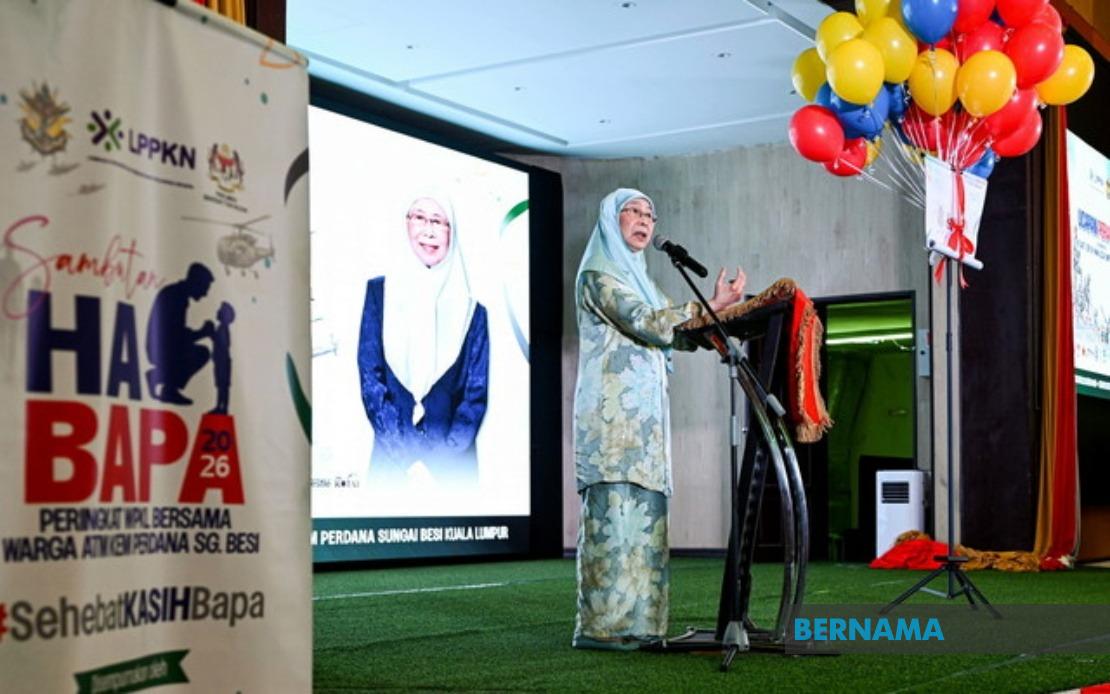
Fathers serving in the Malaysian Armed Forces deserve sustained empowerment given the considerable demands they face balancing military service with family life, according to Datuk Seri Dr Wan Azizah Wan Ismail, wife of the Prime Minister. Speaking at the 2026 Federal Territory of Kuala Lumpur Father's Day Celebration, Dr Wan Azizah underscored that recognition of these sacrifices must translate into concrete support mechanisms that acknowledge both the professional obligations and personal roles these servicemen juggle daily.
The Bandar Tun Razak Member of Parliament highlighted the critical importance of implementing comprehensive family support systems, particularly the National Family Compassion Policy (DKKN), which she presented as instrumental in enabling military fathers to discharge their parental duties effectively despite operational requirements that frequently separate them from their children and spouses. She characterised such policies not as optional enhancements but as necessary infrastructure for a military personnel system that expects individuals to maintain professional excellence while navigating the challenges of absent parenthood.
Dr Wan Azizah articulated a broader vision connecting male empowerment to family stability and national cohesion. By strengthening support for fathers, she argued, policymakers simultaneously reinforce the family institution itself, recognising that fathers occupy a foundational position within household structures. This framing positions paternal support not as a peripheral welfare concern but as a strategic investment in social stability, particularly relevant when considering that military service demands place unique strain on family units compared to civilian employment contexts.
Raising societal awareness regarding the critical nature of fatherhood emerged as another key component of Dr Wan Azizah's agenda. She emphasised that public recognition of fathers' roles as primary household leaders remains underdeveloped in contemporary discourse, despite the substantial evidence linking active paternal engagement to improved child outcomes and family resilience. For military families specifically, this awareness gap compounds existing challenges, as servicemen navigate both occupational hazards and a broader cultural environment that historically undervalues paternal contributions to child development and family functioning.
The celebration itself drew approximately 500 participants, comprising active military fathers, their families, and government representatives gathered to commemorate paternal sacrifice. Organised jointly by the National Population and Family Development Board (LPPKN) and the Malaysian Armed Forces, the programme titled 'Sehebat KASIH Bapa' specifically recognised the unique circumstances of military fathers whose duties to national defence periodically necessitate extended separation from loved ones. This official recognition signalled governmental acknowledgement that military service, while necessary for state security, creates particular vulnerabilities within family structures requiring deliberate mitigation.
The National Population and Family Development Board has already begun translating these principles into operational programmes. The Fatherhood Module represents a concrete intervention focusing on parenting skills development, equipping fathers with practical tools for maintaining meaningful relationships with their children despite geographical or temporal constraints. This pedagogical approach recognises that good intentions and emotional commitment, while necessary, may prove insufficient without specific skillsets adapted to the demands military fathers face.
Complementing the Fatherhood Module is the Men Empowerment Network (MEN), which creates peer support structures and shared learning spaces specifically designed for male engagement in family and domestic responsibilities. Such networks address an often-overlooked reality: many military and civilian fathers lack accessible forums for discussing parenting challenges, emotional engagement with children, or reconciling professional identity with paternal identity. By establishing dedicated spaces for these conversations, policymakers create opportunities for knowledge transfer and normalisation of active paternal engagement.
For Malaysia specifically, this renewed focus on military father support reflects evolving national conversations regarding work-life balance, gender roles, and family structures. Regional neighbours including Singapore and other developed nations have increasingly prioritised paternal involvement policies, and Malaysia's attention to this area positions it within contemporary regional frameworks emphasising holistic family support systems. The Malaysian Armed Forces, as a critical institution shaping national security and social stability, serves as a logical starting point for these broader cultural shifts.
The implications extend beyond individual military families to encompass institutional health within the MAF itself. When servicemen struggle to maintain meaningful family relationships, retention challenges, psychological stress, and operational effectiveness may suffer. Conversely, robust family support systems enhance recruitment and retention prospects, improve mental health outcomes, and ultimately contribute to a more stable and effective military institution capable of fulfilling national defence obligations.
Dr Wan Azizah's emphasis on ongoing empowerment suggests recognition that single initiatives prove insufficient. Rather, sustainable change requires layered approaches combining policy frameworks, institutional support, public awareness campaigns, and skill-building interventions. For military families specifically, this multi-faceted strategy acknowledges that effective paternal engagement represents not a luxury amenity but a fundamental requirement for individual wellbeing, family stability, and national security.
Moving forward, the success of these initiatives will depend partly on sustained political commitment and adequate resource allocation. The visibility of Prime Minister's wife participating in these celebrations sends important signals regarding high-level political prioritisation, yet sustained progress requires translating symbolic commitment into consistent funding, institutional support, and policy implementation across all military branches and family support structures.

