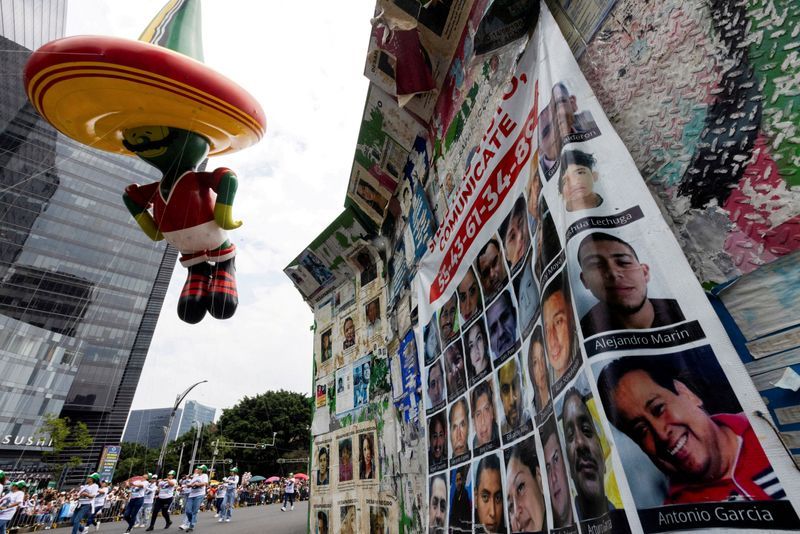
Mexico's advance to the World Cup knockout stage has electrified the nation, with the squad reaching the last 16 unbeaten and without conceding a goal. Yet the patriotic fervor coursing through the streets of Mexico City tells only part of the story. Along Paseo de Reforma, the capital's most prestigious avenue, enormous screens promoting the nation's footballing ambitions stand juxtaposed against posters bearing the faces of Mexico's more than 135,000 missing people—a haunting reminder that national celebration cannot erase the country's most pressing human tragedy.
The scale of disappearances has grown exponentially since 2006, when then-President Felipe Calderon initiated military operations against drug trafficking organizations. What began as a security operation has evolved into one of Mexico's defining challenges, touching nearly every community and family across the nation. The contrast between the global soccer spectacle and this ongoing crisis encapsulates the tension many Mexicans feel: the difficulty of embracing sporting nationalism when the state itself faces accusations of complicity with organized crime and has failed to account for vast numbers of its own citizens.
This internal conflict has manifested visibly throughout the tournament. Paseo de Reforma, typically a showcase of national pride during major sporting events, has witnessed not only celebratory gatherings but also sustained political protests. Members of the CNTE teachers' union have established encampments in central Mexico City, their tents blocking major thoroughfares while they demand the government honor campaign commitments to repeal a 2007 pension reform law and provide salary increases for public-sector workers. Anti-World Cup graffiti adorns walls across the capital and near the Azteca Stadium, evidence of organized civil resistance to the tournament's hosting.
The economic circumstances underlying these protests have worsened for ordinary Mexicans despite some recent inflation moderation. While the country achieved a slowdown in price increases during early June, the core inflation rate remains stubbornly above the Bank of Mexico's three percent target. This persistent cost-of-living pressure has been exacerbated by the World Cup itself: ticket prices for matches have reached thousands of dollars, effectively pricing out working-class supporters who historically formed the backbone of stadium attendance during international competitions. For many, the tournament represents not national pride but exclusion and economic disparity made visible.
The celebratory atmosphere was further darkened by tragedy following Mexico's 1-0 victory over Ecuador in the last-32 round—the nation's first knockout-stage World Cup win in four decades. During festivities around Reforma, four people died in incidents related to the celebrations, tempering what should have been an unambiguous moment of sporting achievement. The incident illustrated how even moments of collective joy remain shadowed by the violence and disorder that characterizes contemporary Mexican life.
Commentators and citizens have articulated the psychological complexity of this moment with unusual candor. Journalist and podcaster Carlos Mendoza observed that the World Cup creates what he terms a "national dopamine rush" that permits Mexicans to defer consideration of uncomfortable political realities—including specific allegations that Morena party politicians have colluded with drug trafficking organizations. This temporary psychological relief, he argues, cannot last; when the tournament concludes, "reality is still there, waiting." The observation captures something essential about how Mexicans are experiencing this World Cup: not as escape, but as brief intermission from confronting systemic failures.
The pricing barrier to stadium attendance particularly rankles observers. Mendoza emphasized that the tournament has fundamentally altered who can participate in supporting the national team. Previously, the challenge lay in securing tickets; now, the barrier is financial capability itself. This shift transforms the World Cup from a shared national experience into an event accessible primarily to the affluent, deepening existing inequalities during moments that ostensibly unite the country. The exclusion feels especially pointed given Mexico's traditional football culture, where stadium attendance has long crossed class boundaries.
President Claudia Sheinbaum maintains substantial public support despite these currents, with her approval rating standing at 69 percent according to polling by El Financiero, a recovery from a slight decline that began in March. The government has declared that locating missing persons constitutes a national priority. Yet skeptics question whether the administration uses World Cup euphoria strategically to defer urgent decisions on substantive governance challenges. Local resident Alejandra Gonzalez articulated this suspicion when she told Reuters that the tournament "places troubles in lower priority among society" while allowing the government to "leverage the euphoria to delay relevant and urgent decisions."
Local politician Rodrigo Cordera attempted to frame the situation as one permitting simultaneous emotional complexity. In social media comments, he suggested that citizens can legitimately experience excitement about ninety minutes of football while simultaneously worrying about the nation's condition, expressing anger at FIFA's organizational decisions, and detesting the governance failures of Mexico City's administration. "Life isn't black and white," he observed—an implicit acknowledgment that many Mexicans inhabit precisely this gray zone, finding authentic pleasure in sporting achievement without surrendering critical judgment about governmental performance.
Gonzalez herself embodied this duality, expressing hope that the celebrations might inspire positive national sentiment while insisting on the necessity of maintaining critical perspective. She emphasized that alongside positive attitude, Mexicans must "think in a critical way to keep pointing out the inequalities and inconsistencies from the government, industries, and ourselves as citizens." This formulation suggests that the challenge Mexico faces is not choosing between celebration and criticism, but rather developing a political culture capable of sustaining both simultaneously—enjoying the team's success while refusing to allow that enjoyment to obscure systemic injustice.
The World Cup thus becomes a lens through which Mexico's deepest tensions become visible. A nation that has produced world-class footballers and passionate supporters finds itself unable to offer those supporters affordable access to matches. A country celebrating sporting achievement simultaneously confronts the reality of 135,000 disappeared persons. The tournament neither resolves these contradictions nor allows their temporary suspension; instead, it illuminates them with unusual clarity, forcing Mexicans to articulate what they value and what they demand of their nation.

