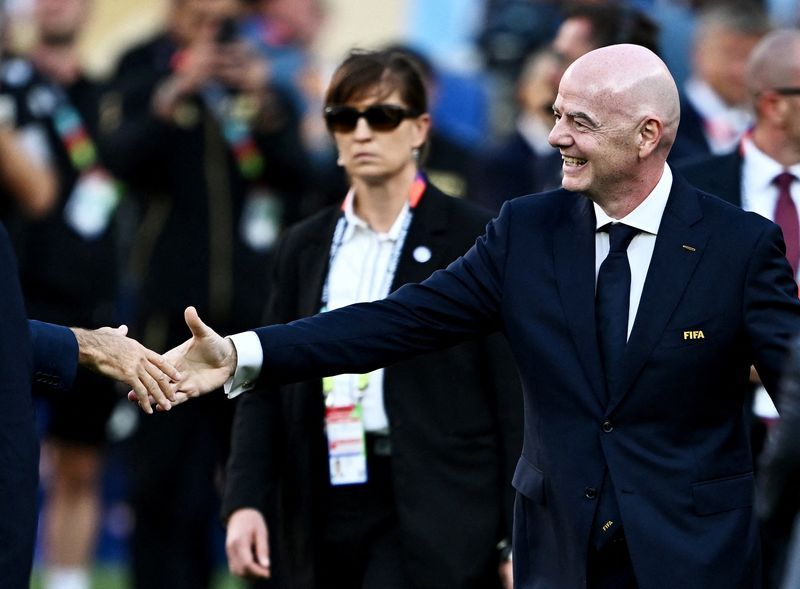
FIFA President Gianni Infantino has secured significant support from Mexico and Argentina's football associations even as the world soccer governing body faces a deepening institutional crisis stemming from his abandoned proposal to sell portions of the World Cup's commercial future. The backing from two of South America and North America's major football powers underscores a continent-wide divide in attitudes toward the Swiss administrator's leadership, with wealthy nations questioning his governance while developing football nations appear to prioritise institutional continuity.
The Mexican Football Federation has broken publicly with its own regional body, CONCACAF, in endorsing Infantino's continued leadership. CONCACAF, which oversees football across North America, Central America and the Caribbean, had previously demanded a comprehensive reassessment of Infantino's presidency following the controversial commercial rights proposal. Mexico's stance represents a strategic calculation that maintaining FIFA's institutional stability and working within established democratic frameworks serves the federation's long-term interests better than joining calls for leadership change outside formal procedures.
Argentina's football association has similarly thrown its weight behind the FIFA president, though with measured language acknowledging that the proposed commercial arrangement generated legitimate concerns. In correspondence to Infantino, the Argentine body praised FIFA's decade-long development agenda and emphasis on transparent governance, suggesting that the proposal itself represents an aberration rather than a systemic failure of FIFA's institutional mechanisms. This framing allows Argentina to support Infantino while maintaining that errors in process and communication, rather than fundamental governance breaches, precipitated the controversy.
The split across football's continental confederations reveals stark divergences in how different regions assess FIFA's governance. The Confederation of African Football threw its unanimous backing behind Infantino on Thursday, positioning the African bloc as a reliable supporter. By contrast, Europe's UEFA has committed to boycotting FIFA competitions, while Asia's confederation declared solidarity with the UEFA-led opposition. These divisions carry profound implications for Infantino's planned reelection campaign at the FIFA Congress scheduled for Morocco in March, a vote that appeared inevitable mere months ago but now carries genuine uncertainty.
CONMEBOL, South America's football confederation, has steered a middle course by rejecting any removal procedure that circumvents FIFA's democratic processes involving all 211 member associations. This position tacitly supports Infantino by insisting that leadership challenges must follow formal institutional channels rather than pressure campaigns orchestrated by rival confederations. Mexico's federation explicitly aligned itself with CONMEBOL's reasoning, signalling that both major footballing nations in the Americas view attempts to oust Infantino outside normal procedures as institutional overreach that could undermine FIFA's credibility.
The controversy centres on a proposal to monetise portions of future World Cup commercial rights, a revenue scheme that FIFA presented to member associations with insufficient consultation and transparency. Following meetings in Rabat, FIFA acknowledged that mistakes had been made regarding process and communication, though the organisation maintains that all actions complied with existing regulations. The apology and promised procedural review appear designed to mollify concerns among smaller nations while preserving Infantino's authority over FIFA's strategic direction.
Croatia's football federation has nonetheless withdrawn support for Infantino, citing concerns about governance and the 2026 World Cup arrangements. England and Albania had already distanced themselves from the FIFA president, suggesting that established European footballing nations view the commercial proposal as symptomatic of deeper governance problems. Yet the absence of a credible alternative candidate to challenge Infantino in March's election undermines the effectiveness of this opposition, leaving critics without a clear path forward through FIFA's democratic mechanisms.
For Malaysian readers and Southeast Asian football observers, the FIFA governance crisis carries important implications. The Asean football community, through the AFC confederation, has aligned with European concerns about Infantino's leadership style, signalling that the region views his proposal as an attempt to unilaterally reshape FIFA's revenue distribution without adequate member consultation. Yet the visible support from Africa and South America suggests that Infantino retains majority backing among FIFA's 211 member associations, particularly among nations that benefit from FIFA development programs and depend on World Cup revenue more heavily than wealthy European federations.
The institutional tensions exposed by this controversy extend beyond personalities or individual proposals. They reflect fundamental disagreements about how FIFA should balance central revenue generation against equitable distribution to smaller associations, how much autonomy continental confederations should exercise over global football governance, and whether FIFA's president should wield significant unilateral authority or operate within tighter constraints established by membership votes. These questions will shape football governance well beyond Infantino's potential reelection, particularly as the 2026 World Cup approaches and FIFA considers future tournament structures and commercial arrangements.
Union FIFPRO, representing professional players globally, has characterised the commercial proposal as a profound abuse of presidential power rather than merely a procedural misstep. This criticism suggests that the controversy may generate pressure for structural reforms limiting executive discretion, even if Infantino survives the March election. The breadth of opposition across multiple constituencies—European federations, players' unions, and individual national associations—indicates that any Infantino victory would likely come with reduced authority and enhanced oversight mechanisms imposed by the membership.
The months ahead will test whether Infantino's regional coalition among African and South American confederations proves sufficient to secure reelection despite sustained European opposition and growing player union activism. If successful, his fourth term would likely proceed under conditions far more restrictive than previous mandates, with enhanced transparency requirements and mandatory member consultation on major strategic decisions. The outcome will ultimately determine not only FIFA's leadership but the trajectory of global football governance and whether major revenue-generating confederations can continue resisting perceived centralisation of power and commercial control.

