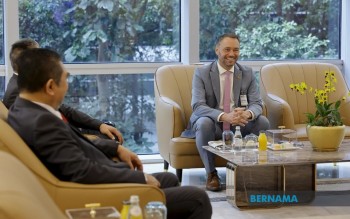
Belgium's Deputy Prime Minister and Minister of Foreign Affairs, European Affairs and Development Cooperation, Maxime Prévot, has underscored the strategic importance of the Malaysia-European Union Free Trade Agreement as a catalyst for deepening commercial relations between the two trading blocs. Speaking during a visit to Kuala Lumpur, Prévot expressed optimism that the MEUFTA would catalyse fresh bilateral opportunities whilst simultaneously reinforcing macroeconomic stability across both regions. The agreement, he noted, represents a shared priority for Brussels and Belgium alike, with negotiations anticipated to reach completion within the coming months or by early next year.
The Belgium delegation's presence in Malaysia marks a significant juncture in EU-Malaysia bilateral engagement. Prévot arrived on a two-day working visit, his inaugural trip to the country since assuming his ministerial portfolio in February last year, signalling heightened diplomatic attention towards strengthening ties with Southeast Asia's third-largest economy. Scheduled meetings with Deputy Prime Minister Datuk Seri Fadillah Yusof, who oversees the Energy Transition and Water Transformation Ministry, indicate that both governments are keen to explore complementary sectoral partnerships beyond conventional trade frameworks.
Belgium's eagerness to advance the MEUFTA stems partly from its structural economic profile. As a densely populated nation of 11.77 million people confined to a geographically modest territory, Belgium has architected an economy heavily reliant on international commerce—exports constitute approximately 85 per cent of its gross domestic product. This export-intensive model necessitates continuous identification of high-potential market access agreements, making Southeast Asian economies particularly attractive. Malaysia, as an upper-middle income nation with significant manufacturing and resource sectors, aligns squarely with Belgium's strategic trade diversification objectives.
The bilateral trade relationship already demonstrates considerable vigour. Figures for 2025 reveal that total commerce between the two nations reached RM9.74 billion, with Malaysian exports commanding RM6.85 billion of this figure while imports from Belgium amounted to RM2.89 billion. This trade asymmetry reflects Malaysia's established strengths in resource commodities and manufactured goods, areas where European demand remains robust. The finalisation of a comprehensive free trade agreement would logically deepen these flows by eliminating tariff barriers and harmonising regulatory frameworks across key sectors.
Beyond immediate merchandise trade, the bilateral investment relationship signals deeper economic integration. As of 2025, Malaysian authorities had approved 67 projects with Belgian participation, representing a combined capital commitment of RM5.1 billion and promising the creation of 4,605 jobs across the domestic economy. These figures underscore that Belgian business interest in Malaysia extends beyond export channels to encompass direct manufacturing, service provision, and technology transfer—activities that generate employment multipliers throughout the local economy. Enhanced market access through MEUFTA would likely accelerate this investment trajectory.
The agenda articulated for Prévot's discussions with Deputy Prime Minister Fadillah encompasses sectors of strategic importance to both Malaysia and the broader Southeast Asian region. Renewable energy cooperation reflects the EU's commitment to the European Green Deal and its 2050 climate neutrality target, areas where Malaysia possesses complementary resources and growing technical capacity. Belgium, home to leading pharmaceutical, chemical, and industrial sectors, brings specialised expertise in sustainable energy infrastructure that could support Malaysia's transition away from coal-dependent power generation.
Rare earth elements constitute another focal point, reflecting geopolitical realities in global supply chains. China historically dominates rare earth extraction and processing, creating vulnerabilities for Western economies and Japan in securing critical minerals essential for renewable energy, defence, and electronics manufacturing. Malaysia possesses rare earth resources and technical expertise, positioning it as a potential strategic partner for Europe's economic security objectives. Discussions on this front may explore not merely extraction but also value-added refining and manufacturing capabilities within Southeast Asia.
The halal industry dimension reveals Belgium's nuanced understanding of Malaysia's economic identity and Southeast Asia's commercial architecture. As home to the world's largest Muslim population, Malaysia has developed sophisticated halal certification, food processing, pharmaceuticals, and cosmetics sectors. Belgium's manufacturing and export-oriented economy creates genuine demand for halal-certified products across European Muslim communities and increasingly amongst non-Muslim consumers concerned with ethical sourcing and animal welfare standards. This sector represents an overlooked but substantial commercial opportunity for both parties.
The timing of these negotiations assumes particular significance within the broader context of European trade strategy. The EU has faced increasing competitive pressure from China and India across Southeast Asian markets, whilst simultaneously pursuing diversified sourcing strategies to mitigate supply chain risks exposed by recent geopolitical tensions. Malaysia, as a founding member of ASEAN and a participant in the Regional Comprehensive Economic Partnership framework, serves as a strategic anchor for European commercial ambitions throughout the region. A successful MEUFTA could establish a template for deeper EU engagement across Southeast Asia.
For Malaysia specifically, the agreement offers tangible benefits beyond headline trade figures. European market access for Malaysian agricultural products, manufactured goods, and services could diversify export destinations and reduce structural dependence on China and intra-ASEAN trade. The agreement would likely include provisions addressing intellectual property, labour standards, and environmental protections, creating competitive pressure that incentivises Malaysian firms to upgrade production capabilities and management practices. Such dynamism ultimately enhances competitiveness within global value chains.
Regional implications warrant consideration alongside bilateral dimensions. A successful Malaysia-EU trade agreement could strengthen ASEAN's collective bargaining position vis-à-vis other major trading blocs whilst demonstrating that Southeast Asian economies can negotiate sophisticated commercial arrangements with developed markets. Other ASEAN members—Indonesia, Thailand, Vietnam—would observe the agreement's terms and implementation carefully, potentially influencing their own bilateral negotiations with Brussels. The template established through MEUFTA thus carries significance extending well beyond the Malaysia-EU dyad.
The convergence of Belgium's high-level political engagement, concrete investment track records, and alignment on strategic sectors suggests serious momentum towards concluding negotiations expeditiously. The anticipated timeframe of months to one year suggests both parties perceive genuine mutual benefit rather than engaging in pro forma discussions. For Malaysian policymakers and businesses, the unfolding MEUFTA negotiations represent a pivotal opportunity to lock in preferential access to EU markets at a moment when geopolitical competition for market share is intensifying. Prévot's visit thus signals not merely diplomatic courtesy but substantive movement towards reshaping Malaysia's trade architecture.

