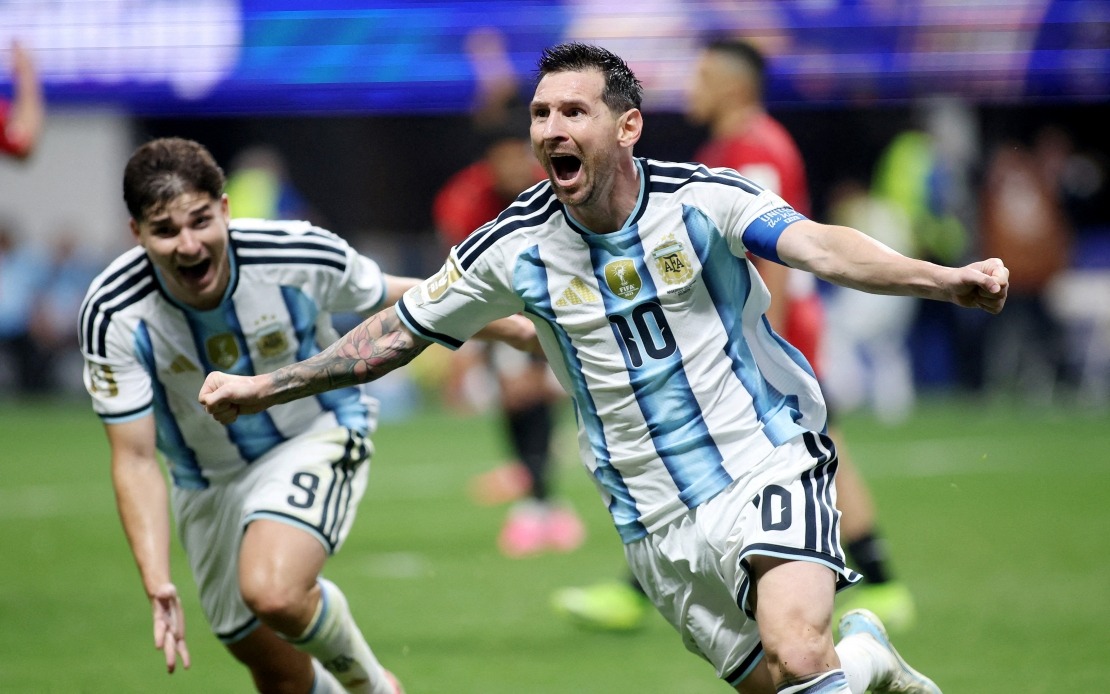
Lionel Messi will attempt to add another memorable page to his World Cup legacy when Argentina faces England in Atlanta on Wednesday, seeking not only the Golden Boot but a second world championship before what many expect will be his retirement. The 39-year-old Argentine forward has already matched France's Kylian Mbappé at the summit of the tournament's scoring charts with eight goals, putting himself in contention for multiple honours as the competition enters its crucial final stages in North America.
Messi's 2022 World Cup triumph in Qatar represented a crowning achievement for a player widely considered among football's greatest talents. He netted seven times that tournament, including a decisive brace in the final, as Argentina prevailed against France in a penalty shootout. That victory felt like a culmination of the Argentine squad's collective mission to secure the world's most coveted football prize before their talisman departed from international football. Yet rather than fade into retirement, the Inter Miami star has returned to the global stage with undimmed ambition.
His current form defies expectations for a player in his fourth decade. Messi has established himself once more as a central figure in Argentina's attack, and his eight-goal tally places him level with Mbappé at the top of the scoring hierarchy. While Mbappé maintains the advantage in direct tie-breaker categories—particularly assists and minutes played—the race remains genuinely competitive. England's Harry Kane and young sensation Jude Bellingham lurk behind on six goals each, with Norway's Erling Haaland having been eliminated from contention following his nation's departure from the tournament.
The Golden Boot would represent a significant missing piece in Messi's decorated career. At the 2022 World Cup, Mbappé claimed the award despite finishing on the losing side in the final, scoring a hat-trick in that decisive match. The accolade has eluded Messi throughout his World Cup campaigns, making this summer's contest particularly significant for the Argentine maestro. His tally of eight goals already matches his best individual tournament performance and sets the stage for a compelling battle with Mbappé in the coming matches.
Beyond individual scoring records, Messi has already cemented his place in World Cup history through several all-time achievements. He has surpassed Germany's Miroslav Klose's longstanding record of 16 World Cup goals, moving to 21 across his six tournaments. Mbappé, now with 20 goals, appears almost certain to eventually overtake this mark given his age and trajectory, but for now Messi remains the record holder. England's Kane has also climbed the all-time scoring list significantly with 14 goals, demonstrating how the modern game has produced prolific international strikers.
Messi and Cristiano Ronaldo achieved another historic milestone by becoming the first male players to compete in six World Cup tournaments. Both have subsequently surpassed Lothar Matthäus's previous record of 25 World Cup appearances, with Messi set to reach his 33rd appearance against England—six matches ahead of his Portuguese rival. This longevity at the highest level underscores the physical durability and mental fortitude required to compete at football's pinnacle across multiple decades.
Reflecting on Messi's World Cup journey reveals the evolution of a generational talent. His 2006 debut yielded a single goal, followed by a barren 2010 tournament in South Africa. His breakthrough came in 2014 at Brazil, where he scored four times and carried Argentina to the final, narrowly losing to Germany. The 2018 edition produced just one goal before his extraordinary resurgence in Qatar at age 35, when he netted more goals in a single tournament than across his previous four World Cups combined.
That 2022 campaign featured four penalty conversions, though Messi has proven inconsistent from the spot during World Cup regulation play. In this tournament, he has already missed opportunities from the penalty mark—sending one wide against Austria and seeing another saved by Egypt's Mostafa Shobeir in the round of 16. Across all his World Cup appearances excluding shootouts, Messi has converted only four of eight penalties. Conversely, his record in shootout situations has been flawless, succeeding in all three attempts across the Netherlands matches in 2014 and 2022, and the 2022 final triumph over France.
For Southeast Asian viewers and football enthusiasts across the region, Messi's performance carries particular resonance given the global appetite for World Cup narratives. His quest for a second title and the Golden Boot adds compelling storylines as the tournament approaches its climax. The encounter with England, a traditional football powerhouse rebuilding under new management, promises a fascinating tactical contest between two contrasting styles and philosophies.
Argentina's path to the final remains the primary objective, with England presenting a formidable obstacle. However, Messi's individual achievements—potentially winning the Golden Ball as tournament's best player, surpassing goalscoring records, and accumulating appearances—combine to create a multi-layered narrative that extends beyond simple match outcomes. Whether the Argentine forward can claim that elusive Golden Boot while leading his nation to back-to-back titles would represent a fitting denouement to one of football's most illustrious careers.
The countdown to Wednesday's semi-final underscores a broader theme in modern sport: the capacity for elite athletes to extend their competitive peaks beyond conventional timelines. Messi's continued excellence at 39 challenges assumptions about athletic decline and suggests that proper conditioning, motivation, and supporting infrastructure can preserve performance far longer than previously imagined. His World Cup story, spanning from 2006 to 2024, encompasses nearly two decades of international football and remains one of sport's greatest individual journeys.

