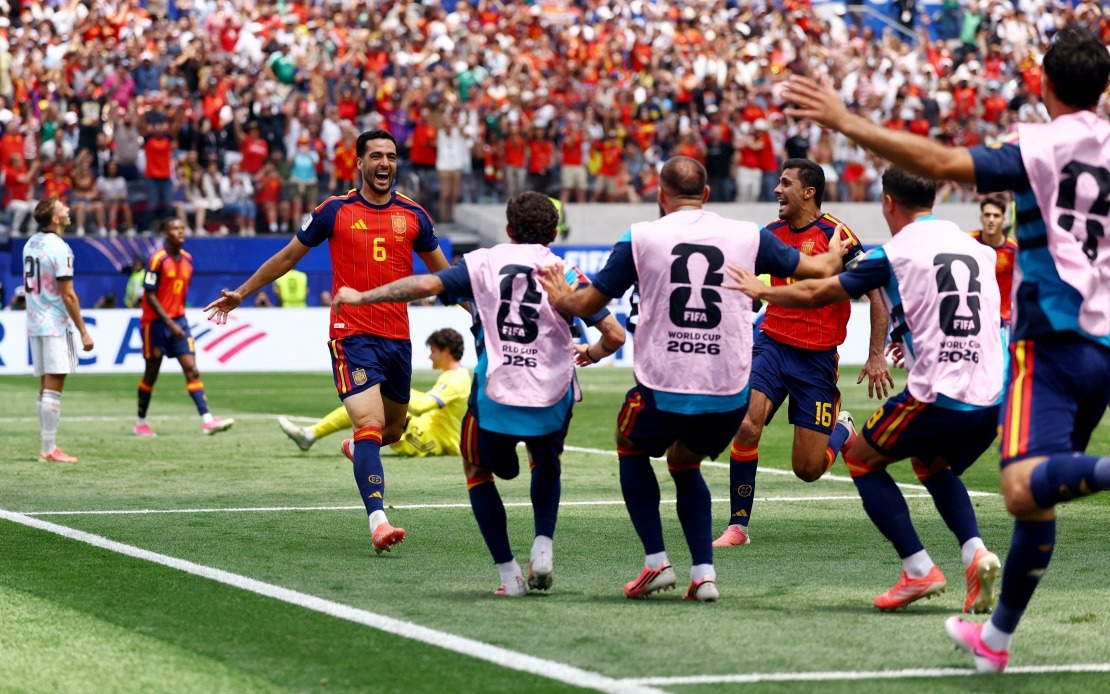
Spain has secured a berth in the World Cup semi-final after dispatching injury-ravaged Belgium 2-1 in a quarter-final encounter at SoFi Stadium in Inglewood, California, on Friday. The victory sets up a tantalising clash with France near Dallas on Tuesday, reprising their recent Euro 2024 semi-final meeting which the Spanish side won convincingly. The triumph marks another impressive chapter in Spain's resurgent tournament run, which has seen the team demonstrate both attacking prowess and defensive resilience despite facing well-organised opposition throughout the knockout stages.
Fabián Ruiz handed Spain the advantage when he converted in the 30th minute, establishing an early control that the Spanish side would largely maintain throughout the encounter. The Belgian response came through Charles De Ketelaere's equaliser, an unexpected moment that also represented a significant milestone for goalkeeper Unai Simón. The Spanish custodian had compiled a remarkable record of 649 minutes without conceding across two World Cup campaigns, a shutout streak that De Ketelaere's finish finally ended. This breakthrough suggested Belgium might mount a genuine challenge despite their mounting injury concerns.
The turning point arrived when Mikel Merino, operating as a substitute once more, capitalised on a crucial error to restore Spain's lead in the 88th minute. Merino has emerged as an invaluable impact player for La Roja during this tournament, having also scored the decisive goal in the previous round against Portugal from the bench. His ability to inject fresh impetus into attacking sequences has become a hallmark of Spain's tactical approach, with coach Luis de la Fuente deploying him strategically to exploit opposition fatigue in the latter stages of matches.
Belgium's challenge was severely compromised by cascading injury setbacks that undermined their capacity to compete at full strength. Captain and midfield lynchpin Youri Tielemans was forced to withdraw during the warm-up period with a suspected hamstring injury, compounding the absence of Amadou Onana, whose knee ligament damage ruled him out of the competition earlier. These losses stripped Belgium of vital midfield experience and presence, leaving them vulnerable to Spain's possession-based dominance. The Belgian tactical setup, already stretched by these absences, further deteriorated when goalkeeper Thibaut Courtois departed with an injury in the 71st minute.
The departure of Courtois necessitated the introduction of Manchester United's Senne Lammens, a goalkeeper thrust into an unfamiliar and demanding situation. Lammens was exposed almost immediately, spilling a long-range effort from Pau Cubarsi that Merino ruthlessly converted with a precisely placed finish into the roof of the net. This sequence encapsulated the difference between the two teams at crucial moments—Spain's superior depth, composure, and execution in high-pressure scenarios proved decisive. While Belgium showed character in fighting back to level the match, their inability to sustain that momentum or weathered the personnel challenges proved insurmountable.
The impending semi-final between Spain and France represents a heavyweight encounter between two continental titans. France, having triumphed in the 1998 and 2018 World Cups and reaching the 2022 final where they lost to Argentina, possess a formidable pedigree. However, Spain will enter the contest as the betting favourite following their Euro 2024 triumph and their commanding performance against Belgium. The Spanish side's technical quality, midfield control, and tactical discipline have impressed observers, suggesting they have positioned themselves as genuine candidates for the tournament title. France's challenge will centre on disrupting Spain's rhythm and transitioning their attacking prowess into clinical finishing opportunities.
The venue near Dallas carries less significance than the quality of opposition awaiting Spain, as the team has demonstrated an ability to perform across varying conditions throughout the tournament. Their route to the semi-final has involved overcoming increasingly competitive opponents, suggesting their current form and confidence levels are at their peak. The absence of the injured players affecting Belgium underscores the importance of squad depth in knockout football, a parameter where Spain possesses considerable advantages. The Spanish camp will approach the France encounter with justified belief, recognising that a World Cup final berth now sits within reach should they perform to their evident capabilities.
From a Southeast Asian perspective, Spain's progression offers fascination for regional football enthusiasts who have long admired the Spanish style of play. The dominance of possession-based, technical football represented by La Roja has influenced coaching philosophies across Asia, where clubs and national federations have sought to emulate Spain's systematic approach to development and match execution. Spain's continued success at the highest level validates this methodology, providing evidence that technical excellence and tactical sophistication can overcome physicality and direct approaches. The forthcoming semi-final against France will provide another showcase of how these competing philosophies operate under the most intense pressure, offering valuable insights for football development programmes across the region.
The quarter-final result also underscores the unpredictability that characterises World Cup football, where injury circumstances can dramatically alter tournament trajectories. Belgium's experience illustrates how even accomplished squad combinations can be destabilised by unexpected personnel losses, a cautionary tale for all remaining competitors. Spain's ability to progress through such circumstances, meanwhile, reflects their organisational excellence and the effectiveness of their substitution strategy. The semi-final stage now beckons for La Roja, offering the opportunity to build upon their Euro 2024 success and pursue the world championship that has eluded them since their 2010 triumph in South Africa.

