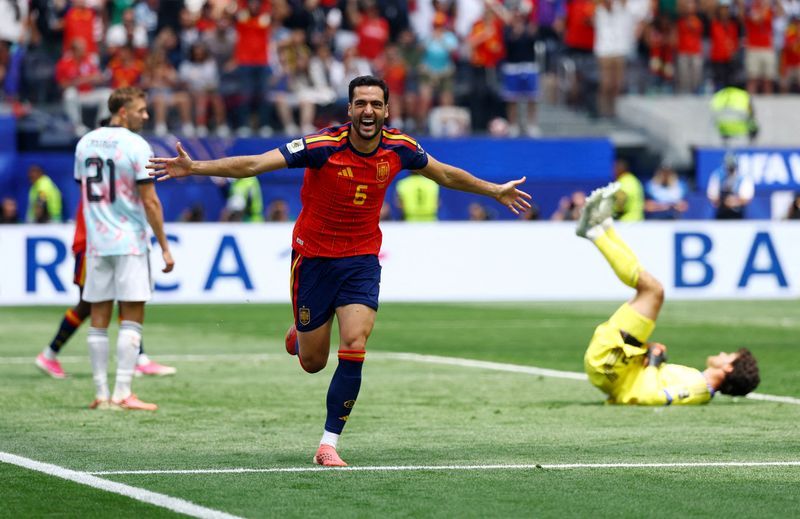
Spain's path to the World Cup semi-finals was secured through a tense quarter-final encounter with Belgium at Los Angeles Stadium on Friday, with substitute Mikel Merino delivering the decisive moment deep into the second half. The Spanish side's 2-1 triumph came courtesy of Merino's clinical finish in the 88th minute, capping a match marked by shifting momentum and the significant absence of key Belgian players through injury. The victory represents a milestone for Spanish football, returning the nation to the semi-final stage for only the second time in World Cup history, the first occasion being their triumphant 2010 campaign in South Africa.
The opening half unfolded with Spain seizing the initiative and translating their early dominance into a goal. Fabian Ruiz broke the deadlock in the 30th minute, capitalizing on a moment of hesitation from Belgium's goalkeeper Thibaut Courtois, who had ventured from his line to make a diving save before Ruiz's follow-up effort found its way past defender Timothy Castagne and into the net. Spain's coach Luis de la Fuente had made a bold selection decision by starting the Paris Saint-Germain midfielder, benching Pedri in favour of Ruiz—a tactical gamble that appeared vindicated by the opening goal and Spain's commanding possession-based approach.
Belgium's response came swiftly and carried genuine threat. Charles De Ketelaere levelled the match eleven minutes after Ruiz's opener, displaying intelligent movement to meet Castagne's cross with a well-placed header that beat Unai Simon. The goal marked Belgium's first breakthrough of the tournament and halted Spain's clean sheet record, injecting renewed confidence into the Belgian side despite their mounting injury concerns. The teams entered the interval locked at 1-1, with the oppressive Californian heat contributing to the physical toll on both elevens.
Belgium's injury crisis had loomed large over their participation from the moment the teams arrived for the fixture. Captain Youri Tielemans was ruled out just before kickoff after suffering a warm-up injury, with Hans Vanaken drafted into the starting lineup as an emergency replacement. The situation was compounded by the absence of midfielder Amadou Onana, who had sustained an anterior cruciate ligament tear during Belgium's hard-fought round-of-sixteen victory against the United States. These absences fundamentally altered Belgium's midfield composition and tactical flexibility, leaving them navigating the tournament with a stripped-down squad.
Following the interval, Spain emerged with renewed intensity and purpose. The European champions gradually suffocated Belgium's counterattacking opportunities, maintaining possession while probing methodically for weaknesses in the defensive structure. Their pressure eventually created the decisive opening when goalkeeper Senne Lammens, substituted into the match after Courtois's withdrawal due to injury, failed to secure Pau Cubarsi's low strike cleanly. The ball skewed loose in front of the goal-line, creating sufficient space for Merino, who had entered the fray just two minutes earlier in the 86th minute, to finish with composure.
Merino's introduction proved transformative, exemplifying how fresh legs and tactical substitution can alter a contest's trajectory. The Basque midfielder's positioning at the crucial moment demonstrated intelligent game awareness, allowing him to be precisely where the rebound fell and to execute the finish with clinical precision. His intervention crystallized Spain's superiority and ended Belgium's semi-final aspirations, silencing the growing anxiety that may have gripped Spanish supporters as the match entered its final stages without a decisive breakthrough.
The venue itself reflected the tournament's scale and significance. Los Angeles Stadium hosted a sold-out attendance, with the crowd predominantly favouring Spain's style of play. Among the notable figures in attendance were international musicians including Courtney Love and Noel Gallagher, Hollywood actor Brad Pitt, and Spanish cinema personalities Penélope Cruz and Javier Bardem, underscoring the global cultural resonance of the competition.
Spain's advancement sets up a tantalizing semi-final encounter against France in Dallas on Tuesday, pitting the tournament's defending European champions against the competition's favourites. France enters that fixture with considerable credentials and depth, having navigated their own challenging quarter-final. The matchup promises to be a compelling contest between Spain's technically proficient, possession-dominant system and France's balanced approach combining flair with pragmatism. For Malaysian and Southeast Asian football followers, Spain's progression offers an intriguing alternative to the conventional tournament narrative, showcasing how European technical football can overcome physical challenges and tactical adversity.
Spain's return to the World Cup semi-finals carries broader implications for the tournament's competitive landscape. Their 2010 triumph demonstrated the effectiveness of the pass-and-control methodology that dominated European football for the subsequent decade, influencing coaching philosophies across multiple continents. The current Spanish squad, while rebuilt since that golden era, retains recognizable elements of that footballing philosophy, suggesting that classical approaches remain viable at the tournament's highest level. As they prepare for their Dallas showdown, Spain stands as the last remaining representative of European football philosophy most oriented toward technical mastery and patient buildup, potentially offering a distinctive contrast to the approaches deployed by their semi-final opponent.

