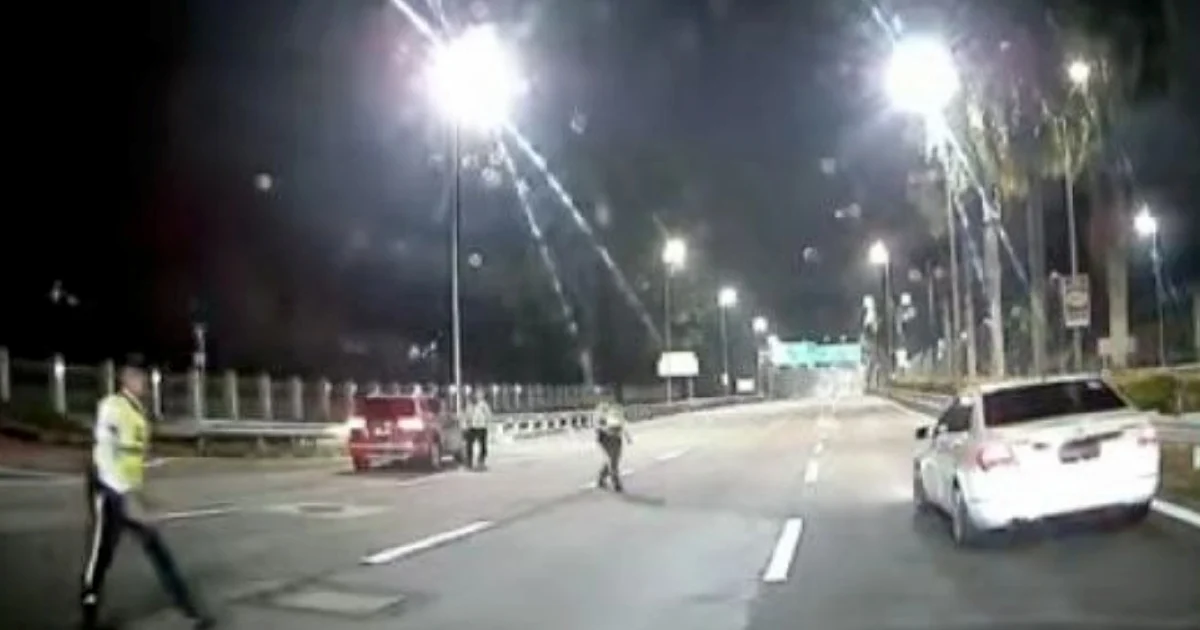
An incident involving a young motorist's vehicle crashing through a law enforcement roadblock on one of Kuala Lumpur's major expressways has culminated in the arrest of a 20-year-old man for investigation purposes. The white Mercedes broke through the checkpoint positioned near the National Institute of Public Administration (Intan) before the driver accelerated along the Sprint Expressway, prompting swift police intervention.
The dramatic nature of the incident, which captured public attention through social media, underscores growing concerns about road safety and enforcement effectiveness on Malaysia's main arterial routes. The Sprint Expressway, a critical transport corridor serving the Klang Valley region, has been the scene of multiple violations and safety incidents over recent years. This particular breach of a police roadblock raises troubling questions about the vulnerabilities inherent in enforcement operations conducted on congested urban expressways.
Roadblocks remain a standard enforcement tool for Malaysian authorities seeking to check driver documentation, vehicle roadworthiness, and compliance with traffic regulations. When a motorist elects to accelerate through such a checkpoint rather than comply with police instructions, it escalates the situation from routine enforcement into a dangerous pursuit that threatens the safety of other road users. The decision to proceed through the blockade speaks to either a deliberate attempt to evade authorities or, in some circumstances, panic on the driver's part—a distinction that investigators will endeavour to clarify.
The location of this roadblock near Intan, an established institutional zone, suggests the checkpoint may have been part of a coordinated enforcement operation in response to specific traffic violations or compliance concerns in that area. The proximity to a major government training institution also indicates the operation was likely a planned intervention rather than an ad-hoc stop. Understanding the timing and rationale behind the checkpoint placement will form an important component of the investigation.
For residents and regular commuters of the Klang Valley, incidents of this type reinforce anxieties about the efficacy of traffic enforcement mechanisms. While authorities deploy roadblocks to improve compliance and deterrence, each instance where a driver successfully breaches a checkpoint without immediate physical restraint inevitably raises public discussion about whether current enforcement methods possess sufficient teeth. The fact that the motorist managed to accelerate away after breaking through suggests the checkpoint may not have been fortified with physical barriers designed to prevent forcible passage.
The apprehension of the driver following this incident demonstrates that despite initial evasion, law enforcement agencies retain robust investigative capabilities and can typically identify and locate vehicles involved in such breaches. Vehicle registration databases, traffic camera footage, and witness testimony all contribute to post-incident identification. That the detained motorist is only 20 years old may also indicate this was a young, inexperienced driver making a poor judgment call under pressure rather than a hardened traffic violator.
The circumstances prompting the roadblock breach remain unclear from available information. Possible explanations range from the driver being unlicensed or uninsured, to concerns about the vehicle's roadworthiness, to individuals fleeing from unrelated matters. Investigators will examine whether the motorist had legitimate grounds for alarm or whether the decision to breach was simply a misguided response to routine questioning. Each scenario carries different implications for how the incident should be understood and prosecuted.
This occurrence also highlights the inherent risks faced by police personnel manning roadblocks. Officers conducting vehicle checks on expressways operate in environments where traffic is moving at relatively high speeds and where enforcement activities necessarily extend into live traffic lanes. Motorists who attempt to breach checkpoints place not only themselves and other road users in jeopardy but also endanger the police officers and traffic wardens conducting these operations. The incident serves as a stark reminder of the occupational hazards inherent in frontline traffic enforcement.
The viral spread of the incident through social media platforms reflects the contemporary reality that dramatic traffic situations are now routinely recorded and shared online. This public documentation, while sometimes aiding investigations through eyewitness footage, also risks inflaming public sentiment and complicating fair judicial processes. The detained motorist's presumption of innocence remains important even as public discussion unfolds around the circumstances of his actions.
Moving forward, the investigation will likely examine whether charges should include offences related to dangerous driving, evading police, or other relevant breaches under Malaysian traffic legislation. The penalty structure for such violations has been subject to ongoing discussion among policymakers seeking to recalibrate deterrence levels. Depending on the severity of the breach and any additional factors uncovered during investigation, the outcome of this case may influence future enforcement strategies and checkpoint procedures.
The incident underscores the need for continued dialogue between traffic authorities, road safety advocates, and the motoring public regarding the balance between enforcement effectiveness and public cooperation. Roadblocks remain necessary tools for maintaining standards of vehicle and driver compliance, yet their success ultimately depends on voluntary motorist compliance coupled with credible law enforcement capacity to follow up on violations. This case will provide valuable insights into these dynamics as it progresses through investigation and potentially the judicial system.

