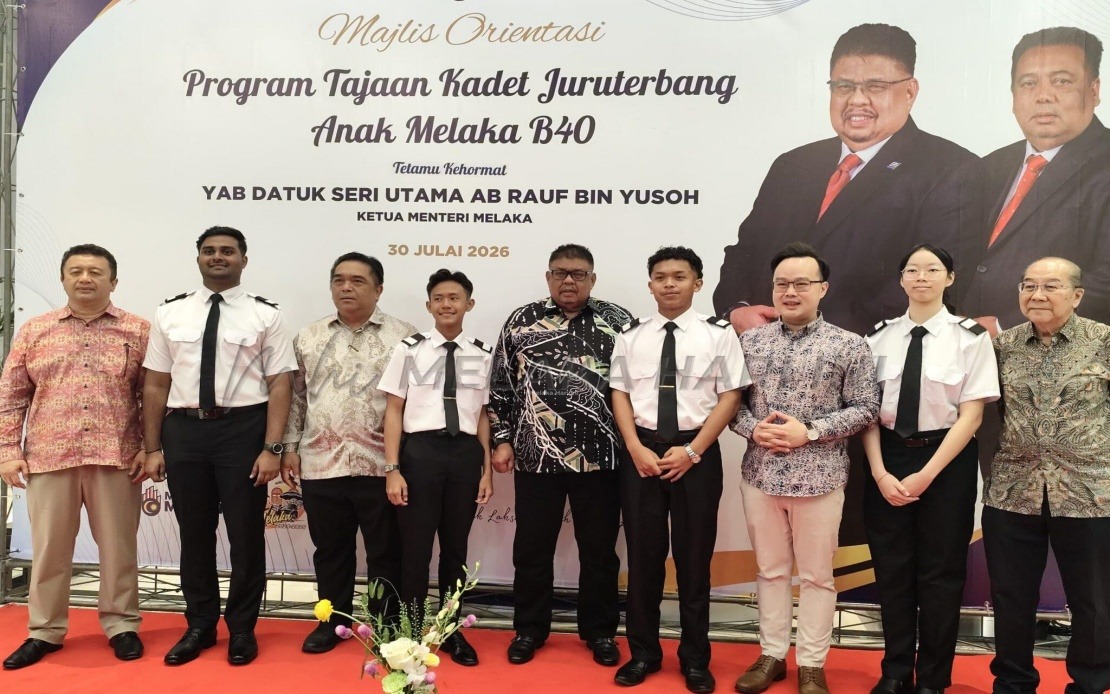
Melaka's state government has announced an ambitious initiative to sponsor 20 children from the B40 income bracket for full cadet pilot training through the International Aero Training Academy (IATA), in a programme valued at approximately RM10 million. The sponsorship represents a significant attempt to address educational disparity in the aviation sector and create pathways for talented youth from disadvantaged backgrounds to pursue careers in one of Malaysia's strategic industries.
Chief Minister Datuk Seri Ab Rauf Yusoh unveiled the scheme during the orientation ceremony at IATA's Batu Berendam facility, with the first intake comprising four selected candidates from Melaka. A further 16 sponsored positions will be made available through a subsequent selection round scheduled for the following year, allowing the state to stagger recruitment and manage the intensive training requirements. This phased approach suggests a deliberate strategy to ensure proper vetting and support mechanisms are in place for each cohort of trainees.
The initiative extends beyond conventional scholarship frameworks by framing the investment as a talent-development strategy rather than mere financial assistance. Ab Rauf emphasised that capability and determination should not be constrained by economic circumstances, positioning the programme as a response to the reality that many gifted young Malaysians lack the means to access premium aviation education. By removing financial barriers, the state government seeks to unlock potential that might otherwise remain untapped in its communities.
The partnership with IATA represents a collaborative model that increasingly characterises Malaysian development initiatives, whereby government, private educational institutions, and industry players combine resources and expertise. Captain Kenneth Yap Kean Foo, IATA's chief executive, participated in the launch, signalling the academy's commitment to the programme and its potential role in nurturing Malaysia's future aviation workforce. Such partnerships can prove transformative, particularly when they connect disadvantaged students with internationally accredited training facilities.
Beyond aviation, the sponsorship ecosystem appears to be expanding within Melaka's development framework. The Chief Minister disclosed that a private higher education institution has proposed a parallel initiative offering scholarships for nursing studies to 30 low-income students. This diversification suggests that state leadership views human capital development across multiple sectors as essential to long-term economic resilience and social mobility. The nursing sponsorship addresses critical skills shortages in Malaysia's healthcare system while providing career security for participating youth.
The broader context of these initiatives reflects Malaysia's ongoing challenge of ensuring that economic opportunities reach beyond urban and affluent communities. The B40 designation targets households earning below RM4,290 monthly, a significant proportion of Malaysia's population particularly concentrated in rural and semi-urban areas. For Melaka specifically, channelling premium training opportunities to this demographic represents a deliberate counter to the notion that poverty is inheritable or that talent is distributed unevenly across income groups.
Aviation sector development holds particular relevance for Melaka's economic diversification agenda. As the state seeks to reduce dependence on traditional manufacturing and tourism, developing indigenous expertise in aviation—including pilot training, maintenance, and related technical fields—positions Melaka to capture opportunities within Malaysia's broader aerospace ambitions. Nurturing local talent through sponsorship programmes reduces future reliance on foreign expertise and builds sustainable competitive advantage.
The sponsorship model also carries social implications beyond individual beneficiaries. When a child from a low-income family successfully completes intensive pilot training and enters the aviation industry, the economic returns typically extend to their household and extended community. Higher earnings, improved living standards, and the prestige of professional achievement often catalyse broader family upward mobility. Scaled across 20 sponsored pilots, the collective impact on family dynamics and community aspirations in Melaka could prove substantial.
Critical to the programme's success will be selection mechanisms that identify not merely academically capable candidates but those demonstrating resilience, commitment, and the psychological attributes necessary for aviation training. Pilot training is rigorous and expensive; candidates must possess not only intellectual capacity but also the determination to succeed in an intensely competitive field. Melaka's selection process will require careful assessment frameworks to ensure resources are directed toward individuals most likely to complete training and build sustainable aviation careers.
The initiative also invites scrutiny regarding post-training employment pathways. Sponsoring cadet training creates value only if graduates secure meaningful aviation positions; without coordinated workforce planning or employer partnerships, successful trainees might face underemployment despite their qualifications. Melaka's government will need to work with Malaysian airlines, regional carriers, and aviation operators to ensure sponsored graduates transition smoothly into the industry, maximising return on the RM10 million investment.
From a Southeast Asian perspective, Melaka's approach aligns with regional trends toward using targeted human capital development to address inequality. Singapore and Thailand have long invested in sectoral talent pipelines, while Indonesia and Philippines increasingly recognise that selective sponsorship in high-value sectors can generate greater social returns than universal but shallow assistance. Melaka's dual focus on aviation and nursing reflects this logic—concentrating resources on sectors with proven employment demand and competitive advantage.
The programme signals that Melaka's leadership recognises education and skills development as fundamental to political legitimacy and economic sustainability. By demonstrating commitment to transforming lives through opportunity rather than redistribution alone, the state positions itself as investment-oriented and forward-looking. For young Malaysians in lower-income households, the initiative delivers a concrete message that pathways to professional success exist, conditional on talent and effort rather than family wealth or connections.
Moving forward, the success of this sponsorship initiative will likely determine whether similar programmes expand within Melaka or become a model for replication elsewhere in Malaysia. Other states facing comparable demographic challenges may observe outcomes closely, evaluating whether sponsored training in premium sectors represents an effective approach to human development and economic competitiveness. The coming years will reveal whether Melaka's strategic investment translates into sustained career advancement for sponsored graduates and measurable economic benefits for the state.

