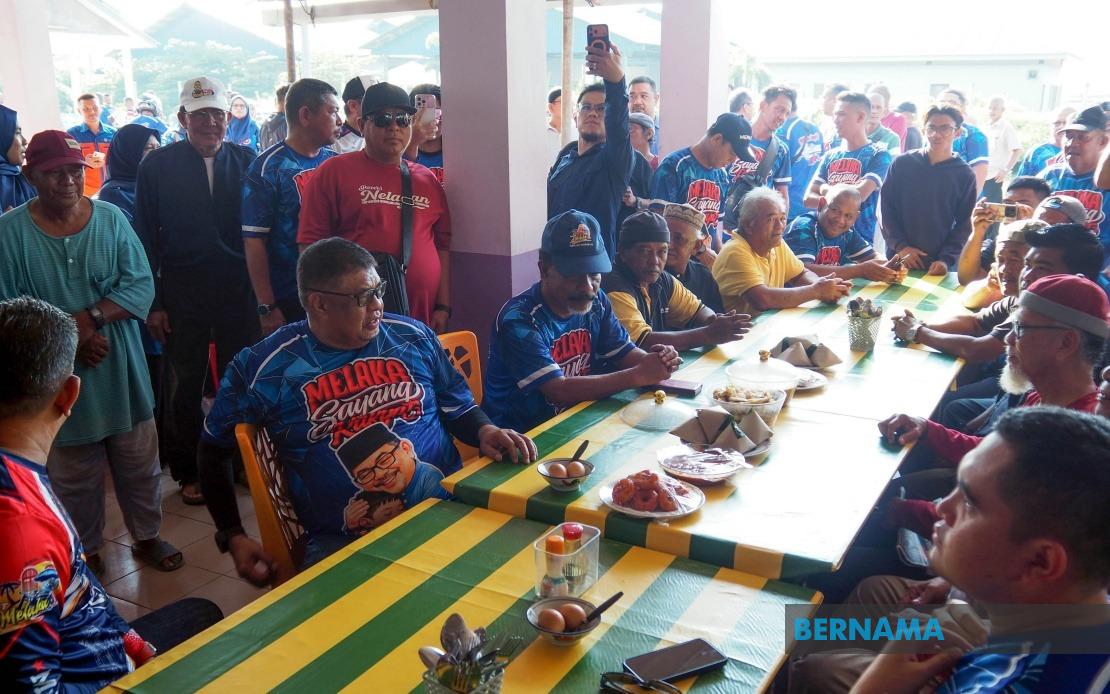
Melaka's government has unveiled a package of welfare and modernisation initiatives aimed at strengthening support for the state's fishing communities, marking a significant policy shift toward incorporating technology and social protection into a traditionally labour-intensive sector. Chief Minister Datuk Seri Ab Rauf Yusoh announced the measures during a grassroots engagement programme in Jasin, where he committed to providing Social Security Organisation (PERKESO) coverage alongside fish finder equipment to all registered fishermen operating in Melaka waters.
The announcement emerged from the fifth instalment of the Chief Minister's community outreach series, a touring initiative designed to create direct dialogue between state officials and residents at the neighbourhood level. By conducting these visits away from the state capital, Ab Rauf Yusoh positioned the government as responsive to community-identified needs rather than imposing top-down solutions. This approach signals a departure from purely office-based policy formulation, instead embedding decision-making within the actual contexts where fishermen live and work. The visit to Kuala Sempang Jetty in the Merlimau state constituency specifically targeted the fishing sector, reflecting recognition of its economic and social importance to coastal communities.
The immediate financial component of the initiative distributed direct assistance to 107 registered fishermen through the 'Bantuan Jaring Nelayan' scheme, with each recipient receiving RM200, totalling RM21,400 in disbursements. Alongside individual payments, the government distributed 360 kilogrammes of fish valued at RM3,600 to the broader public, allocating approximately 1.5 kilogrammes per person. These concurrent distributions served dual purposes: providing tangible relief to fishermen themselves whilst simultaneously enhancing food security and demonstrating government commitment across a broader constituency base.
The introduction of fish finder technology represents a deliberate modernisation strategy that addresses a longstanding operational limitation within Malaysia's traditional fishing sector. Fish finders use sonar technology to detect underwater concentrations of fish, enabling fishermen to identify productive locations rather than relying on accumulated experience and intuition. This technological upgrade directly addresses productivity challenges that have constrained income growth in small-scale fishing operations. Amirul Shah Fuad Shah, a 35-year-old fisherman with more than two decades of experience, underscored this potential advantage, noting that fish finders typically cost between RM1,000 and RM2,000 for private purchase—placing them beyond immediate reach for many practitioners in the sector.
The PERKESO coverage component addresses occupational welfare gaps that have historically left fishing communities exposed to employment-related risks with minimal institutional protection. Unlike factory workers or construction labourers covered through standard employment frameworks, self-employed and informal sector fishermen frequently lack comprehensive social security. Exposure to maritime hazards—including unpredictable weather, equipment failure, and accidents at sea—creates genuine vulnerability, particularly for ageing practitioners with limited alternative income sources. By extending PERKESO's protective umbrella, the state government acknowledges these occupational realities and commits institutional resources toward risk mitigation for one of Melaka's most economically dependent communities.
Md Khalil Md Jadi, chairman of the Kampung Sempang Fishermen's Association at age 67, welcomed the initiatives as meaningful recognition of a sector where many practitioners are elderly and depend entirely on maritime livelihoods. His perspective highlighted the demographic reality of Malaysian fishing communities, where successive generations have not uniformly sustained fishing traditions, leaving aging practitioners without secure transition pathways toward retirement. The combination of PERKESO coverage and productivity-enhancing technology directly addresses this demographic challenge by simultaneously protecting existing income sources and expanding their earning capacity.
The initiatives carry particular significance within Malaysia's broader rural development and sectoral modernisation frameworks. Fishing represents a critical primary industry in coastal states, contributing substantially to national food security, employment, and foreign exchange earnings. However, the sector faces chronic challenges including resource depletion, climate vulnerability, and labour outflows as younger workers pursue alternatives. Melaka's integrated approach—combining social protection, technological capability, and direct financial support—offers a potential model for state governments elsewhere confronting similar sectoral pressures. The visible emphasis on fishermen's collective welfare reflects evolving political recognition that traditional livelihoods require active government intervention to remain viable and attractive within contemporary economic contexts.
From a Southeast Asian perspective, Malaysia's fisheries sector operates within competitive regional dynamics involving Thailand, Vietnam, and Indonesia—major fishing nations that dominate ASEAN production volumes. Productivity improvements driven by modern equipment adoption can enhance Malaysia's competitive positioning, particularly for small-scale operators seeking to maintain market relevance against larger industrial operations. The Melaka initiative suggests state governments increasingly recognise that technology transfer, rather than pure subsidy approaches, represents a more sustainable pathway toward sectoral competitiveness and household income growth.
The expansion of PERKESO coverage to fishing communities also aligns with broader social protection expansion initiatives across Malaysia's state and federal levels. As informal and self-employed sectors comprise substantial portions of the national labour force, institutional coverage mechanisms have progressively extended beyond traditional employment categories. This extension reflects evolving policy understanding that social security systems require comprehensive coverage models to address inequality and vulnerability effectively. Melaka's decision institutionalises this principle within the fishing context, potentially establishing expectations that other states formalise similar arrangements.
Implementation will test the government's capacity to effectively deliver fish finder technology, ensure proper maintenance and training, and sustain PERKESO contributions over time. Success requires sustained funding commitments, adequate administrative capacity, and genuine uptake by target beneficiaries. Fishermen's receptiveness, demonstrated in Amirul Shah Fuad Shah's and Md Khalil's statements, suggests preliminary enthusiasm, yet translating policy announcements into embedded community practice remains operationally challenging. The coming months will reveal whether these initiatives become entrenched within fishing communities or remain episodic policy gestures tied to electoral cycles.

