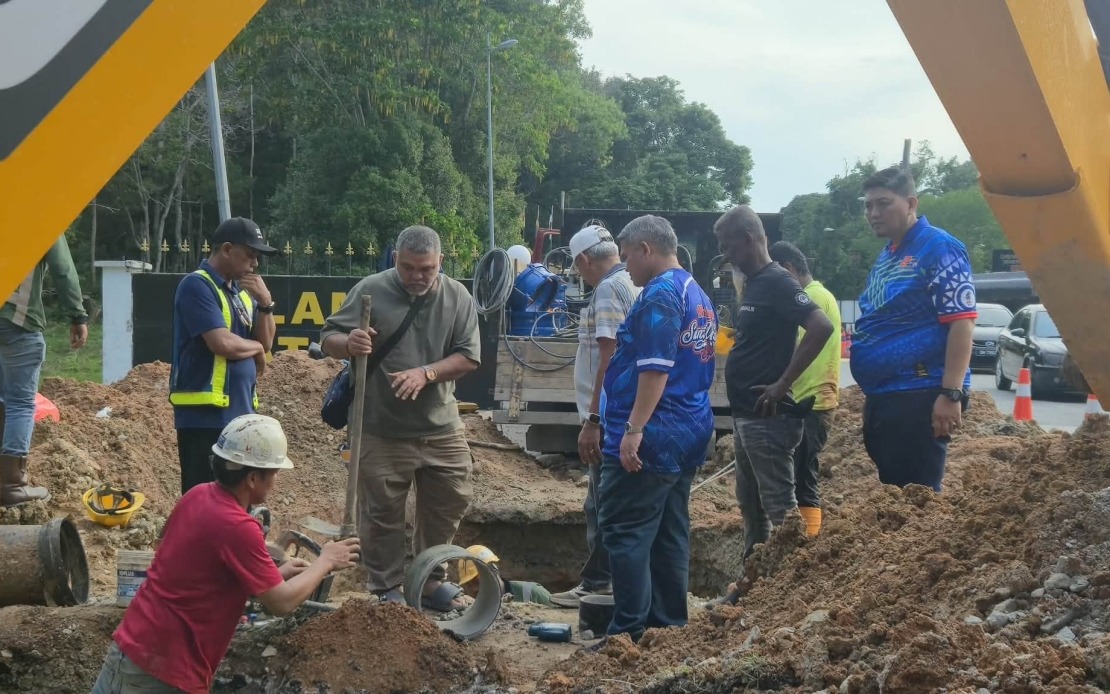
The Melaka state government is moving to tackle persistent water shortages at Kem Terendak in Sungai Udang by proposing the construction of a temporary holding tank, marking an escalation of efforts to manage an infrastructure crisis affecting the military camp's 2,000 resident personnel and households. The proposal, announced on July 20, emerges as a major pipeline rupture along Jalan Kampung Payasum continues to cripple water distribution across the 130-hectare garrison, also disrupting supply to five schools including a MARA Junior Science College within the camp perimeter.
Datek Rais Yasin, the Melaka housing and local government exco member and Sungai Udang assemblyman, outlined the interim arrangement while the state waits for completion of a comprehensive water reticulation upgrade expected by April 2028. The temporary tank represents an acknowledgment that standard repair protocols may not adequately protect residents during the extended timeframe for the major redevelopment project. Rais told journalists that SAMB, the state's water operator, would submit detailed plans to the Ministry of Defence, as the military facility falls under federal jurisdiction via the Public Works Department and Mindef. This jurisdictional complexity has potentially delayed swifter interventions, placing the onus on both state and federal authorities to coordinate relief measures.
The proposed temporary tank strategy reflects growing recognition that Kem Terendak's aging water infrastructure requires urgent stabilisation beyond emergency responses. The camp's water system has exhibited chronic vulnerabilities, with the current crisis marking the second significant disruption in recent months. Defence officials and camp residents have privately voiced frustration over the reliance on aging pipes originally installed decades ago, when the garrison's population and demands were considerably lower. The April 2028 completion target for the full upgrade project represents a nearly four-year window during which temporary measures must bridge the gap between current inadequacy and long-term solutions.
In the immediate aftermath of the pipe burst, SAMB deployed 25 tanker lorries delivering 25,000 gallons daily to offset lost supply—a logistically intensive operation that Rais acknowledged falls short of actual demand. For a camp housing 2,000 personnel and families across residential quarters, administrative buildings, and educational facilities, this emergency provision covers only roughly half of typical daily consumption during peak demand periods. The state authority has additionally distributed water containers to schools to maintain routine operations, a measure reflecting the cascading impacts of infrastructure failures on civilian services within military compounds. Rais publicly apologised to residents, signalling state government accountability despite the federal ownership structure of the facility.
The temporary tank proposal hinges on Defence Ministry approval, introducing bureaucratic uncertainty into the relief timeline. Mindef must balance security considerations, budgetary constraints, and operational priorities when evaluating placement and design specifications for infrastructure additions. The identification of a suitable location proves non-trivial within an active military installation where space allocation is heavily regulated. Alternative water sourcing options, including deepening reliance on mobile tanker services, carry sustainability concerns and substantial ongoing costs that neither the state nor federal authorities appear willing to maintain indefinitely. This creates pressure for rapid approval of the temporary tank, though no specific timeline has been announced.
The underlying pipe rupture, situated along a major distribution corridor, required approximately 18 to 24 hours for initial repairs, with full system restoration projected to require an additional one to two days beyond the initial repair window. The extended restoration period reflects the complexity of purging air from pipes, conducting pressure tests, and verifying water quality across the network. However, this particular failure also exposes a systemic vulnerability: if a single pipeline segment can disable an entire garrison's water supply, the distribution network lacks redundancy and fail-safe mechanisms. The April 2028 upgrade project presumably addresses this architectural deficiency by installing parallel mains and sectionalised distribution zones, though no public technical details have been disclosed about the planned improvements.
Military camps across Malaysia have historically depended on state or federal water operators, creating tension when infrastructure maintenance and capital investment responsibilities remain unclear. Kem Terendak's predicament mirrors challenges experienced at other defence establishments where aging utility systems serve dual military and civilian populations. The presence of residential quarters for military families and educational institutions adds complexity, as supply interruptions affect non-combatant civilians who lack the adaptive capacity of deployed military personnel. This reality has likely prompted the state government's proactive stance, recognising that water crises at military facilities generate political pressure and media attention disproportionate to their technical complexity.
The involvement of Syarikat Air Melaka Berhad in coordinating relief efforts positions the state utility as a potential long-term solution provider, though its formal authority over federal installations remains limited. SAMB's donation of two 5,000-litre water tanks to the garrison, presented during the July 20 ceremony attended by Terendak Garrison Headquarters commanding officer Lt Col Annuar Kaliman and SAMB chief executive officer Datuk Mohd Saleh Jusman, represents both practical assistance and a symbolic assertion of state partnership in addressing the crisis. The relatively modest tank volumes suggest they are intended for emergency reserves rather than solving core supply deficiencies, pointing again toward the temporary tank proposal as the next escalation in interim measures.
Regional water security implications extend beyond Kem Terendak, as similar infrastructure vulnerabilities likely exist across Southeast Asia's military establishments. Malaysia's experience with aging garrison water systems reflects broader challenges of maintaining defence infrastructure amid competing budgetary demands. The Melaka government's response demonstrates how state-level initiative can partially compensate for federal service delivery gaps, though true solutions require coordinated investment and planning across administrative jurisdictions. The April 2028 completion date, while offering eventual relief, underscores the pressing need for temporary measures to prevent recurring crises that disrupt operations and erode confidence in institutional capability.
Looking forward, the temporary tank approval will signal whether Mindef prioritises expedited relief or maintains cautious administrative procedures. Should the proposal advance rapidly, it may establish a precedent for other military facilities experiencing water stress. Conversely, delays could force escalation to higher-level political pressure or alternative technical solutions. For Malaysian residents and personnel at Kem Terendak, the outcome will determine whether water supply stabilises within weeks or remains subject to periodic disruptions over the coming years. The convergence of state ambition, federal constraints, and infrastructure decay offers a microcosm of how Malaysia navigates shared responsibility for essential services in increasingly complex governance environments.

