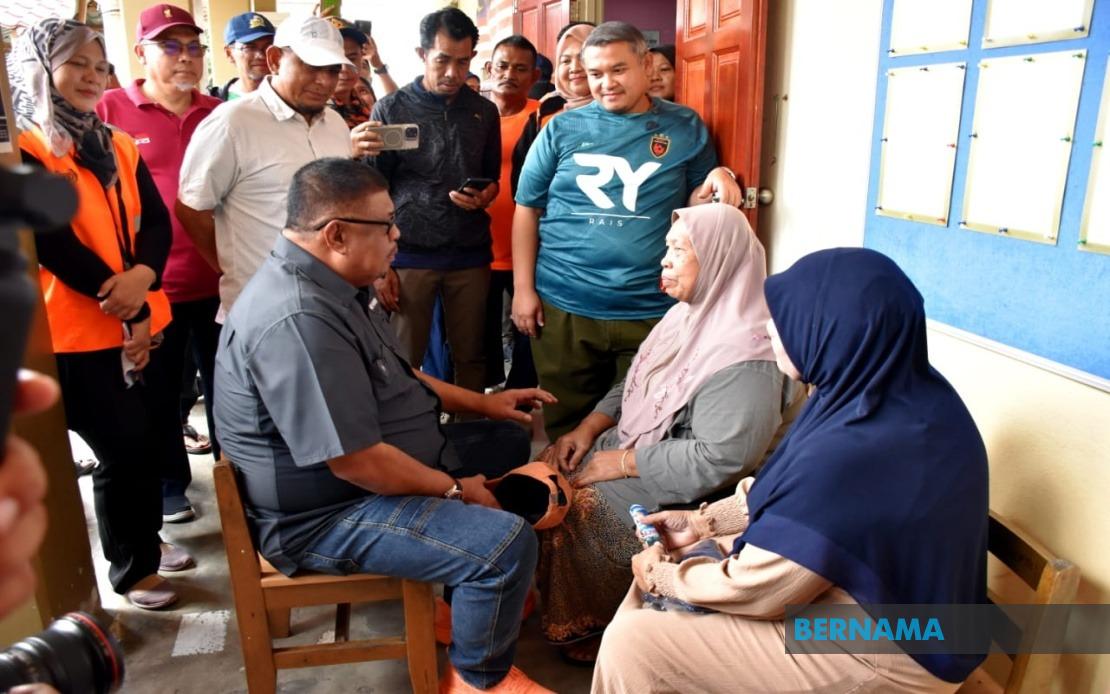
Melaka Chief Minister Datuk Seri Ab Rauf Yusoh has made a firm commitment to finally put an end to the flooding catastrophe that has devastated Tanjung Minyak for more than 30 years, signalling renewed political will to tackle one of the state's most intractable infrastructure challenges. Speaking during a visit to flood evacuation centres in the area, the Chief Minister acknowledged the urgency of the situation and vowed that the state government would conduct a comprehensive examination of all available proposals and expert recommendations to chart a definitive path forward for this chronically flood-prone locality.
The recent deluge that prompted the Chief Minister's intervention represents an unprecedented weather event for the region. Rainfall measurements exceeded 100mm in both Melaka Tengah and Alor Gajah districts, surpassing even the exceptional precipitation levels recorded during Tropical Storm Senyar late last year. According to Melaka's Irrigation and Drainage Department director Mohd Adnan Ahmad Fauzi, this extraordinary intensity of rainfall—the heaviest witnessed in more than two decades—exposed critical vulnerabilities in existing water retention infrastructure, causing systems designed for normal conditions to overflow catastrophically into surrounding residential zones.
The scale of the humanitarian impact underscores the severity of the crisis. More than 900 evacuees, representing approximately 300 families, have been displaced and are currently sheltering across multiple relief centres throughout Melaka. Among these locations is Sekolah Kebangsaan Tanjung Minyak 2, where the Chief Minister met with displaced residents to assess conditions firsthand. The state government has positioned itself to ensure that welfare provisions and support measures remain prioritised until normal living conditions can be restored to affected communities.
AbRauf's comments indicate that the state intends to move beyond reactive emergency responses that have characterised Tanjung Minyak's history with flooding. The Chief Minister explicitly stated that his administration would evaluate methodologies and recommendations from all pertinent government agencies with the specific objective of identifying enduring solutions capable of mitigating the persistent burden created by severe rainfall events. This signals a departure from temporary fixes and suggests consideration of more substantial infrastructure interventions or urban planning reforms.
The involvement of senior state officials reflects the political importance now attached to resolving the issue. Datuk Rais Yasin, who chairs the state committee overseeing housing, local government, drainage, climate change and disaster management, attended the relief centre visit alongside Halyjah Muhamad, the director of Melaka's Social Welfare Department. Their presence indicates institutional coordination across multiple portfolio areas, suggesting that solutions may encompass drainage system upgrades, land-use modifications, or climate adaptation strategies rather than isolated technical fixes.
From a regional perspective, Tanjung Minyak's flooding problem reflects broader challenges confronting coastal and low-lying areas throughout Malaysia and Southeast Asia as climate patterns shift and urbanisation intensifies. The unprecedented nature of recent rainfall—exceeding records spanning more than 20 years—aligns with scientific projections regarding increased extreme weather intensity in tropical regions. Melaka's response mechanisms and proposed long-term interventions may provide valuable lessons for neighbouring states grappling with similar vulnerabilities.
The coordination structure mobilised in response demonstrates improvements in disaster response infrastructure compared to historical patterns. The state has activated high-alert protocols across all relevant agencies, with the District Office serving as a coordination hub for immediate aid distribution and the state government managing broader relief operations. This layered approach suggests evolution in emergency management capabilities, though critics might argue that decades of recurring floods should have prompted preventative measures long before displacement became necessary.
The acknowledgment by state authorities that rainfall patterns have intensified and that existing infrastructure proves insufficient implies potential future discussions around climate adaptation investments. Melaka, as one of Malaysia's most flood-prone states with significant coastal exposure, faces particular urgency in developing climate-resilient infrastructure. The Chief Minister's commitment to long-term solutions may necessitate substantial capital expenditure, potentially including upgraded drainage systems, retention ponds, elevated infrastructure in vulnerable zones, or managed retreat from the most exposed areas.
Tanjung Minyak's three-decade struggle with flooding represents not merely a local engineering problem but a test of governance capacity and political commitment to environmental adaptation. Residents have endured recurring displacement, property damage, and disrupted livelihoods across generations while temporary solutions were repeatedly implemented and failed. The current political rhetoric emphasising comprehensive, long-term resolution carries significant weight given this history of deferred action, and implementation will ultimately determine whether this represents genuine strategic reorientation or another iteration of familiar political commitments.

