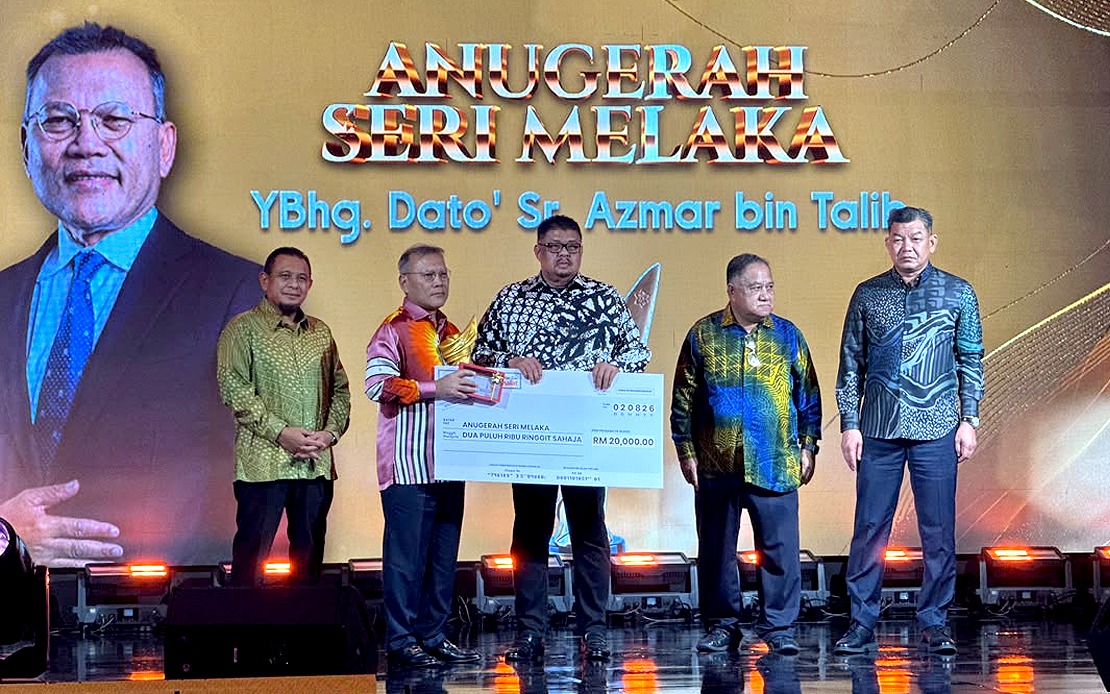
Melaka Chief Minister Datuk Seri Ab Rauf Yusoh has issued a call to the state's accomplished professionals and high achievers to transition from personal success to active mentorship roles within government-backed development initiatives. Speaking at the Anugerah Seri Melaka (ASM) awards ceremony held at the Melaka International Trade Centre in Ayer Keroh, Ab Rauf articulated a vision where individual accomplishments become catalysts for broader community advancement rather than isolated achievements confined to personal portfolios.
The appeal reflects a strategic shift in how Melaka envisions leveraging human capital for state development. Rather than celebrating success stories in isolation, the state government has positioned the Melaka Sayang Rakyat (MeSRa) initiative as a framework to document, publicise and systematically utilise the experiences of accomplished individuals as blueprints for younger Malaysians. This approach recognises that expertise and professional networks accumulated through decades of career advancement represent valuable social assets that extend far beyond individual benefit.
Under the ASM framework, successful nominees are expected to translate their experiential knowledge into actionable mentorship and partnership opportunities with the state administration. Ab Rauf emphasised that this collaborative model aims to create a multiplier effect where one Melaka-born success story illuminates pathways for others to achieve similar milestones. The concept essentially transforms high achievers into institutional assets rather than merely celebrated figures, embedding their contributions directly into the state's development machinery.
The awards ceremony recognised exceptional individuals across four competing categories during its latest iteration. The Corporate category honour went to Datuk Azmar Talib, chief executive officer of TRX City Sdn Bhd, while national badminton player Aaron Chia received recognition in the Sports category. Performing arts director Lokman Abd Ghani was honoured for contributions to Arts and Culture, and Datuk Zamri Misman, director-general of the Legal Affairs Division at the Prime Minister's Department, received the Public Service award.
A Special Category award was conferred upon Dr Saiful Anuar Singar, an internationally recognised medical science researcher whose work extends beyond state borders. The diversity of award recipients across sectors reflects Melaka's production of talent spanning corporate enterprise, athletic achievement, cultural development and public administration. Each recipient embodies a different pathway to excellence, yet all share common characteristics of dedication, sustained effort and institutional contribution.
The awards ceremony drew more than 200 nominations, a figure that demonstrates substantial community participation in identifying deserving candidates. Each nomination represents a documented life journey shaped by perseverance and sacrifice, according to Ab Rauf's remarks. This volume of nominations suggests that Melaka possesses deeper reserves of accomplished professionals than might be publicly visible, indicating potential for expanded mentorship networks if properly mobilised.
Financial incentives accompany the recognition, with special category recipients receiving RM20,000 in cash plus a trophy, while category winners secured RM10,000 and trophies. Although these sums represent meaningful recognition rather than transformative compensation, they signal the state government's willingness to invest in identifying and celebrating excellence. The structure creates tiered recognition that distinguishes exceptional achievement from category-specific excellence.
For Malaysian readers particularly in other states, Melaka's initiative offers a governance model worth examining. Many state administrations struggle to bridge the gap between celebrating success and systematically deploying that success as a development tool. By formalising recognition through awards and explicitly requesting strategic partnership from honourees, Melaka creates institutional mechanisms that encourage accomplished individuals to contribute beyond traditional corporate social responsibility frameworks.
The emphasis on documentation and sharing of success stories addresses a knowledge transfer problem endemic to developing regions. Young professionals and entrepreneurs often navigate challenges without exposure to tried methodologies developed by predecessors in their communities. When successful individuals become isolated achievers rather than active mentors, knowledge gaps persist across generations. Melaka's approach attempts to systematically address this by making mentorship and experience-sharing explicit expectations of award recipients.
The initiative also reflects broader Southeast Asian trends toward identifying and retaining talent within home states and regions. Brain drain remains a persistent challenge across the region as accomplished individuals relocate to larger economic centres. By creating status recognition and formal integration into government partnership frameworks, Melaka attempts to create incentive structures that encourage prominent professionals to maintain substantive connections to their home state rather than purely nostalgic ones.
The relevance of this approach extends beyond Melaka's borders, offering lessons for other Malaysian states seeking to optimise human capital utilisation. In an increasingly competitive regional environment where talent mobility is high, states that successfully activate networks of accomplished diaspora members and locally-based achievers gain substantial development advantages. These individuals bring not only expertise but also extended professional networks spanning domestic and international contexts.
For the award recipients themselves, the recognition carries expectations beyond ceremonial acknowledgement. The framing of recipients as strategic partners implies ongoing responsibility to engage with state development initiatives, mentor emerging professionals, and leverage their networks for community benefit. This represents a subtle but significant reframing of what receiving such recognition entails, moving from passive honour toward active obligation.
As Malaysian states increasingly compete for investment, infrastructure projects and talent retention, initiatives like ASM demonstrate an evolving understanding that human capital and institutional networks constitute as critical infrastructure as physical development. By systematically identifying high achievers and formalising their integration into governance structures, Melaka is effectively building an invisible infrastructure of expertise and mentorship that compounds over time and becomes a durable competitive advantage.

