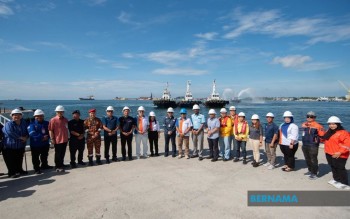
Megah Port Management Sdn Bhd has taken a significant step toward consolidating its role as Labuan Port operator by formally initiating marine services, supported by the acquisition of four purpose-built tugboats valued at RM23 million. The deployment of this modern fleet represents a strategic infrastructure commitment designed to elevate operational standards across one of Malaysia's key maritime hubs. Managing director Datuk Seri Patrick Tiong unveiled the vessels and related services at Dermaga Merdeka Jetty, signalling the company's determination to establish itself as a capable and responsible port authority player in East Malaysia's shipping ecosystem.
The tugboat procurement directly stems from obligations outlined in the recently finalised Operation, Facility and Management Continuation Agreement between Megah Port Management and the Labuan Port Authority. Rather than treating marine services as an optional enhancement, the company has positioned the investment as a fundamental responsibility integral to its concession terms. This contractual framework ensures that port stakeholders—ranging from shipping operators to regulatory authorities—can expect consistent, regulated vessel-handling services backed by dedicated assets and trained personnel. For Malaysian maritime commerce, particularly in the Labuan jurisdiction, this formality adds transparency and accountability to what is traditionally a high-risk operational domain.
The operational scope of the newly activated marine services extends across multiple terminals within Labuan Port's jurisdiction, notably the DG Terminal, Petronas Chemicals Methanol Labuan Terminal, Asian Supply Base Fuel Terminal, and Shell Timur Terminal. This comprehensive coverage indicates that the tugboat fleet will serve a diverse range of vessel types and cargo operations, from conventional general cargo ships to specialised chemical tankers. The breadth of the service network underscores the complexity of Labuan Port's role as both a general cargo facility and a petrochemical hub, requiring flexible and responsive maritime support infrastructure. Such diversification also means that operational efficiency gains will ripple across multiple industrial sectors reliant on the port's throughput.
Tugboat capabilities extend well beyond the routine assistance of vessel movement into berth. According to Tiong's remarks, the fleet is engineered to manage critical scenarios including vessel guidance during adverse weather, emergency towing of disabled ships, and precision manoeuvring in confined waters where larger vessels lack manoeuvrability. These functions are particularly vital in Labuan's geographic context, where tropical weather patterns and narrow port channels create navigation hazards. The investment in modern tugboat technology reflects a pragmatic understanding that maritime incidents carry not only economic but also environmental and safety consequences that extend beyond the port boundary itself.
Emergency response capacity represents a distinctive value proposition of this marine services initiative. Beyond routine towage, the tugboats can be rapidly mobilised to support fire suppression, rescue operations, and pollution containment in the event of maritime incidents. Tiong's emphasis on emergency preparedness signals an awareness that modern port management encompasses risk mitigation and crisis response—dimensions often overlooked in cost-benefit analyses of port infrastructure. For Malaysian regulators and the shipping industry, this capability addresses legitimate concerns about disaster response in a region prone to tropical cyclones and where maritime incidents can escalate rapidly into environmental or safety crises affecting coastal communities.
The coordination framework outlined by management reveals a maturing approach to port governance in Malaysia. Megah Port Management has committed to close collaboration with the Malaysian Maritime Enforcement Agency, Marine Police Force, and other enforcement entities to ensure compliance with maritime law and safety standards. This institutional partnership model, rather than siloing port operations from regulatory oversight, creates a more integrated maritime safety ecosystem. The explicit invitation for constructive feedback from authorities suggests an openness to continuous improvement—a stance that distinguishes more professionally managed port operators from those treating regulation as mere compliance theatre. For Malaysian ports seeking to upgrade their international standing, this collaborative posture matters.
The formal launch included a live emergency response demonstration, where tugboats showcased their capacity to respond to simulated fire incidents within Labuan waters. Such public demonstrations serve multiple purposes: they reassure industry stakeholders of genuine operational readiness, they validate the investment to port workers and the local community, and they provide maritime agencies with empirical evidence of response capabilities. In Southeast Asia, where port safety records vary considerably and shipping companies increasingly conduct due diligence on port facilities, such demonstrations carry competitive advantage. Labuan, competing for regional transshipment and bunkering business, benefits from visible evidence that its operator is serious about safety standards.
The RM23 million investment figure warrants context within Malaysia's broader port infrastructure spending patterns. While substantial, this sum reflects the targeted nature of the investment—upgrading marine services at an existing facility rather than undertaking greenfield port expansion. For Megah Port Management, the capital deployment signals confidence in Labuan Port's long-term viability and the company's commitment to its concession. For Malaysian Port Authority watchers, it suggests that privatised and semi-privatised port operators remain willing to invest in the East Malaysian market, despite the region's smaller overall throughput compared to major Peninsular Malaysia ports. This investment confidence may encourage similar upgrades at other secondary ports.
Labuan Port's evolution under Megah Port Management reflects broader trends in Malaysian maritime infrastructure development. The port has transitioned from a facility primarily serving oil and gas operations to a more diversified maritime hub handling chemicals, general cargo, and bunkering. The marine services initiative supports this diversification by providing professional vessel-handling capabilities that appeal to a wider array of shipping operators. Shipping companies evaluating ports for regular calling consider safety records, operational efficiency, and support infrastructure; Labuan's upgraded tugboat capacity addresses these criteria directly. Within the competitive regional port landscape—where competition from Brunei's ports and Singapore's vast capacity looms large—such incremental improvements accumulate into meaningful competitive positioning.
The involvement of multiple stakeholder groups in the service launch—including the Ministry of Transport, Labuan Port Authority, enforcement agencies, and industry representatives—underscores the interconnected nature of modern port operations. Port facilities no longer function as isolated commercial entities but as nodes within integrated maritime networks encompassing security, environmental protection, and economic development. Megah Port Management's explicit acknowledgement of these relationships suggests a governance model attuned to contemporary expectations of corporate responsibility in critical infrastructure sectors. For Malaysian policymakers evaluating port concession arrangements, this stakeholder engagement approach provides a useful template for balancing commercial objectives with public interest considerations.
Looking forward, the marine services initiative establishes a foundation for Labuan Port to pursue premium positioning within regional shipping networks. Vessel operators, particularly those managing high-value or hazardous cargoes, actively seek ports offering comprehensive support services beyond basic berthing. By deploying dedicated tugboats and establishing systematic protocols for emergency response, Megah Port Management creates conditions for attracting higher-margin shipping business. For Malaysian commerce more broadly, a fully capable Labuan Port reduces dependence on foreign ports for East Malaysian trade, supporting the government's objective of building regionally significant port infrastructure. The RM23 million investment, therefore, carries implications extending well beyond Labuan's immediate port community into the broader Malaysian maritime economy.

