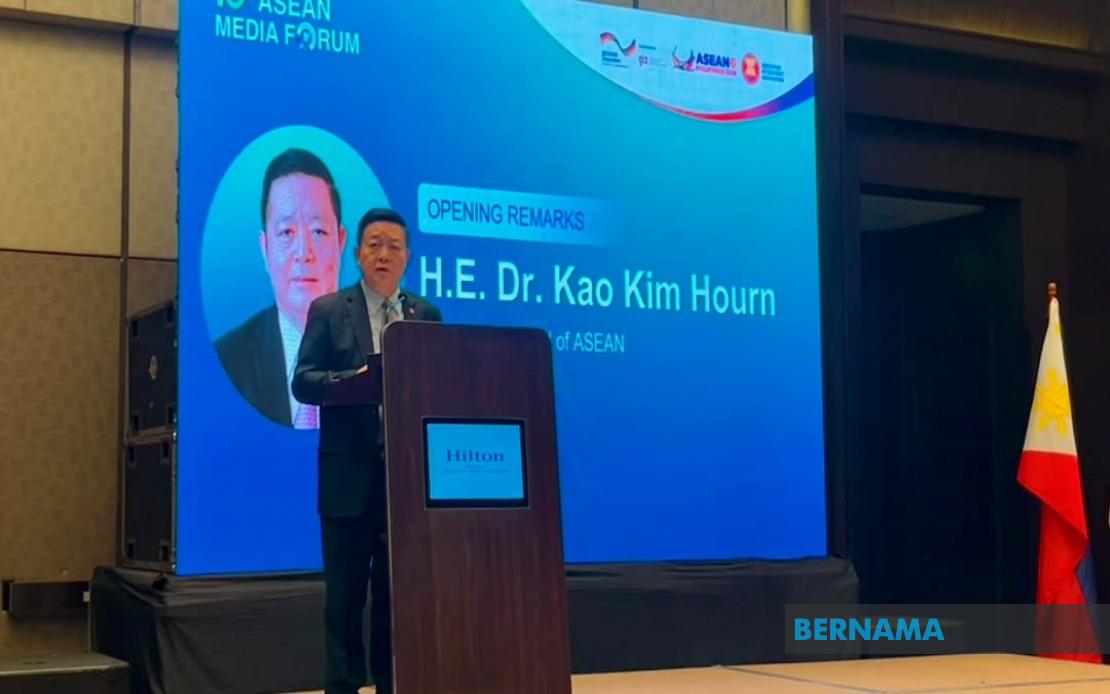
The media industry stands as an indispensable pillar in ASEAN's efforts to deepen public understanding and forge a stronger collective identity, according to ASEAN Secretary-General Dr Kao Kim Hourn, who made the remarks during the 10th ASEAN Media Forum in Manila this week. Speaking to regional journalists and media leaders, Kao emphasised that as the bloc moves towards realising its ASEAN Community Vision 2045—an ambitious framework outlining the region's development priorities through mid-century—the role of the media transcends conventional news reporting to become a strategic instrument for regional cohesion and informed citizenship.
The information landscape across Southeast Asia has undergone transformative changes over the past decade, fundamentally reshaping how news reaches audiences and how people engage with regional developments. Digital platforms and social media have dismantled traditional gatekeeping structures, enabling instantaneous content distribution and democratising the channels through which information flows. Simultaneously, generative artificial intelligence has emerged as both an opportunity and a challenge, offering newsrooms the potential to enhance operational efficiency and deliver multilingual reporting in real time. Yet these same technological forces have created pathways for misinformation and disinformation to propagate rapidly across borders, complicating the information environment in which citizens form their understanding of regional issues.
The proliferation of synthetic media and deepfake technologies presents particularly acute risks to the integrity of public discourse in Southeast Asia. As Kao noted, the ease with which manipulated content can now be produced and distributed means that editorial accountability and journalistic credibility have become increasingly precious assets. The challenge is especially acute in a region where digital literacy levels vary significantly across countries and demographic groups, creating vulnerabilities to coordinated disinformation campaigns. For Malaysian readers and policymakers, this phenomenon has direct relevance, as the nation has already grappled with the destabilising effects of online falsehoods during electoral periods and public policy debates.
Kao articulated a vision of the media's expanded responsibility within ASEAN's institutional architecture. Rather than serving merely as chroniclers documenting the bloc's activities, journalists and media organisations must function as educators and translators, helping citizens understand how regional policies and decisions affect their daily lives. This reimagining of the media's role recognises that ASEAN's legitimacy ultimately depends on public comprehension of and support for regional integration initiatives. When citizens struggle to connect abstract regional frameworks to concrete, tangible benefits or concerns, public enthusiasm for ASEAN can atrophy. The media fills this critical gap by making complex policy domains—whether trade arrangements, security protocols, or social initiatives—intelligible and relevant to ordinary people.
Undersecretary for Foreign Affairs Leo M. Herrera-Lim, representing the Philippines in its capacity as ASEAN Chair, reinforced this institutional perspective by situating journalism within all three pillars of ASEAN Community Vision 2045: the Political-Security pillar, the Economic pillar, and the Socio-Cultural pillar. His framing suggests that credible media coverage spans the full spectrum of regional governance and integration efforts. A region that communicates as deliberately as it decides, in Herrera-Lim's formulation, demonstrates that media engagement is not ancillary to ASEAN decision-making but foundational to it. For Malaysia, which has long been an influential voice within ASEAN despite recent domestic political turbulence, maintaining access to reliable information about regional developments remains crucial for informed public participation in matters of collective regional interest.
The emphasis on professional journalism grounded in verification and ethical standards has acquired heightened urgency amid technological disruption. Kao pointed out that once public trust is eroded, restoring credibility becomes an extraordinarily difficult undertaking. This observation carries particular weight in Southeast Asia, where some countries have experienced cycles of declining trust in institutional media due to perceived bias, censorship, or capture by political interests. The challenge facing regional media is thus twofold: defending professional standards against technological threats to authenticity while simultaneously rebuilding public confidence in journalism as a reliable information source.
The ASEAN Media Forum itself represents the bloc's institutional response to these challenges. Established in 2017 to commemorate ASEAN's 50th anniversary, the forum has evolved into a regional platform where journalists, media executives, and policymakers convene to exchange perspectives, identify collaborative opportunities, and develop shared approaches to emerging problems. The 10th iteration of the forum demonstrates the initiative's maturation as a venue for strategic dialogue about journalism's role in regional integration. By bringing together practitioners from all ten member states, the forum creates opportunities for cross-border collaboration and mutual learning, helping journalists develop contextual understanding of regional dynamics that transcends national perspectives.
The involvement of the German government through its development agency GIZ in supporting the forum underscores the international recognition of media's importance to regional stability and integration. External partners recognise that a well-functioning regional information ecosystem benefits not only ASEAN member states but also the broader international community relying on accurate reporting from Southeast Asia. This external engagement also provides resources and expertise that not all ASEAN members might independently mobilise, democratising access to professional development opportunities for journalists across the region.
For Malaysia specifically, the imperatives articulated by Kao and Herrera-Lim warrant serious reflection among domestic media stakeholders and policymakers. Malaysian journalists and news organisations operate within a regional context increasingly shaped by digital disruption and information warfare. The nation's media industry, comprising a mix of state-linked entities, private conglomerates, and independent outlets, faces particular pressures in demonstrating professional standards and public credibility. Engaging constructively with regional forums like the ASEAN Media Forum provides Malaysian practitioners with opportunities to benchmark practices, exchange experiences with peers facing analogous challenges, and contribute to shaping norms around responsible journalism in the region.
The geopolitical backdrop against which ASEAN and its media operate has become considerably more complex. Regional tensions, great power competition, and transnational challenges ranging from climate change to pandemics demand sophisticated, contextualised reporting that helps publics understand their region's position within global power dynamics. Kao's emphasis on making ASEAN's work more accessible reflects an implicit recognition that public understanding of regional responses to geopolitical challenges remains underdeveloped. Enhanced media engagement could potentially strengthen public support for ASEAN positions in international negotiations and increase awareness of the bloc's relevance to everyday security and prosperity concerns.
Looking ahead towards ASEAN Community Vision 2045, the media landscape will likely undergo further transformation as artificial intelligence capabilities expand and digital platforms evolve. The proactive engagement demonstrated by regional leaders in addressing these challenges through forums like the ASEAN Media Forum suggests an institutional commitment to ensuring that technological disruption does not erode the media's capacity to serve as an informed, credible voice for regional integration. For Malaysian readers and stakeholders, monitoring how ASEAN's media community responds to these evolving challenges will provide valuable insight into the region's broader capacity for institutional adaptation in an era of unprecedented technological and geopolitical change.

