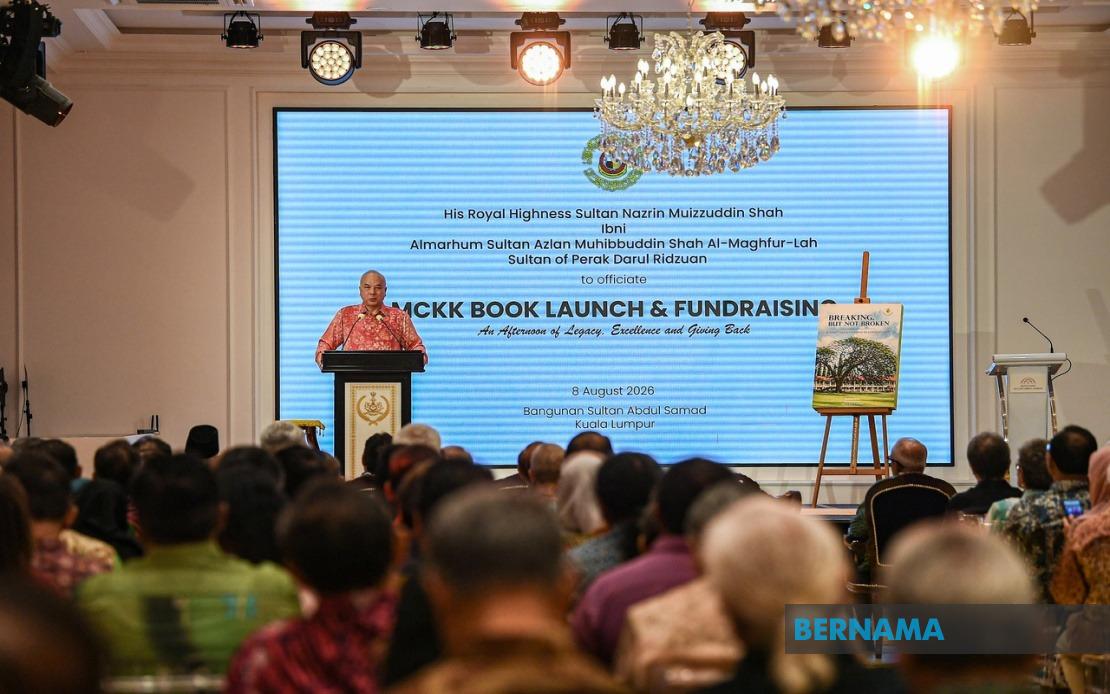
The Sultan of Perak Sultan Nazrin Shah has called for heritage educational institutions to fundamentally reimagine their purpose and curriculum to remain relevant in an age of rapid technological disruption and artificial intelligence. Delivering remarks while launching a book on the subject, the Royal Patron of the Malay College Kuala Kangsar Board of Governors stressed that institutions like MCKK possess the potential to flourish again if they embrace necessary structural and pedagogical changes suited to contemporary circumstances, rather than relying on historical reputation alone.
Sultan Nazrin's intervention comes at a pivotal moment for Malaysia's so-called "power schools"—the country's most prestigious residential institutions that have historically shaped the nation's leadership class. His assessment was notably candid: these once-dominant schools have experienced a measurable decline in their capacity to produce consistently exceptional graduates. The Ruler pointed to observable deficiencies in language proficiency, analytical reasoning, and civic commitment among recent alumni, representing a stark departure from the calibre of previous generations who dominated the civil service, judiciary, and corporate sectors.
The fundamental challenge, according to Sultan Nazrin, lies in adapting educational approaches to address realities that earlier curricula could never have anticipated. An education system designed in the 20th century, he suggested, cannot adequately prepare young Malaysians for labour markets and social environments increasingly shaped by artificial intelligence deployment, automation, and knowledge work requiring continuous upskilling. The transition demands more than cosmetic curriculum adjustments; it requires reconceiving what these institutions fundamentally seek to achieve and how they measure success.
Crucially, the Ruler rejected a false dichotomy between practical capability and broader human development. He emphasised that preparing students for economic competitiveness in a technology-driven world must occur alongside efforts to nurture critical thinking, ethical reasoning, and a commitment to societal contribution. In periods of stability, these dual objectives might be pursued sequentially; in an era of unpredictable transformation, they must be pursued simultaneously and with equal vigour. This distinction matters particularly for Malaysian institutions, where heritage schools have traditionally claimed a nation-building mandate extending beyond academic credentials.
The book being launched, authored by Ghazally Ismail, Ahmad Ibrahim, and Hisham Badrul Hashim, earned Sultan Nazrin's commendation precisely because it addressed these uncomfortable realities with analytical rigour rather than defensive nostalgia. The authors apparently documented specific capability gaps within MCKK and comparable institutions, examining not only structural weaknesses but also the broader ecosystem factors contributing to institutional drift. By treating the subject unflinchingly, the authors created space for institutional leaders to contemplate substantive reform rather than incremental tinkering.
The MCKK Foundation's fundraising achievements demonstrate that stakeholder confidence in the institution's potential remains alive, though conditional. Since establishment in 2008, the Foundation has mobilised over RM36 million in donations and pledges from both private donors and major corporations. This represents genuine confidence in the school's mission, though also implies that reform and reinvestment are prerequisites for continued institutional viability. The scale of capital deployment—RM19 million in infrastructure development alone—indicates serious commitment to modernising physical facilities that had long been acknowledged as inadequate.
Beyond bricks-and-mortar improvements, the Foundation has prudently established an endowment mechanism exceeding RM16 million, generating annual investment income that now exceeds RM7 million. This sustainable funding model, contributed to by entities including PETRONAS and the Sultan of Brunei, provides institutional flexibility to pursue educational innovation without depending entirely on enrolment-driven revenue. The distribution of this income across scholarships, teacher development, international participation, and heritage preservation reflects a holistic approach to institutional strengthening.
The implications for Malaysia's broader educational ecosystem extend beyond MCKK itself. Heritage schools occupy a particular niche: they educate approximately one percent of Malaysian secondary students, yet their alumni disproportionately populate leadership positions across government, judiciary, military, and corporate Malaysia. Decline in their output quality therefore carries cascading consequences for institutional governance quality across the nation. More broadly, if Malaysia's most resourced and prestigious schools struggle to adapt to technological change, the challenge facing under-resourced public institutions becomes exponentially more daunting.
Regional context also matters. Neighbouring countries have invested substantially in reimagining elite education for the digital age. Singapore's restructuring of its secondary system, Thailand's emphasis on innovation hubs within heritage institutions, and Indonesia's efforts to modernise boarding schools all represent responses to similar pressures. Malaysian heritage schools cannot afford to fall further behind regional competitors if they wish to maintain capacity to attract academically gifted students and top teaching talent.
Sultan Nazrin's framing suggests that institutional salvation depends on leaders embracing complexity rather than retreating into simplified narratives about past glory or blaming external factors. The necessary transformation involves simultaneously honouring institutional heritage and legacy values, while ruthlessly interrogating practices that have become counterproductive. This requires governing bodies with genuine appetite for change, senior leadership willing to make difficult personnel and structural decisions, and teaching staff energised by meaningful professional development opportunities aligned with contemporary pedagogical practice.
The role of patrons like Sultan Nazrin himself becomes critical in this environment. Royal endorsement of educational reform carries particular weight in Malaysian institutional culture. By explicitly calling for transformation rather than defending historical practices, the Perak Ruler has provided political and cultural cover for institutional leaders seeking to drive substantial changes that might otherwise encounter resistance from alumni networks and traditionalist constituencies.
Moving forward, success for MCKK and comparable institutions depends on translating royal encouragement and fundraising momentum into concrete pedagogical and structural changes. This includes rethinking teacher recruitment and professional development, revisiting curriculum architecture to integrate computational thinking and ethical reasoning from foundational years, reimagining residential life to develop collaborative and intercultural capacities essential for diverse Malaysian society, and establishing transparent metrics for assessing both traditional outcomes (university entrance, leadership pipeline) and emerging capabilities (critical thinking, adaptability, innovation orientation).
The Sultan's intervention ultimately reflects recognition that educational institutions, like all complex organisations, face binary choices: they either consciously direct their own evolution, or they decline into irrelevance. For Malaysia's heritage schools, the window for deliberate transformation remains open, but institutional inertia is a powerful force. Whether MCKK and its peer institutions can execute meaningful change while preserving what truly matters in their educational mission will significantly influence Malaysia's capacity to develop the sophisticated human capital required for a technology-driven future.

