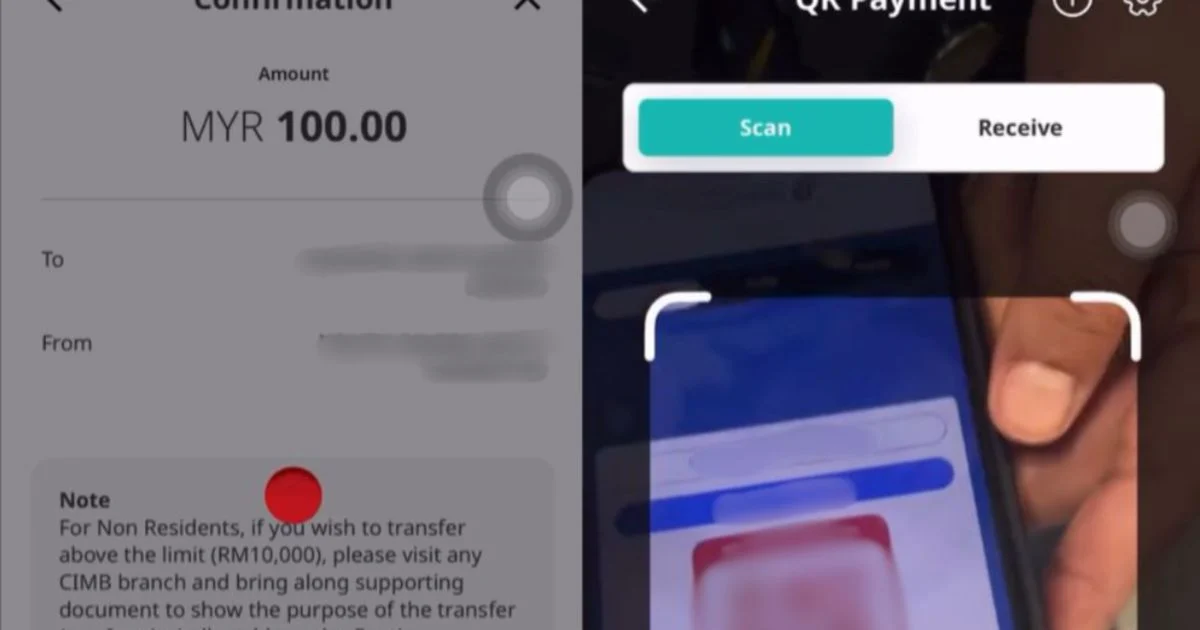
The Malaysian Border Control and Protection Agency (MCBA) has commenced an internal inquiry following allegations that one of its officers stationed at Kuala Lumpur International Airport Terminal 2 accepted a RM100 personal payment transmitted via QR code. The incident, which underscores mounting concerns about operational integrity at Malaysia's principal aviation hub, has prompted the agency to examine the circumstances surrounding the transaction and determine whether established protocols were breached.
QR code payment systems have become ubiquitous across Malaysia's service sector in recent years, offering convenience to both merchants and consumers. However, the alleged use of such technology for personal financial transactions by a uniformed officer raises troubling questions about the application of payment systems in official settings and the potential for misuse. The transaction reportedly occurred at Terminal 2, which processes millions of travellers annually and represents a critical point of entry for Malaysia's tourism and business sectors.
The MCBA's swift response to launch a formal investigation reflects growing pressure on border authorities to maintain public confidence in their operations. As the agency responsible for protecting Malaysia's borders and maintaining port security, any suggestion of improper conduct among its personnel carries significant implications for the agency's reputation and public trust. The investigation will likely examine whether the officer acted within authorised procedures, whether consent was properly obtained, and whether the transaction violated financial accountability standards that bind government employees.
Malaysia has experienced several high-profile cases involving public sector corruption in recent years, contributing to heightened scrutiny of officer conduct across government agencies. The National Anti-Corruption Plan and various enforcement efforts have emphasised transparency and accountability as essential safeguards. In this context, the MCBA's decision to investigate sends an important signal that alleged impropriety will not be overlooked, regardless of the seniority or position of the officer involved.
The incident also highlights vulnerabilities that may exist in how digital payment systems are monitored and regulated within government institutions. While mobile payment platforms offer efficiency, institutions must establish clear guidelines distinguishing between official and personal financial transactions, particularly in environments where officers interact with members of the public. The ease with which QR codes can facilitate person-to-person payments creates potential avenues for circumventing traditional accountability mechanisms, necessitating enhanced oversight protocols.
Terminal 2 processes a substantial portion of KLIA's annual passenger traffic, making the conduct of officers stationed there particularly consequential. Travellers passing through the airport form critical first and final impressions of Malaysia as a destination, and any perception of irregularity or impropriety at border control can influence visitor confidence and satisfaction. The tourism industry, a significant contributor to Malaysia's economy, relies substantially on travellers' positive experiences during entry and departure procedures.
The investigation will likely encompass interviews with the officer in question, examination of any available transaction records, and statements from any individuals who may have witnessed or participated in the alleged exchange. Digital payment platforms typically maintain detailed logs of transactions, which may prove instrumental in establishing a factual record. Simultaneously, the inquiry should assess whether systemic gaps exist that allowed such conduct to occur without immediate detection or intervention.
Officers working at border control positions occupy positions of considerable authority and discretion. The allocation of such responsibility demands correspondingly rigorous standards of personal conduct and ethical performance. Training programmes and institutional culture must reinforce that personal financial transactions conducted through means available to the public are fundamentally incompatible with the official duties entrusted to border security personnel. The investigation affords the MCBA an opportunity to reinforce these principles across its workforce.
The timing of this investigation occurs amid broader discussions in Malaysia regarding digital payment adoption and financial inclusion. As cashless transactions become increasingly normalised, regulatory frameworks must evolve to address misconduct risks in digital environments. Government agencies cannot simply adopt new payment technologies without corresponding adjustments to oversight mechanisms and staff conduct standards. The MCBA's investigation may illuminate best practices for other agencies navigating similar challenges.
Though the incident involves a single alleged transaction of modest financial magnitude, it carries proportionally significant implications for institutional credibility. The manner in which the MCBA handles the investigation—its transparency, thoroughness, and adherence to due process—will shape perceptions of whether the agency genuinely prioritises accountability or merely performs investigations when public attention is directed toward specific cases. Officials managing the inquiry should ensure that findings are communicated clearly to relevant stakeholders, demonstrating that established standards are uniformly enforced.
Border authorities across Southeast Asia increasingly confront challenges posed by digital innovation and payment system evolution. Malaysia's experience with this particular case may offer instructive lessons for regional counterparts seeking to maintain operational integrity whilst adopting modern technologies. The incident underscores that advancing technological capabilities must be accompanied by correspondingly advanced governance frameworks, not simply superimposed onto existing institutional structures without adequate adaptation.
The investigation represents a critical juncture for the MCBA to demonstrate its commitment to internal discipline and public accountability. Whether the allegations are ultimately substantiated or discredited, the agency's handling of the matter will influence public confidence in border operations and government service delivery more broadly. As Malaysia continues its trajectory toward developed nation status, the integrity of institutions responsible for protecting borders and facilitating commerce remains paramount to national interests and international reputation.

