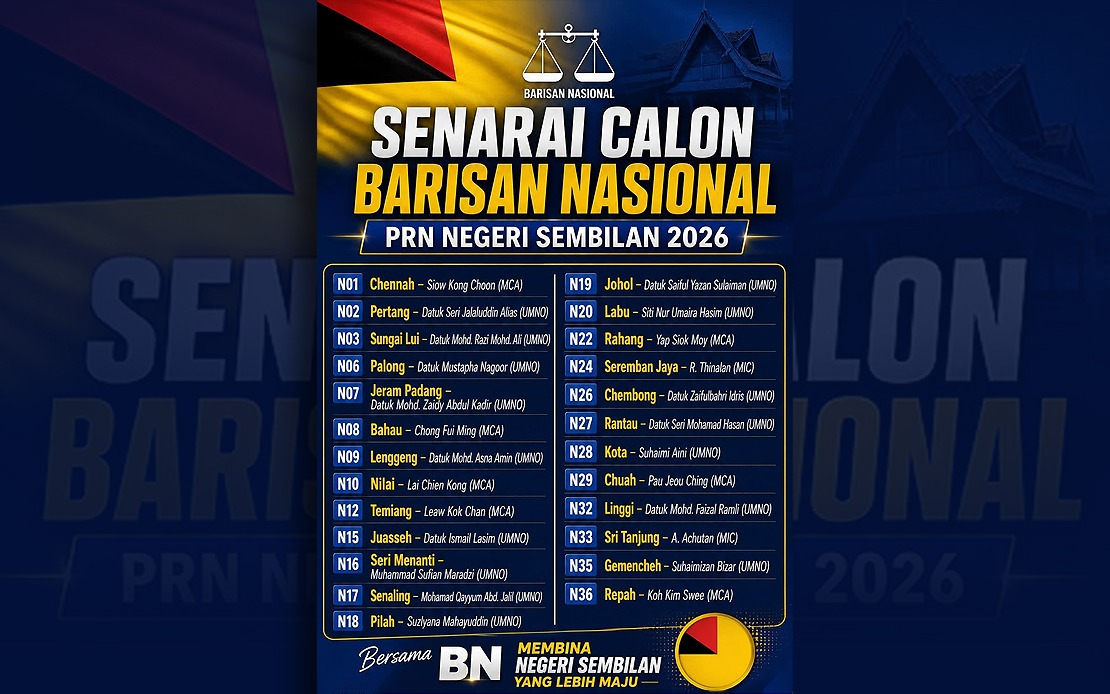
The Barisan Nasional coalition has finalised its seat distribution for the Negeri Sembilan state election, assigning seven State Legislative Assembly seats to the Malaysian Chinese Association and four to the Malaysian Indian Congress, according to BN chairman Datuk Seri Dr Ahmad Zahid Hamidi. The Deputy Prime Minister disclosed the allocation during a campaign meeting with prospective candidates in Seremban on July 15, ahead of the formal announcement of the full candidate list scheduled for later that evening at Stadium Tuanku Abdul Rahman Paroi.
The allocation strategy reflects BN's approach to maximising electoral performance across its diverse membership. Rather than distributing seats purely on historical precedent or party size, the coalition applied a merit-based formula that considered each candidate's viability within their specific constituency. Ahmad Zahid emphasised that this methodology—assessing individual candidates' winning potential—has become standard practice across federal and state electoral contests in Malaysia, ensuring party resources and nomination slots go to those most capable of delivering victories.
The process itself demonstrated the hierarchical nature of candidate selection within BN's formal structure. Ahmad Zahid conducted individual meetings with all prospective candidates seeking the party nomination, requiring each to sign an undertaking and formally pledge allegiance to him as BN chairman. This ceremonial aspect underscores the symbolic importance of party leadership in Malaysian electoral politics, where the chairman's authority over candidate selection remains a critical feature of intra-party dynamics. The personal oaths of loyalty, while procedural, reinforce the traditional top-down governance model that characterises BN's component parties.
The electoral timeline for Negeri Sembilan has been set by the Election Commission with precision typical of Malaysian state polls. July 18 is designated as nomination day, when all candidates must formally register their candidacy. Early voting will occur on July 28, allowing those unable to vote on the main day—including election workers and security personnel—to cast their ballots. The main polling day falls on August 1, giving voters two weeks from nomination to campaign and for parties to mobilise their ground operations. This compressed schedule is standard for Malaysian state elections, which typically run for fourteen to twenty days from nomination to polling.
The context of this seat allocation becomes clearer when examined against the performance in Negeri Sembilan's previous state election in 2018. In that contest, BN secured fourteen seats while the opposition Pakatan Harapan won seventeen seats, and Perikatan Nasional captured five seats. The coalition's loss of the state to Pakatan Harapan represented a significant setback during that election cycle, reflecting broader trends of voter dissatisfaction with BN's governance. The MCA and MIC's combined eleven seats in this election represent BN's continued reliance on these component parties to maintain meaningful representation in state legislatures, despite their diminished electoral influence compared to earlier decades.
The MCA's allocation of seven seats reflects the party's position as the largest non-Malay component party within BN, though its practical influence has contracted considerably. Once a dominant force in Malaysian Chinese politics, the MCA now struggles to compete with DAP in most urban constituencies, though it retains pockets of support particularly among older Chinese voters and in rural areas. The seven seats allocated likely represent constituencies where MCA retains organisational strength or where Chinese voters remain less firmly committed to opposition parties. These seats are strategically valuable for BN not for their individual numerical weight but for their symbolic importance in maintaining multiethnic coalition politics.
The MIC's four-seat allocation reflects similar positioning at the tail end of BN's coalition. The Indian-focused party has experienced significant membership decline and voter defection over the past decade, with many Indian voters shifting toward DAP or PKR. The four constituencies assigned to MIC presumably represent areas with substantial Indian populations where the party maintains grassroots presence or where incumbent relationships provide electoral advantages. Like the MCA, the MIC's inclusion in BN serves partly to maintain the coalition's multiethnic character, even as its numerical contribution to overall seat counts has diminished.
For Malaysian voters concerned with regional political dynamics, the Negeri Sembilan election carries implications beyond the state itself. The state sits centrally within the Klang Valley and Selangor region, forming part of the Darul Khusus administrative nexus. BN's performance here will signal whether the coalition's recent modest electoral recovery at the federal level translates to state-level gains. A strong BN performance could suggest that Prime Minister Anwar Ibrahim and Pakatan Harapan face genuine electoral vulnerability, potentially affecting calculations ahead of the next federal election expected within two to three years.
Conversely, should Pakatan Harapan retain or expand its majority in Negeri Sembilan despite BN's reorganisation, it would indicate that the opposition coalition's 2018 victory has solidified into genuine voter preference rather than temporary protest votes. The state election therefore serves as a genuine barometer of contemporary Malaysian electoral sentiment, particularly regarding how voters weigh factors like economic management, anti-corruption performance, and demographic changes. Southeast Asian observers watching Malaysia's democratic health will pay attention to voter turnout rates and whether this election sees any notable shift in geographical voting patterns.
The formation of candidate slates across BN's component parties also reveals ongoing negotiations within the coalition about resource allocation and constituency clout. While the formal decision about which party contests which seat ultimately rests with the central BN leadership, the actual nomination battles within each party remain intense. MCA and MIC members seeking nominations must navigate internal party politics while ultimately submitting to Ahmad Zahid's final authority. This two-tier selection process—first within parties, then coalition-level approval—creates opportunities for factional conflict and occasionally produces candidates who lack genuine grassroots support, potentially weakening BN's electoral performance in marginal constituencies.
The Negeri Sembilan election will test whether BN's coalition mechanics, refined through multiple federal and state contests over the past four years, can effectively counter Pakatan Harapan's voter consolidation. The allocation of seats to minority component parties reflects a coalition logic that prioritises maintaining the alliance structure over maximising UMNO's seat count, even where UMNO-fielded candidates might perform better in specific constituencies. This strategic choice reveals the continuing importance of multiethnic coalition politics in Malaysian governance, even as critics argue that BN's internal compromises sometimes produce suboptimal electoral outcomes.
The coming campaign will determine whether this allocation proves shrewd or merely manages decline. The August 1 polling date looms as a significant test of whether BN can reclaim Negeri Sembilan or whether Pakatan Harapan will consolidate its control. Given the state's demographic diversity and its proximity to the contested Selangor heartland, the outcome may reverberate through Malaysian politics well beyond the state's boundaries, influencing calculations about the coalition's viability as the country's electoral competition intensifies over the coming years.

