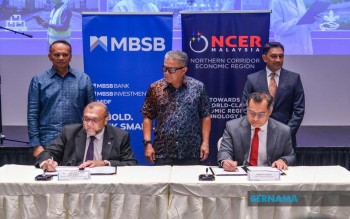
Malaysia's banking and regional development landscape took a significant step forward as MBSB Bank Bhd and the Northern Corridor Implementation Authority formally inked a memorandum of understanding in Petaling Jaya on July 17, establishing a RM1 billion financing facility designed to catalyse small and medium enterprise expansion across the four-state Northern Corridor Economic Region. The partnership represents a targeted effort to channel capital towards businesses positioned to drive economic activity in Perlis, Kedah, Penang and Perak, regions that have increasingly attracted investor attention and demonstrated resilience in competitive markets.
The initiative emerged from recognition that the Northern Corridor, despite its growing track record as one of Malaysia's fastest-expanding economic zones, still faces accessibility challenges for mid-sized enterprises seeking to scale operations. MBSB Bank chairman Datuk Wan Kamaruzaman Wan Ahmad articulated this vision by noting that the financing allocation would equip businesses with resources to expand production capacity, integrate into sophisticated supply chains, and contribute meaningfully to the region's longer-term development trajectory. Such connectivity to larger value chains represents a critical pathway for SMEs that typically lack the capital reserves or balance-sheet strength to independently pursue expansion without external financial backing.
The formal signing ceremony involved MBSB Bank group chief commercial banking officer Noor Mohamed Amin and NCIA chief operating officer Hasri A Hassan executing the agreement, signalling institutional commitment across both organisations. This bilateral approach underscores how Malaysia's regional development strategy increasingly depends on coordination between financial institutions and statutory planning bodies rather than relying solely on government subventions or centralised allocation mechanisms. The structural arrangement allows both parties to leverage distinct operational strengths—MBSB's banking expertise and customer acquisition capabilities combined with NCIA's sectoral intelligence and regional networks.
Critically, the financing facility carries a deliberate export orientation, with MBSB Bank group chief executive officer Rafe Haneef emphasising attraction of high-potential, internationally-focused enterprises. This strategic angle reflects broader Malaysian policy priorities around deepening integration into global value chains and reducing dependency on domestic demand alone for growth. The bank has additionally partnered with Europe-based Santander Group to establish a platform facilitating cross-border expansion, meaning Northern Corridor SMEs accessing this financing can simultaneously gain access to international market development support. Such layered support structures transform a simple credit line into a more comprehensive business acceleration programme.
The Northern Corridor has strategically positioned itself around six pillar sectors, each representing areas where Malaysian competitive advantages remain robust. Electrical and electronics manufacturing continues to anchor regional industrial activity, though advanced manufacturing increasingly captures investor focus as companies seek diversification beyond commodity-dependent production. Agri-food processing and logistics have similarly emerged as priority areas, reflecting both the agricultural heritage of northern states and the geographic proximity to Thailand and other Southeast Asian markets. The newer dimensions—digital economy and green technology—signal the region's evolution toward higher-value, sustainability-aligned activities rather than remaining locked into traditional resource extraction or low-margin assembly operations.
Under Malaysia's 13th Malaysia Plan framework, NCIA chief executive Datuk Mohamad Haris Kader Sultan positioned the financing partnership as essential infrastructure for building an enabling ecosystem capable of attracting sustained foreign and domestic investment. This framing reflects growing acknowledgment that capital availability alone proves insufficient without complementary supports including infrastructure, regulatory clarity, human capital development, and strategic partnership networks. By embedding the financing facility within a broader regional development narrative, policymakers signal that NCER success depends on coordinated action across multiple institutional actors rather than isolated initiatives.
The NCER's emerging reputation rests partly on demonstrated success in capturing investment flows that might otherwise gravitate toward the Klang Valley or southern Johor. The region has successfully attracted major manufacturers in electrical and electronics while carving out meaningful positions in aerospace components, automotive supply chains, and semiconductor-adjacent activities. This diversification reduces vulnerability to sector-specific downturns and creates employment opportunities across skill levels, though upskilling challenges persist in moving workforces from assembly roles toward higher-value engineering and management functions. The RM1 billion financing facility addresses the capital dimension of this aspiration, though complementary workforce development and infrastructure investment remain essential.
For Malaysian SMEs strategically positioned in the Northern Corridor, this financing availability addresses a persistent constraint that has historically channelled promising regional businesses toward relocation to Selangor or other established industrial clusters where debt financing proved more readily accessible. By improving financing availability proximate to businesses' operational locations, the initiative reduces dislocation costs and preserves local economic benefits rather than allowing value creation to migrate southward. Regional officials have long contended that financing gaps rather than entrepreneurial deficiency explain slower SME growth in peripheral regions, making capital-focused interventions particularly relevant.
The partnership's practical mechanics remain partially underdefined in public announcements, particularly regarding application procedures, collateral requirements, interest rate parameters, and tenor structures. Clarity on these operational details will ultimately determine whether the RM1 billion facility achieves sufficient uptake to materially impact regional development. Historical experience with Malaysian financing schemes demonstrates that well-intentioned capital availability frequently underutilises available funds due to documentation complexity, perceived bureaucratic obstacles, or interest rates that exceed what marginal businesses can sustain. Transparent communication about access mechanisms and technical support availability will therefore prove critical for conversion of facility allocation into actual disbursements.
From a regional Southeast Asian perspective, the Northern Corridor's development trajectory carries implications extending beyond Malaysia's borders. As Thailand's industrial base evolves and labor cost pressures mount in Vietnam, the Northern Corridor's proximity to major ASEAN manufacturing hubs and transport corridors to China make it strategically valuable for multinational enterprises seeking diversified production footprints. Financing arrangements that lower capital constraints for suppliers and component manufacturers integrated into cross-border supply chains can accelerate NCER's emergence as a preferred Southeast Asian location, particularly for electronics and advanced manufacturing segments where regional clustering effects matter significantly.
Looking ahead, the success of this MBSB-NCIA partnership will likely influence policy thinking around similar regional development initiatives elsewhere in Malaysia. If the mechanism effectively deploys capital while maintaining prudent credit standards, comparable arrangements might extend to Sabah-Sarawak, the East Coast Economic Region, or other designated growth zones. Conversely, if capital deployment proves sluggish or credit quality deteriorates, policymakers may reconsider reliance on market-based financing mechanisms in favour of more direct government interventions. The Northern Corridor initiative thus carries significance both for immediate participant businesses and for longer-term templates governing Malaysia's regional development financing strategies.

