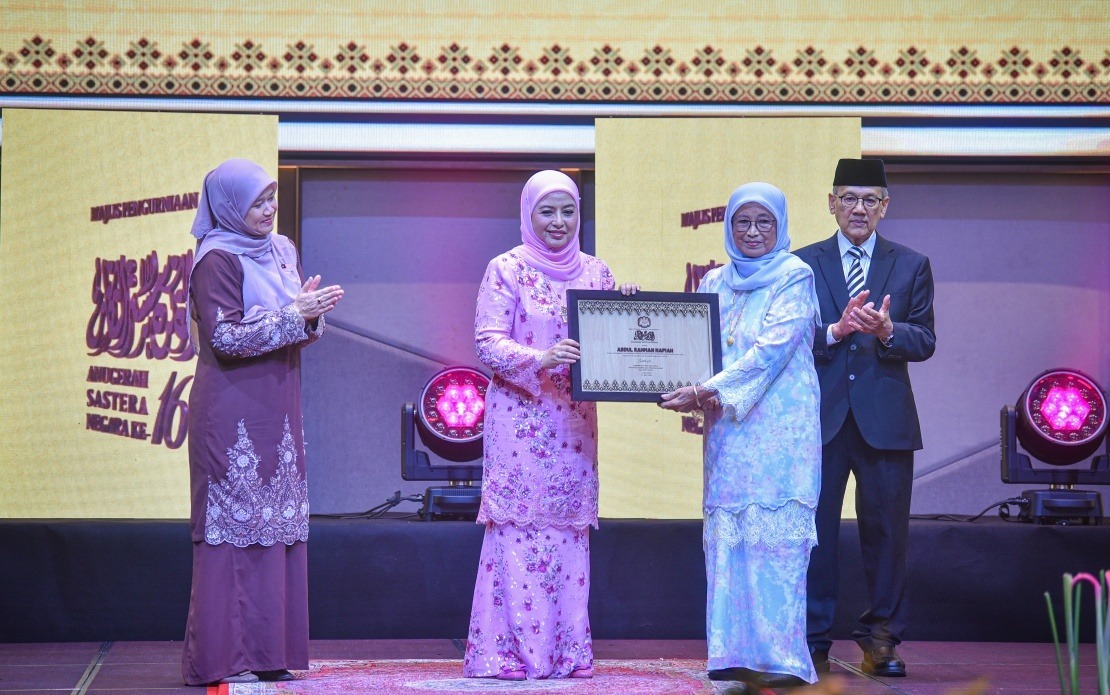
Malaysia has recognised one of its most influential literary figures by conferring the National Laureate honour on Dr Abdul Rahman Napiah, widely known by his pen name Mana Sikana. The award, presented posthumously at a ceremony in Kuala Lumpur, represents the nation's highest accolade for writers whose sustained excellence has shaped the country's literary landscape. Queen Raja Zarith Sofia presented the honour to Mana Sikana's widow, Salmah Ali, acknowledging decades of creative and scholarly work that fundamentally altered how Malaysians approach literature and culture.
Education Minister Fadhlina Sidek, who chaired the selection panel, characterised Mana Sikana's legacy as extending far beyond the creation of individual literary works. Rather than simply producing content for readers, the late writer functioned as an intellectual architect, constructing frameworks through which Malaysian society could better understand itself. His contributions promoted empathy across Malaysia's diverse communities while encouraging deeper examination of human values within a culturally complex nation. The minister emphasised that his influence permeated multiple dimensions of the literary ecosystem, from inspiring creative practitioners to establishing standards for critical discourse.
The scale of Mana Sikana's output underscores his commitment to the craft. Over the course of his career, he produced more than 100 published works, each contributing to a body of scholarship and creativity that demonstrated remarkable range. Rather than remaining confined to a single genre or approach, his prolific output showed willingness to experiment with different forms and ideas, establishing him as a writer unafraid to challenge prevailing orthodoxies. This expansiveness meant that subsequent generations of Malaysian writers encountered someone who had already expanded the technical and conceptual possibilities available to them.
Beyond his role as a creator, Mana Sikana shaped Malaysian literary thought through three interconnected spheres of influence that Fadhlina highlighted. First, he deliberately pushed the boundaries of how Malaysian writers could approach their craft, introducing and refining techniques that expanded creative possibilities. Second, he championed critical and theoretical rigour within Malaysian literature, rejecting the notion that creative work should exist in isolation from serious intellectual analysis. Third, he invested substantially in nurturing emerging talent through institutional channels, using his positions at various universities to mentor researchers, critics and writers who would themselves become influential figures.
Born in Bagan Serai, Perak, on October 9, 1946, Mana Sikana followed an educational trajectory that prepared him for intellectual leadership. He commenced his professional life as a secondary school teacher before transitioning into academia, where he would eventually hold positions at some of Southeast Asia's most prestigious institutions. His tenure at Universiti Kebangsaan Malaysia allowed him to engage with Malaysia's emerging generation of scholars, while appointments at Nanyang Technological University in Singapore and Universiti Pendidikan Sultan Idris demonstrated regional recognition of his expertise. A doctorate from UKM provided him with the credentials and platform to pursue ambitious intellectual projects that transcended national boundaries.
Throughout his career, Mana Sikana accumulated numerous recognitions that documented his standing within Malaysian literary circles. The Malaysian Literary Prize and Malaysian Perdana Literary Prize acknowledged his creative achievements, while the Perak Laureate Award and Darul Ridzuan Lifetime Literary Achievement Award honoured his contributions to Malaysia's intellectual heritage. These honours, accumulated over decades, reflected steady recognition that his work possessed enduring significance. Nevertheless, the National Laureate award represents a qualitatively different form of recognition—one conferred by the Malaysian government itself through the institution of the monarchy, signalling that his influence transcended academic and literary communities to touch the nation's cultural consciousness.
The National Laureate designation carries substantial material accompaniments that extend Mana Sikana's influence beyond his death. Recipients receive a national letter of honour, a cash award of RM60,000, and crucially, a publishing allocation covering up to 50,000 books or RM500,000 in value. This provision proves particularly significant: the Malaysian government commits to purchasing and distributing these books throughout the national education system, placing Mana Sikana's work directly into schools, libraries, and government offices across the country. For a nation still developing comprehensive reading cultures, such distribution mechanisms represent a powerful endorsement and democratisation of access to a laureate's thought.
Mana Sikana's death in May 2025 at the age of eighty from heart complications deprived Malaysian letters of a guiding intellectual force. Had he lived, he would undoubtedly have continued writing, teaching, and intervening in literary debates. Yet his passing also created a moment for national reflection on his accumulated contributions. The National Laureate award functions partly as an assessment of completed work—a summation of what this single writer achieved across five decades of active intellectual engagement. It serves simultaneously as a statement about what Malaysia values in its literary practitioners: not merely popularity or commercial success, but sustained excellence, intellectual rigour, and genuine commitment to expanding the horizons of Malaysian culture.
The award ceremony represents a significant moment for Malaysian literature at a time when the cultural sector faces competing demands for attention and resources. By elevating Mana Sikana to national laureate status, Malaysia signals that literary achievement merits recognition equivalent to other national accomplishments. In a region where popular culture increasingly dominates public discourse, such institutional affirmation of serious literary work carries symbolic weight. The decision also sends a message to younger writers that sustained intellectual engagement and commitment to craft can eventually receive the nation's highest recognition, even if immediate commercial rewards prove limited.
Mana Sikana's recognition as the 16th National Laureate places him within a distinguished lineage of Malaysian writers whose work has defined the nation's literary identity. The numbering itself suggests that this award, established decades earlier, has consistently identified writers whose influence extends across generations and disciplines. By joining this pantheon posthumously, Mana Sikana gains a form of immortality—his name permanently linked with Malaysia's literary greatness. More substantially, his work gains renewed attention and accessibility through the government distribution programme, ensuring that students, teachers, and general readers will encounter his ideas through official channels for years to come.

