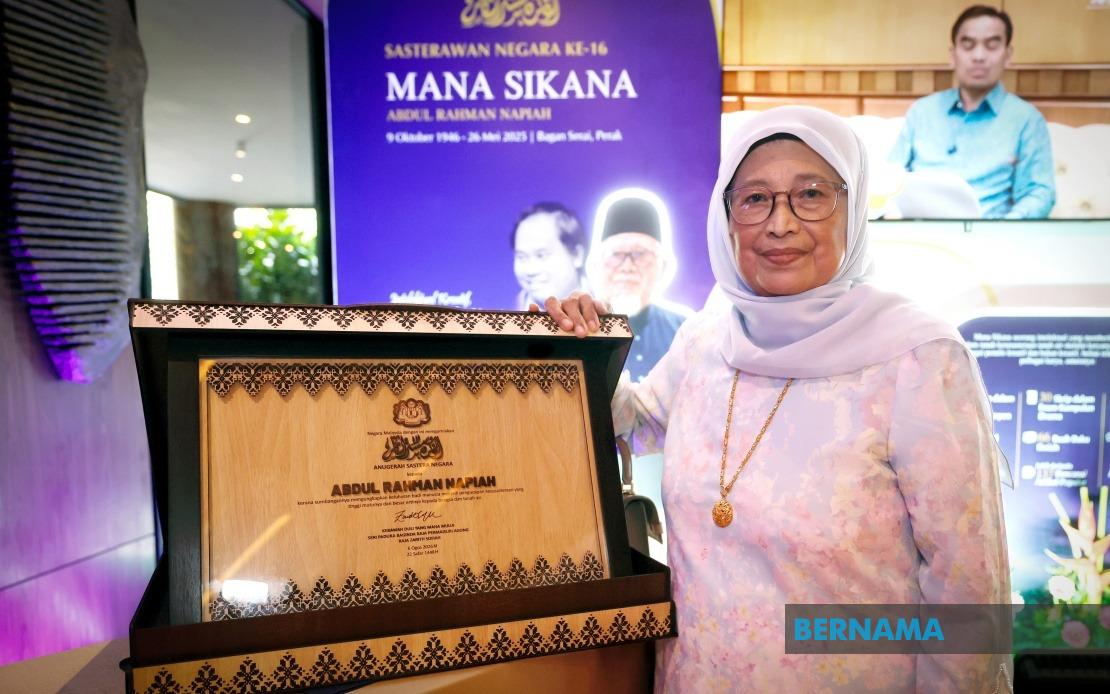
The conferment of Malaysia's 16th National Laureate upon the late Dr Abdul Rahman Napiah, better known by his literary pen name Mana Sikana, represents a long-overdue acknowledgment of his profound impact on the nation's literary culture. His widow, Salmah Ali, accepted the prestigious honour at a ceremony in Kuala Lumpur on behalf of her husband, who passed away last May at the age of 80 from heart complications. The award was presented by Her Majesty Raja Zarith Sofia, Queen of Malaysia, in the presence of Education Minister Fadhlina Sidek, underscoring the significance placed on Mana Sikana's contributions to Malaysian letters.
For Salmah Ali, now 82 years old, the bestowal of this honour carried profound emotional weight. She revealed that her husband had been aware before his death that the award was a possibility, and had spoken of his desire to receive it. Despite her pride in his recognition, she acknowledged the bittersweet nature of the moment—celebrating an achievement without the man who had dedicated his life to realising it. Her recollection painted a picture of a writer whose passion for literature never waned, even as health concerns mounted in his final months. On the very day he fell ill, Mana Sikana had been presenting a working paper to Dewan Bahasa dan Pustaka, the institution responsible for promoting Malay language and literature, before suffering the stomach pain that would lead to his hospitalisation.
Mana Sikana's trajectory through Malaysian academia and letters was marked by consistent achievement and steady advancement. Born in Bagan Serai, Perak, on October 9, 1946, he began his professional life as a schoolteacher before transitioning into higher education. His academic credentials eventually saw him attain the rank of professor, a testament to the rigour with which he approached both creative writing and scholarly analysis. His institutional affiliations spanned some of Malaysia's most prominent universities, including Universiti Kebangsaan Malaysia, as well as regional institutions such as Nanyang Technological University in Singapore and Universiti Pendidikan Sultan Idris.
What distinguished Mana Sikana's career was the breadth of his engagement with literature and the arts beyond the written word. According to his widow, during their years living in Johor Bahru, he actively produced dramatic works for Singaporean radio and television stations, while simultaneously maintaining a teaching position and contributing regularly to Malaysian television. This multimedia approach to storytelling was uncommon among literary figures of his generation, reflecting an adaptability and entrepreneurial spirit that allowed him to reach diverse audiences across borders. His willingness to work across mediums—from traditional literature to broadcast drama—expanded the scope of his influence within Southeast Asia.
Education Minister Fadhlina Sidek's formal remarks at the ceremony contextualised Mana Sikana's selection within the broader framework of national literary development. She emphasised that his recognition as National Laureate reflected his instrumental role in strengthening Malaysian literature through multiple avenues: creative writing, literary theory, critical analysis, and academic discourse. This multifaceted approach to literary work had distinguished him from peers who specialised narrowly in a single dimension of literary practice. His contributions extended beyond Malaysia's borders, evidenced by his service as a visiting lecturer at universities in Indonesia, positioning him as a regional intellectual whose ideas circulated throughout Southeast Asia.
The legacy Mana Sikana left extends into his immediate family, where his intellectual influence remained tangible until his death. Salmah Ali noted that her husband continued to share his knowledge and passion for writing and literature with their four children and twelve grandchildren, embodying a commitment to transmitting literary culture across generations. In a region where oral traditions and family-centred education remain culturally significant, this intergenerational transmission of literary values carries particular importance. His grandchildren represent a cohort who will carry forward their grandfather's emphasis on the power of narrative and the written word.
The timing of this award, coming posthumously, invites reflection on the recognition systems within Malaysian cultural institutions. That Mana Sikana learned of the possibility of receiving this award before his death, yet did not live to formally accept it himself, underscores broader questions about how quickly national honours recognise lifetime achievement. The National Laureate award, as Malaysia's highest literary honour, typically arrives at the culmination of a long career. For Mana Sikana, the recognition came at a moment when he could no longer participate in the ceremonial acknowledgment of his work, a bittersweet irony that his widow's emotional statement at the presentation made palpable.
From a wider Malaysian perspective, Mana Sikana's elevation to National Laureate affirms the government's commitment to honouring literary achievement in the Malay language during an era when English-language publishing dominates global markets. His career spanned decades of shifting linguistic and cultural currents in Malaysia and Southeast Asia, yet he maintained his focus on enriching Malay-language literature and drama. This steadfastness, coupled with his academic rigour and creative prolificacy, merits the distinction he has received. For younger Malaysian writers and academics, his example demonstrates that substantial career achievement and intellectual contribution to national cultural development remain recognised and valued within Malaysian institutions.
The National Laureate distinction carries implications beyond literary circles, signalling to Malaysian society that investment in language, culture, and creative thought represents a priority worthy of the nation's highest honours. Mana Sikana's career illustrated how a single individual, through sustained dedication to craft and scholarship, can shape literary landscapes across multiple countries and media. His widow's acceptance of the award on his behalf represents not only a personal moment of vindication for a family supporting a demanding artistic life, but also a public affirmation that such dedication matters within the Malaysian national narrative.

