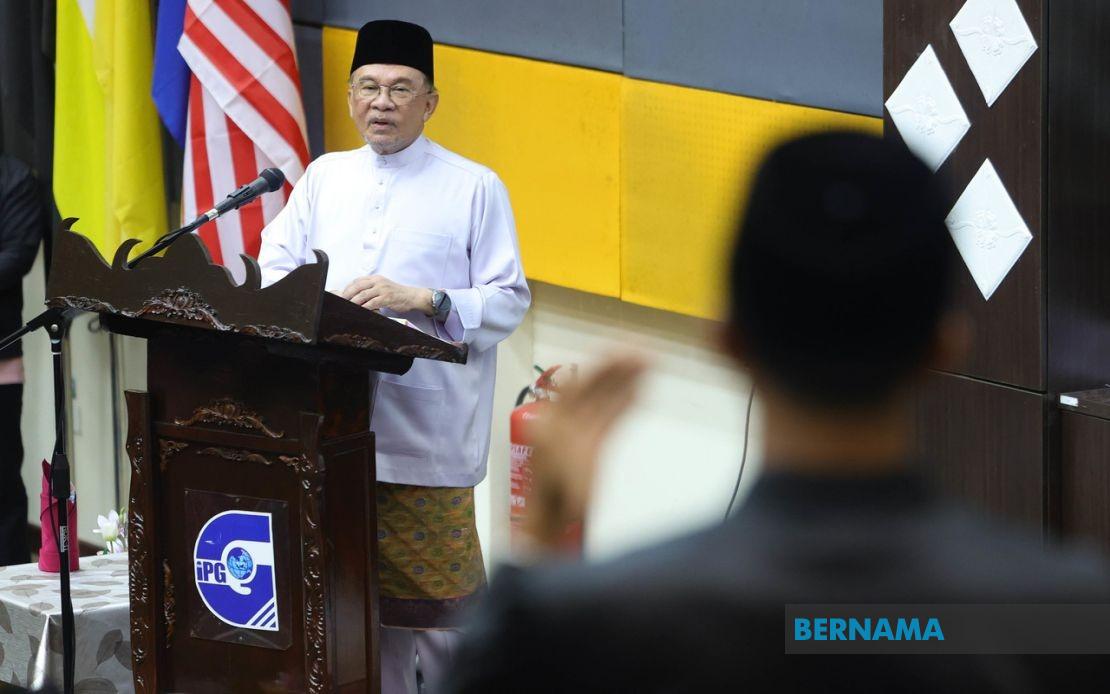
Malaysia's education sector stands at a critical juncture where technological prowess must be married with moral foundation, Prime Minister Datuk Seri Anwar Ibrahim declared in Nilai on July 17. Speaking at an education gathering attended by Education Minister Fadhlina Sidek and IPGKPT director Dr Kartini Abdul Mutalib, the premier underscored that the nation cannot afford to produce educators skilled merely in artificial intelligence and other cutting-edge fields without simultaneously instilling character, ethics, and human values.
The challenge facing Malaysian schools reflects a global tension that policy makers across Southeast Asia grapple with daily. As countries race to integrate emerging technologies into their curricula, educators often find themselves torn between delivering technical competency and nurturing the moral compass that underpins responsible citizenship. Anwar's intervention signals that Malaysia recognises this dual imperative cannot be sacrificed for short-term competitive advantage. The government's position reflects growing concern that purely technocratic approaches to education risk producing graduates with sophisticated capabilities but diminished capacity for ethical reasoning and social responsibility.
The Prime Minister articulated this balance through a memorable formulation: reaching for the skies while maintaining roots on the ground. This phrase encapsulates a vision where mastery of artificial intelligence, robotics, and biotechnology proceeds hand-in-hand with cultivation of religious understanding, cultural pride, moral integrity, and appreciation for human dignity. For Malaysian educators, this means professional development programmes must encompass not only coding and data analytics but also philosophy, ethics, comparative religion, and the study of moral frameworks drawn from Malaysian society's diverse traditions.
Anwar stressed that static curricula and conventional pedagogical methods are insufficient to keep Malaysia competitive in an era of accelerating technological change. Educational systems must possess the agility to respond to emerging fields and evolving job market demands. Yet this dynamism cannot be untethered from foundational values. The implicit warning is that any pursuit of modernity that abandons ethical moorings becomes counterproductive, potentially equipping future generations with tools for harm rather than flourishing.
For Southeast Asia more broadly, Malaysia's positioning carries particular significance. The region competes vigorously for technology investment and skilled talent, with Singapore, Vietnam, and Thailand all expanding STEM education. However, Anwar's formulation suggests Malaysia can differentiate itself not through technological prowess alone but through creating a distinctive educational ecosystem that produces technologically literate individuals grounded in multicultural consciousness and ethical reasoning. This could represent a competitive advantage in sectors requiring both innovation and trustworthiness, from fintech to healthcare technology.
Crucially, the Prime Minister linked educational quality directly to Malaysia's multiracial fabric. He cautioned that schools cannot fulfil their mission if students or teachers are infected with prejudice against other communities. This represents a direct challenge to educational institutions: excellence in mathematics and science means little if parallel deficits emerge in social cohesion and interfaith understanding. Anwar's framing suggests that in Malaysia's context, education is inherently a nation-building enterprise where technical competency and social harmony are mutually reinforcing rather than competing priorities.
The emphasis on tolerance and mutual respect takes on heightened importance given regional tensions and the proliferation of divisive rhetoric across social media platforms. Educational institutions have become critical frontiers where young Malaysians form impressions of communities different from their own. Teachers trained only in STEM subjects without corresponding preparation in managing diverse classrooms and fostering intercultural dialogue become ill-equipped to address prejudice when it emerges. Anwar's call therefore extends professional development requirements beyond subject matter expertise into the realm of cultural competency and conflict resolution.
Historically, Malaysia's education system has attempted to balance these elements through the national curriculum, though implementation has been uneven. Teachers' colleges and training institutions face pressure to produce graduates quickly without always investing sufficiently in the character formation and values development that Anwar identifies as essential. His intervention suggests the government intends to elevate this dimension, potentially through revised teacher training standards, curriculum review, and institutional resources directed toward ethics and values education.
The geopolitical backdrop matters considerably. As major powers compete for influence in Southeast Asia through technology transfer and educational partnerships, Malaysia must ensure that foreign educational models adopted do not inadvertently undermine local values and social cohesion. Teachers trained exclusively in imported frameworks may inadvertently transmit foreign value systems that conflict with Malaysian society's pluralistic character. Anwar's insistence on rooting education in local context while embracing global technologies thus represents a form of cultural self-determination alongside technological ambition.
Implementing this dual mandate will require sustained investment and institutional commitment. Universities responsible for teacher preparation must recruit and retain faculty capable of modelling the integration Anwar describes. Curriculum designers must resist the temptation to treat ethics as an ancillary add-on rather than a central element of teacher formation. Professional development programmes for serving educators must create space and support for ongoing reflection on values alongside technical skill upgrading. Without such systemic reinforcement, the Prime Minister's vision risks remaining aspirational rather than operational.
The statement also carries implicit acknowledgment that rapid technological adoption without corresponding ethical development creates risks for society. Artificial intelligence systems can encode and amplify biases; surveillance technologies can enable authoritarianism; automation can displace workers without adequate social support. Teachers equipped to help students think critically about technology's societal implications become essential safeguards. This shifts teacher preparation from purely technical training toward a model where educators function as thoughtful mediators between technological possibility and human flourishing.
For Malaysian schools, the coming years will reveal whether this articulation of educational purpose translates into concrete policy changes. Curriculum revisions, teacher training reform, resource allocation, and institutional incentives will indicate government commitment. The success of this approach depends not only on what teachers know and can do, but on the institutional and cultural conditions that enable them to model the integration of technological mastery with ethical depth that Anwar envisions.

