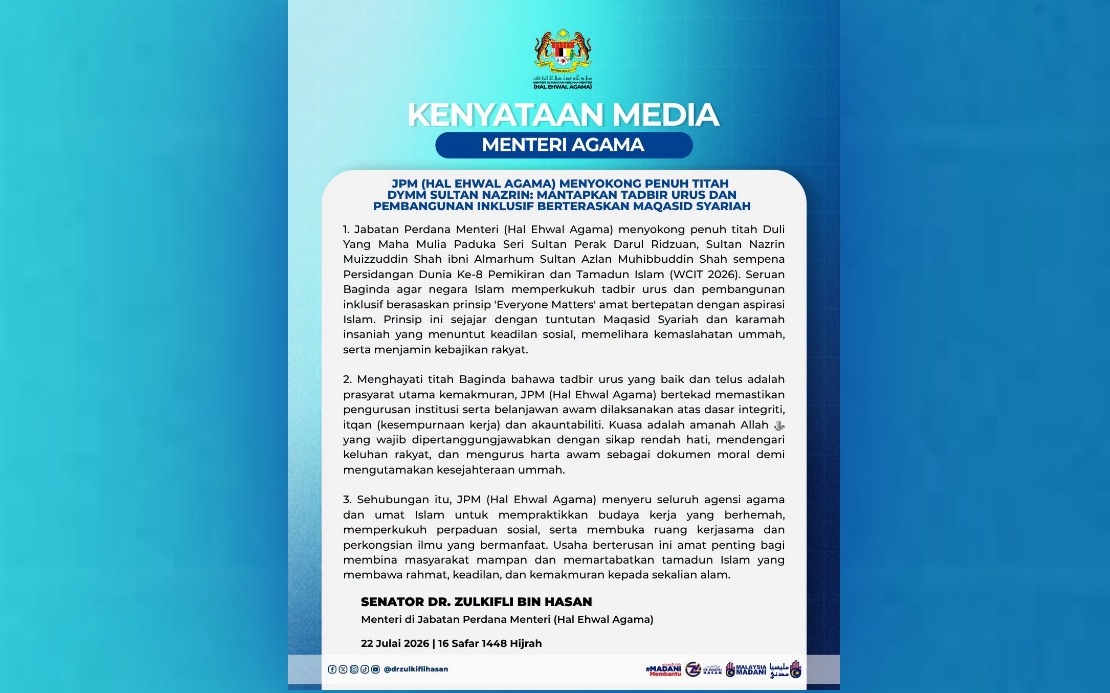
The Prime Minister's Department (Religious Affairs) has committed to anchoring its institutional governance framework on three pillars—integrity, accountability, and public welfare—drawing inspiration from Sultan Nazrin Shah's articulation of an inclusive governance model for the Muslim world. Minister Dr Zulkifli Hasan framed this alignment as fundamental to Malaysia's approach to religious administration, signalling that the monarchy's vision for good governance will directly influence policy direction across religious institutions and public service delivery in the country.
Sultan Nazrin's intervention into governance discourse carries particular weight in Malaysia's constitutional framework, where the ruler's pronouncements on national matters carry moral and institutional authority. Speaking at the 8th World Conference on Islamic Thought and Civilisation, the Perak Sultan articulated a vision where public administration serves all citizens irrespective of ethnicity, faith, or political affiliation—a statement laden with implications for Malaysia's religiously sensitive political context, where tensions between secular governance and Islamic institutional autonomy persist.
Dr Zulkifli positioned the "Everyone Matters" principle not as a secular imposition but as deeply rooted in Islamic jurisprudence, specifically invoking Maqasid Syariah—the higher objectives of Islamic law—as theological grounding for inclusive governance. This framing carries strategic importance: it anchors institutional reform in Islamic legitimacy rather than presenting it as external Western influence, thereby neutralising potential criticism from conservative constituencies who view inclusive governance with suspicion. The invocation of karamah insaniah, or human dignity, further strengthens this theological scaffolding.
The minister emphasised that effective governance requires exercising executive authority as a sacred trust from Allah, demanding humility and responsiveness to citizen grievances. This characterisation represents an implicit critique of top-down administrative approaches, suggesting that Malaysia's religious bureaucracy should shift toward greater responsiveness to public concerns. For a country where citizens frequently lodge complaints about opaque religious enforcement and uneven application of syariah law, this language signifies potential movement toward more transparent institutional practices.
Sultan Nazrin's broader argument situates inclusive governance within economic interdependence and globalisation. He contended that no nation can insulate itself from global currents of trade, investment, knowledge exchange, and technological innovation—realities that shape prosperity regardless of a country's resource endowments. This contextualisation is particularly relevant to Malaysia, a middle-income economy dependent on global capital flows and technological adoption. The sultan's implicit message: institutional rigidity or exclusionary governance models undermine economic competitiveness in an interconnected world.
The commitment to integrity in institutional management and public budgeting addresses systemic concerns about how religious affairs budgets are deployed across Malaysia's federal and state systems. With multiple religious authorities operating simultaneously—federal Islamic Development Department alongside state Islamic offices and various syariah courts—coherent standards for financial accountability and resource allocation remain inconsistent. Dr Zulkifli's invocation of itqan, or excellence in work, suggests efforts to establish performance benchmarks across this fragmented institutional landscape.
Crucially, the minister's call for courteous workplace culture and inter-agency collaboration within religious administration reflects acknowledgment that Malaysia's religious institutions have sometimes been perceived as rigid, difficult to access, or unresponsive to diverse constituencies. For non-Muslim citizens and religious minorities in Malaysia, the health of religious governance institutions matters directly: these bodies exercise coercive power through syariah enforcement, family law, and religious education policy that affects the broader society. Enhanced accountability and public-centredness could theoretically improve institutional behaviour.
The emphasis on social unity and knowledge-sharing among religious agencies speaks to fragmentation within Malaysia's Islamic institutional architecture, where federal and state bodies occasionally operate at cross-purposes, and where different state-level Islamic authorities implement syariah law with varying rigour and interpretation. A unified governance philosophy centred on common welfare principles could, in theory, reduce inconsistencies and arbitrary application of religious regulations across state boundaries—a longstanding source of grievance among Malaysian Muslims themselves.
However, translating principles into institutional reform requires mechanisms for enforcement and accountability. The minister's statement remains programmatic rather than prescriptive, outlining aspirations without specifying structural reforms, performance metrics, or oversight mechanisms that would operationalise these governance commitments. The gap between rhetoric and implementation remains substantial, particularly given Malaysia's historical pattern of governance initiatives announced at high levels that encounter resistance or indifference within bureaucratic structures.
For regional context, Sultan Nazrin's intervention reflects broader trends within Southeast Asian Islamic leadership toward reconciling Islamic governance principles with transparent, accountable administration. This positions Malaysia potentially as a model—or cautionary tale—in how Muslim-majority nations navigate modernisation of religious institutions without sacrificing Islamic authenticity. The prince's framing of "Everyone Matters" as consistent with Maqasid Syariah essentially claims compatibility between Islamic governance and contemporary standards of administrative transparency, directly addressing ideological tensions that have historically hindered reform efforts.
The department's stated commitment carries implications for interfaith relations and minority protections as well. When religious affairs administration embraces inclusive governance centred on public welfare, it theoretically creates space for non-Muslim concerns about how religious regulations affect minority communities. Religious policy affecting halal certification standards, interfaith activities, or religious freedom matters to Malaysia's plural society; governance frameworks emphasising inclusivity and accountability potentially offer improved channels for minority input into decisions affecting their interests.
Moving forward, implementation will determine whether this governance vision generates genuine institutional change or remains aspirational rhetoric. The religious affairs ministry should establish concrete metrics for measuring integrity, accountability, and public responsiveness across its portfolio—mechanisms that would allow citizens to track whether institutional behaviour actually aligns with stated principles. Without such accountability scaffolding, Sultan Nazrin's "Everyone Matters" principle risks becoming simply another governance platitude circulated through official channels while actual institutional practices remain unchanged.

