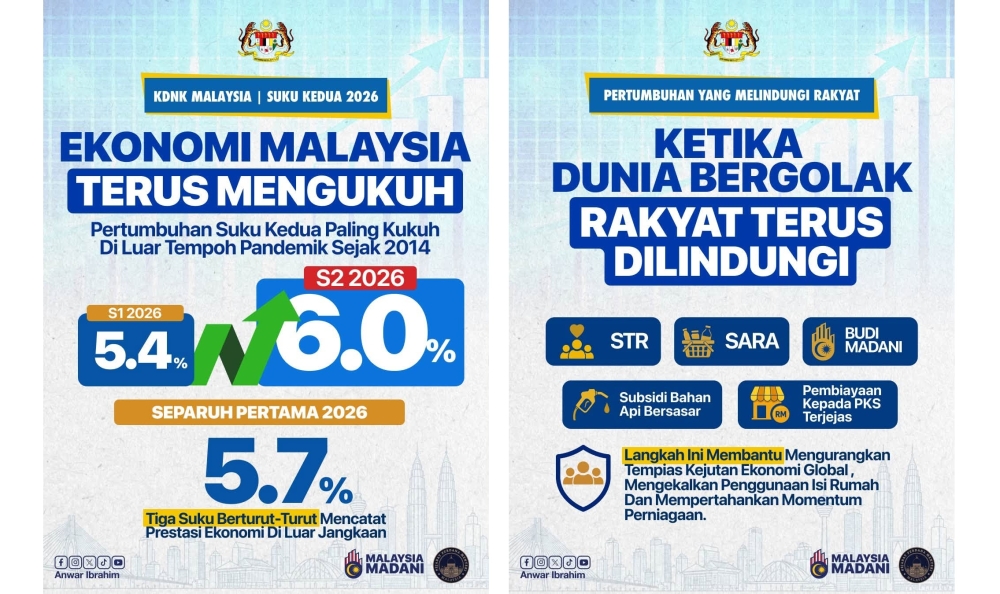
Prime Minister Datuk Seri Anwar Ibrahim expressed satisfaction on Wednesday with Malaysia's economic performance in the second quarter, describing the expansion rate as more robust than initially anticipated by analysts and economists. His comments underscored the government's confidence in the nation's macroeconomic trajectory despite headwinds from the international economic environment. The remarks came as the country continues its recovery from pandemic-related disruptions and seeks to establish sustainable growth momentum heading into the latter half of the year.
The stronger-than-expected expansion reflects the growing resilience of Malaysia's diversified economy, which has benefited from steady manufacturing output, continued resilience in the services sector, and improved domestic consumption. The government's continued focus on infrastructure development and targeted investment in high-growth industries has also provided scaffolding for economic activity. Anwar's characterization of the performance as exceeding projections suggests that domestic demand has proven more durable than external observers had calculated, a positive signal for employment and consumer confidence throughout the nation.
A central element of Anwar's statement centred on the government's protective measures shielding the population from the brunt of global inflation, which has posed significant challenges to households and businesses across Southeast Asia and beyond. Through targeted subsidies, price controls on essential commodities, and welfare assistance programmes, Malaysia has sought to insulate lower and middle-income groups from the worst effects of rising input costs. These interventions reflect a deliberate policy choice to prioritise social stability and purchasing power preservation, even as they impose fiscal demands on the state budget.
The government's inflation management strategy has operated on multiple fronts. Direct support mechanisms—including cash transfers and expanded food assistance—have provided immediate relief to vulnerable households. Simultaneously, efforts to stabilise domestic fuel and utility prices have prevented cascading cost increases throughout the economy. For Malaysian consumers, particularly those in lower-income brackets, these measures have meant that household budgets have remained more predictable and manageable than might otherwise have been the case in a fully unshielded market environment.
For the regional context, Malaysia's performance carries implications for ASEAN economies facing similar inflationary pressures. The Southeast Asian region has grappled with imported inflation stemming from global supply chain disruptions, elevated energy prices, and tighter monetary conditions. Malaysia's combination of economic expansion alongside inflation containment demonstrates that growth and price stability need not be mutually exclusive, offering a potential model for regional policymakers navigating comparable challenges.
The government's success in managing this balancing act also reflects broader structural factors. Malaysia's diversified export base, encompassing semiconductor manufacturing, petrochemicals, and palm oil products, has enabled the economy to capture export demand despite global uncertainty. The services sector, particularly financial services and tourism, continues to show signs of recovery as international travel normalises and regional business activity strengthens. This underlying economic dynamism has created fiscal space for the government to maintain protective measures without triggering runaway inflation.
However, the sustainability of the government's inflation-shielding approach remains a subject of economic debate. Fiscal deficits resulting from subsidies and support programmes must eventually be addressed through revenue enhancement or spending restraint. International observers have previously urged Malaysian authorities to calibrate these interventions more precisely to avoid creating dependency on subsidies or distorting market incentives over the medium to long term. The challenge ahead lies in gradually recalibrating support as global conditions stabilise, without triggering sudden price shocks that could derail consumer confidence and economic momentum.
Anwar's emphasis on government protection of households also reflects political messaging, as the administration seeks to demonstrate its commitment to social welfare and economic security for ordinary Malaysians. With the government pursuing an agenda of inclusive growth and greater wealth redistribution, statements highlighting efforts to shield citizens from external economic shocks serve to reinforce the administration's narrative of people-centric governance. This framing becomes particularly important in an environment where global economic uncertainties persist and households remain sensitive to cost-of-living pressures.
Looking forward, the maintenance of Q2's growth momentum depends on several factors. Sustained global demand for Malaysian exports, particularly semiconductors, will be crucial, as will the continued recovery of domestic consumption and investment spending. Interest rate decisions by Bank Negara Malaysia will influence borrowing costs and investment behaviour. Additionally, geopolitical developments affecting trade routes and energy markets could yet introduce new volatility into Malaysia's economic outlook.
The Prime Minister's statement also comes at a time when regional central banks have been grappling with the difficult task of tightening monetary policy to contain inflation while avoiding excessive damage to growth. Bank Negara's own policy trajectory will be closely watched by markets and investors seeking signals about Malaysia's inflation outlook and financial stability. Should the stronger Q2 expansion prove durable, the central bank may find itself with additional flexibility in its policy stance compared to more severely inflation-challenged neighbours.
Ultimately, Anwar's affirmation of Malaysia's economic trajectory reflects a government keen to project confidence and competence in navigating a complex global environment. The stronger-than-expected Q2 growth provides genuine substance to such claims, though the task of translating near-term expansion into sustained prosperity and rising living standards remains an ongoing challenge. The government's protective measures have purchased stability, but their fiscal cost underscores the importance of maintaining robust economic growth and ensuring that structural reforms continue to enhance productivity and competitiveness across all sectors of the Malaysian economy.

