Malaysia's strategic position along the Strait of Melaka is becoming increasingly valuable as global shipping patterns undergo profound transformation. AmBank (M) Bhd chief economist Firdaos Rosli has outlined how the country's port sector will harness two major structural shifts reshaping international trade: the rerouting of cargo flows away from geopolitically volatile regions and the maritime industry's accelerating transition towards sustainable fuel alternatives.
Geopolitical tensions in West Asia have fundamentally altered shipping patterns over the past two years, with companies deliberately routing containers through the Strait of Melaka to avoid conflict zones and security risks. This strategic recalibration has positioned Malaysia as a safer alternative for transshipment operations, reinforcing its competitive advantage as a neutral hub for global commerce. The country's geography, combined with world-class port facilities and established logistics infrastructure, has made Malaysian ports the natural choice for international operators seeking stability during periods of regional uncertainty.
Performance data underscores this opportunity. Port Klang and Port Tanjung Pelepas (PTP) collectively handled 29.17 million twenty-foot equivalent units (TEUs) in 2025, demonstrating the substantial scale of operations. More significantly, both facilities have maintained growth momentum into 2026, with Port Klang increasing container volumes by five per cent year-on-year during the first five months and PTP achieving eight per cent growth over the same period. These figures reveal that the transhipment surge is not merely a temporary spike driven by short-term disruptions but reflects deeper, structural realignment in how multinational corporations organise their supply chains.
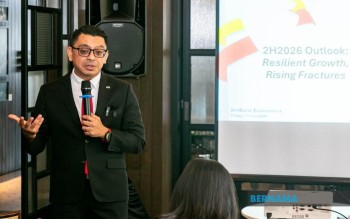
Firdaos emphasised during AmBank's media briefing that sustaining this competitive edge requires continuous strategic investment. Port operators cannot simply rely on passive advantages created by global instability; instead, they must proactively expand capacity and modernise infrastructure to handle growing container volumes and accommodate larger, more efficient vessels. This necessity for ongoing capital expenditure has implications for both port operators and Malaysian policymakers, as underinvestment could quickly erode the country's market share to rival hubs like Singapore or regional competitors elsewhere in Southeast Asia.
Beyond traditional transhipment economics, Malaysia is simultaneously establishing itself as a regional hub for the maritime industry's environmental transformation. The International Maritime Organization's push to decarbonise shipping has created significant opportunities for ports willing to invest in green bunkering facilities. AmBank's analysis highlights that Malaysia is actively adopting alternative marine fuels, particularly liquefied natural gas (LNG) and methanol, positioning the country ahead of many regional competitors in this critical transition.
The government's Green Bunkering Regulatory Roadmap establishes an ambitious target: low-carbon fuels should comprise 40 per cent of maritime fuel consumption by 2050. PTP has already begun commercial LNG and methanol bunkering operations, demonstrating that Malaysia's infrastructure and regulatory framework can support this shift at scale. As shipping companies face mounting pressure from international environmental standards and corporate sustainability commitments, the availability of alternative fuel supplies becomes a competitive necessity rather than a luxury. Ports offering these capabilities will attract disproportionate business from environmentally conscious operators.
However, the sector faces a challenging operating environment characterised by persistently elevated shipping costs. The Baltic Exchange Index, a key indicator of freight rate movements, surged more than 120 per cent year-on-year in both February and May 2026, and remained elevated at 64.6 per cent in June. These figures are particularly noteworthy because freight rates typically decline sharply once temporary disruptions resolve. The sustained elevation suggests ongoing structural supply constraints in global shipping rather than temporary price spikes.
The resilience of high freight rates despite reduced direct conflict-related disruptions reveals something important about the current maritime market: transportation costs have become detached from immediate geopolitical events. While shipping lines may no longer experience direct piracy risks or security incidents in West Asian waters, supply-side pressures—including vessel shortages, port congestion, and crew availability challenges—continue supporting elevated rates. This environment, though challenging for shippers, benefits port operators through increased volumes and potentially higher service revenues.
For Malaysia, these dynamics create both opportunities and complexities. The port sector benefits from higher volumes driven by supply chain diversification, but operators and users must navigate elevated operational costs. Malaysian exporters and importers experience these higher freight charges, which can compress profit margins particularly for price-sensitive sectors like electronics and agricultural products. The long-term benefits of supply chain diversification must be weighed against the near-term burden of inflated logistics costs on Malaysian businesses.
The convergence of trade rerouting and environmental transition offers Malaysia a distinctive opportunity to consolidate its position as Southeast Asia's premier maritime hub. Few regional competitors combine equivalent geographic advantages with the infrastructure, regulatory sophistication, and government commitment to green shipping development. However, realising this potential requires decisive action: sustained investment in port capacity, adoption of cutting-edge efficiency technologies, and regulatory frameworks that attract environmentally progressive shipping companies.
Looking ahead, Malaysia's port sector trajectory depends substantially on how quickly and comprehensively operators respond to these structural shifts. The transhipment boom created by geopolitical factors may eventually subside if regional tensions diminish, yet the environmental transformation of maritime shipping represents a multi-decade structural shift unlikely to reverse. Ports that successfully position themselves as leading providers of alternative fuel bunkering will retain competitive advantages even if geopolitical conditions normalise. This suggests that Malaysia's greatest long-term prize lies not merely in temporary transhipment expansion, but in establishing itself as the region's definitive green shipping hub.

